Home Author
Author

Treviews

Best Gaming Keyboard

by Treviews

Finding a reliable gaming keyboard that balances tactile feedback, programmable keys, and RGB lighting while withstanding intense gaming sessions proves challenging among countless models making bold performance claims. This comprehensive guide showcases top-rated gaming keyboards featuring mechanical switches, anti-ghosting technology, and spill-resistant construction that handles everything from competitive esports to extended work sessions. Tired of mushy membrane keys missing inputs during crucial moments, cramped layouts causing hand fatigue, or keyboards failing after months of use? These expert recommendations feature only the finest gaming keyboards combining premium switch technology with ergonomic designs and robust build quality that ensures years of reliable performance. Ready to elevate gaming performance through lightning-fast response times and programmable macros that streamline complex actions? These exceptional keyboards blend advanced switch engineering with practical features that transform typing and gaming from frustrating compromises into satisfying, precise experiences.

5. Tecknet TK-KB002

Ergonomic design with enhanced typing experience improves comfort and productivity through thoughtful engineering. The computer keyboard features an ergonomic 7-degree input angle and scientifically designed stepped key layout that promotes natural hand positioning during extended use. Integrated wrist rests maintain comfortable hand position throughout long typing sessions, significantly reducing hand fatigue that develops from prolonged keyboard use without proper support. Construction utilizing durable ABS plastic keycaps paired with a robust metal base creates a keyboard offering superior tactile feedback and exceptional long-lasting durability. The metal foundation provides stability preventing the keyboard from sliding or flexing during intense gaming sessions requiring rapid key presses, while the quality keycap construction ensures legends remain visible and tactile feel persists through years of regular use.

Fifteen-zone rainbow backlit illumination allows extensive customization through seven illumination modes and four brightness levels. Even in low-light conditions, users can easily identify keys for enhanced typing accuracy and efficiency during late-night gaming sessions or working in dimly-lit environments. The ability to choose from 15 RGB color modes enables setting the perfect ambiance matching gaming setups or personal preferences. Power-saving features activate after five minutes of inactivity—the keyboard turns off the backlight and enters sleep mode conserving energy. Pressing any key or the Fn+PgDn combination instantly wakes the buttons and backlight, resuming normal operation without delay.

Whisper-quiet gaming switches provide near-silent operation ideal for office environments and gaming setups where noise discipline matters. The classic volcano switch structure ensures durability with an impressive lifespan rated for 50 million keystrokes, providing confidence the keyboard withstands years of intensive use without switch failure. IP32 spill resistance protects against common accidents through four drainage holes strategically positioned in the wrist rest area. These drainage channels prevent liquid damage keeping games and work uninterrupted when inevitable spills occur. The removable key cover simplifies cleaning, allowing easy maintenance when dust accumulation or spills require thorough cleaning beyond surface wiping.

Twenty-five anti-ghost keys with 12 multimedia keys deliver swift and precise responses during gaming. The RGB gaming keyboard’s anti-ghosting technology allows 25 keys to function simultaneously without input conflicts that would otherwise cause missed commands during complex key combinations. Direct multimedia key control for play, pause, and skip functions eliminates the need to minimize games or applications for basic media control, creating seamless gaming experiences where audio adjustments never interrupt gameplay.

4. Corsair K70

The legendary K70 RGB PRO continues the award-winning K70 RGB heritage by retaining iconic elements that made the original famous. The durable aluminum frame provides exceptional build quality and stability that prevents flex or movement during intense gaming sessions. Genuine Cherry MX mechanical keyswitches deliver the premium tactile experience and reliability that enthusiasts demand, while per-key RGB backlighting enables unlimited customization creating stunning visual effects and practical key identification in dark environments. This combination of premium materials and advanced features establishes the K70 RGB PRO as a flagship gaming keyboard worthy of the K70 legacy.

Powered by Corsair AXON Hyper-Processing Technology, the keyboard achieves unprecedented performance levels. This advanced processing architecture handles and transmits inputs up to eight times faster than conventional gaming keyboards, creating tangible advantages during competitive gaming where milliseconds separate victory from defeat. The enhanced processing speed ensures every keypress registers instantly without the input lag that plagues lesser keyboards, maintaining perfect synchronization between player intentions and on-screen actions.

One hundred percent Cherry MX RGB Red mechanical keyswitches provide linear travel with silky smooth keypresses ideal for performance gamers requiring consistent, predictable actuation. These premium switches operate without tactile bumps or audible clicks, enabling rapid key presses without the resistance that can slow input speed. Cherry MX switches carry a 100 million keystroke guarantee, ensuring the keyboard maintains consistent performance through years of intensive gaming and typing. The linear characteristic makes these switches particularly suitable for gaming applications where double-tapping and rapid repeated inputs occur frequently.

Polycarbonate keycaps with standard bottom row layout combine durability with customization flexibility. The durable polycarbonate plastic construction resists wear and maintains legends visibility through extended use. The standard bottom row layout supports custom keycap sets, allowing enthusiasts to personalize keyboard aesthetics without compatibility concerns that proprietary layouts create. Tournament switch functionality helps players focus during crucial competitive matches by automatically locking to distraction-free static backlighting and disabling accidental macro activations. This mode eliminates the visual distractions and potential mishaps that could compromise performance during high-stakes competition where maintaining absolute focus proves essential.

3. Redragon K671

Brilliant color illumination with 11 unique backlights allows choosing the perfect ambiance for any mood or environment. Users can adjust light speed and brightness among five levels creating comfortable environments suitable for both daylight and nighttime use. Double injection ABS keycaps ensure clear backlight shine-through and precise typing feel that persists through extended use. From late-night tasks requiring subtle illumination to immersive gaming sessions demanding vibrant visual effects, this mechanical keyboard enhances every experience through customizable lighting that adapts to specific activities and personal preferences.

Comprehensive macro editing support through the K671 Mechanical Gaming Keyboard enables remapping key functions, setting custom shortcuts, or combining multiple key functions into single keystrokes for more efficient work and gaming workflows. This programmability allows creating complex command sequences executed with single key presses, dramatically streamlining repetitive tasks in games or productivity applications. LED backlit effects receive adjustment through dedicated software, allowing fine-tuning lighting patterns to match preferences—though users should note color customization remains limited while effect patterns and brightness receive full control.

Hot-swappable linear red switches featured on the K671 gaming keyboard require less actuation force compared to other switch types, creating smoother and easier key presses. This characteristic makes red switches particularly well-suited for RPGs, MMOs, and similar games where rapid repeated inputs and prolonged key holds occur frequently. The hot-swappable design allows replacing individual switches without soldering or specialized tools—users receive four spare switches and two red keycaps for exchanging faulty switches when they stop functioning properly. This user-serviceable approach extends keyboard lifespan by enabling repairs rather than requiring complete replacement when individual switches fail.

Full-key anti-ghosting technology ensures all keys work simultaneously without input conflicts. This comprehensive anti-ghosting easily handles any key combination without conflicting inputs that would cause missed commands during complex maneuvers requiring numerous simultaneous key presses. Twelve multimedia key shortcuts provide quick access to calculator, media controls, volume adjustment, and email functions. These dedicated shortcuts eliminate the need for function key combinations or minimizing applications to access basic system functions, maintaining workflow efficiency whether gaming, working, or consuming media content.

2. SteelSeries 64831

Compact tenkeyless design represents the most popular form factor among professional gamers, offering significant advantages for competitive play. Eliminating the numeric keypad creates space for positioning the keyboard comfortably while maximizing mouse movement area—critical for low-sensitivity gaming requiring large mouse movements. This form factor allows positioning gaming peripherals for optimal ergonomics and performance rather than accepting compromises that full-size keyboards impose through their extended width consuming valuable desk space.

Whisper-quiet gaming switches with anti-ghosting technology deliver keystroke accuracy through switches manufactured from durable low-friction material. The near-silent operation makes this keyboard suitable for shared living spaces, office environments, or late-night gaming sessions where mechanical keyboard noise would disturb others. Despite the quiet operation, switches maintain gaming-grade performance with guaranteed durability exceeding 20 million keypresses. This substantial lifespan rating ensures the keyboard remains fully functional through years of intensive gaming and typing without switch degradation affecting performance or consistency.

IP32 water and dust resistant design provides extra durability protecting against common hazards that damage standard keyboards. This protection prevents liquid damage from spills and guards against dust particle infiltration that could interfere with switch operation or cause premature failures. The IP32 rating ensures users can continue playing regardless of minor accidents that would otherwise sideline keyboards lacking environmental protection, making this keyboard particularly suitable for environments where eating, drinking, or dusty conditions pose constant threats to electronics.

PrismSync RGB illumination allows choosing from millions of colors and effects creating stunning visual displays. Reactive lighting responds to keypresses with dynamic effects, while interactive lightshows bring RGB illumination to the next level through synchronized patterns across multiple devices. Dedicated multimedia controls including a clickable volume roller and media keys allow adjusting brightness, rewinding, skipping, or pausing content at the touch of a button without interrupting games or applications. These physical controls provide more immediate and satisfying interaction compared to software-based alternatives requiring mouse navigation or keyboard shortcuts.

1. Corsair K55 RGB Pro

Dynamic RGB backlighting illuminates desktops with six onboard lighting effects providing instant visual customization without software. Users can assign specific colors to each lighting zone or program custom vibrant lighting effects across five RGB lighting zones through the powerful Corsair iCUE software. This comprehensive lighting control enables matching keyboard illumination to room ambiance, coordinating with other RGB peripherals, or creating functional lighting schemes that highlight important key groups through color coding. The flexibility ranges from subtle single-color elegance to explosive rainbow wave effects matching any aesthetic preference or practical requirement.

Six dedicated macro keys activate complex functions, custom shortcuts, or entire keystroke sequences in single button presses. Easy setup through Corsair iCUE software allows programming macros for gaming applications, productivity workflows, or any repetitive task benefiting from automation. Elgato Stream Deck software integration enables instant streaming commands perfect for content creators managing complex broadcasting setups requiring numerous scene changes, audio adjustments, or other stream management tasks. This dual software compatibility makes the keyboard valuable for both gaming enthusiasts and streaming professionals requiring programmable controls.

Dust and spill-resistant design with IP42 rating guards against common accidents ensuring gameplay never requires stopping for keyboard damage. This protection handles typical office and gaming environment hazards including drink spills, food crumbs, and dust accumulation that would compromise unprotected keyboards. The peace of mind from knowing minor accidents won’t destroy the keyboard encourages more relaxed enjoyment without constant vigilance against potential disasters.

Detachable palm rest constructed from soft rubber reduces stress on hands during extended use, enabling comfortable play for longer periods without developing the wrist strain that unsupported typing positions create. The textured surface prevents hands from slipping during intense gaming moments requiring precise control and sustained hand positions. Dedicated volume and media keys provide convenient control for media playback and volume adjustments on-the-fly without interrupting games. These physical controls offer more immediate response than software alternatives while maintaining focus on gameplay rather than forcing attention to volume sliders or media player windows.

The Ultimate Guide to Gaming Keyboards: Precision, Performance, and Personalization

Gaming keyboards elevate competitive performance and typing comfort through mechanical switches, anti-ghosting technology, and programmable features that standard keyboards simply cannot match. Unlike basic keyboards designed merely for typing, gaming keyboards optimize every aspect for performance—ultra-fast response times eliminating input lag, N-key rollover ensuring complex key combinations register perfectly, customizable RGB lighting creating both aesthetic appeal and functional key identification, and programmable macros streamlining complex action sequences into single keystrokes. Professional esports players depend on these specialized keyboards where millisecond advantages and perfect input reliability separate champions from competitors, while enthusiasts appreciate the satisfying tactile feedback and customization options that make every gaming session and work task more enjoyable. Understanding switch types, form factors, build quality, and feature sets helps navigate the vast gaming keyboard market finding models that match specific gaming genres, typing preferences, and budget constraints that range from affordable entry-level options to premium flagship models costing several hundred dollars.

Understanding Mechanical vs Membrane Keyboards

The fundamental choice between mechanical and membrane technologies profoundly affects typing feel, durability, and performance characteristics that determine overall keyboard satisfaction.

Mechanical Switch Advantages

Mechanical keyboards employ individual mechanical switches beneath each keycap, creating distinct tactile feedback and audible clicks (depending on switch type) that many users find more satisfying than membrane alternatives. Each keypress activates a physical mechanical mechanism registering input at specific actuation points—typically 2mm travel distance—enabling faster typing by not requiring bottoming out keys completely. This precise actuation point becomes muscle memory, allowing experienced users to type rapidly with consistent accuracy. Mechanical switches typically last 50-100 million keypresses compared to membrane keyboards degrading after 5-10 million, making mechanical options superior long-term investments despite higher initial costs. The replaceable nature of mechanical switches (especially in hot-swappable keyboards) extends usable lifespan indefinitely through switch replacement rather than complete keyboard replacement when failures occur.

Membrane Technology Benefits

Membrane keyboards use rubber dome switches beneath keys, pressing against circuit boards completing electrical connections registering keypresses. This simpler technology costs substantially less than mechanical alternatives, making membrane keyboards attractive for budget-conscious buyers. Modern gaming membrane keyboards feature improved dome designs and enhanced circuitry minimizing the mushy feel traditionally associated with membrane technology. Whisper-quiet operation makes membrane keyboards suitable for noise-sensitive environments including offices or shared living spaces where mechanical keyboard noise would prove disruptive. The sealed construction inherent in membrane designs often provides superior water resistance compared to mechanical keyboards where individual switch housings create more potential ingress points for liquid damage.

Hybrid Approaches

Some keyboards blend mechanical and membrane technologies—mechanical switches for primary gaming keys (WASD, commonly-used game controls) with membrane construction for less-critical keys. This hybrid approach attempts balancing mechanical advantages where they matter most against membrane cost savings and quiet operation elsewhere. However, the inconsistent feel between different keyboard sections often frustrates users who prefer uniform typing experience. Understanding whether uniform switch experience or cost optimization matters more helps determine if hybrid designs offer valuable compromises or create more problems than they solve.

Critical Switch Types and Characteristics

Mechanical switch selection dramatically affects typing feel, noise levels, and gaming suitability for different genres and personal preferences.

Linear Switches

Linear switches including Cherry MX Red, Black, and various manufacturer alternatives feature smooth, consistent travel from rest position to actuation without tactile bumps or audible clicks. This characteristic enables rapid repeated keypresses without the resistance that tactile switches introduce, making linear switches popular among FPS gamers requiring fast double-taps and sustained key holds. The smooth action also suits general typing for users preferring quiet, uninterrupted keystrokes. However, the lack of tactile feedback makes determining actuation point more difficult for some users who accidentally trigger keys through resting finger pressure.

Tactile Switches

Tactile switches like Cherry MX Brown provide noticeable bumps at actuation points, creating physical feedback confirming keypress registration without requiring complete travel to keyboard base. This tactile bump helps typists develop accurate, efficient keystroke patterns by physically indicating when inputs register. The moderate actuation force and clear feedback make tactile switches excellent all-around choices suitable for both gaming and typing. The subtle tactile bump produces less noise than clicky switches while providing more feedback than linear alternatives, creating popular middle-ground options for mixed-use keyboards.

Clicky Switches

Clicky switches including Cherry MX Blue create distinctive audible clicks and tactile bumps at actuation points, providing both physical and auditory confirmation of keypresses. Enthusiasts often consider clicky switches the most satisfying mechanical switch type through their pronounced feedback and classic typewriter-like sound. However, the loud clicking proves disruptive in shared spaces, making clicky switches unsuitable for offices or households where keyboard noise would annoy others. The pronounced feedback benefits touch typists who appreciate auditory confirmation but may distract gamers preferring to focus on game audio rather than keyboard sounds.

Essential Gaming Keyboard Features

Beyond basic switch selection, numerous features separate basic mechanical keyboards from comprehensive gaming peripherals optimized for competitive performance.

N-Key Rollover and Anti-Ghosting

N-key rollover (NKRO) ensures keyboards register every keypress regardless of how many keys are pressed simultaneously. This proves critical during intense gaming requiring complex key combinations—MOBA players simultaneously pressing ability keys, movement commands, and modifiers need assurance that all inputs register without conflicts. Anti-ghosting technology prevents phantom keypresses that occur when certain key combinations cause unintended inputs registering. Quality gaming keyboards feature full NKRO and comprehensive anti-ghosting ensuring perfect input accuracy during even the most demanding key combinations that competitive gaming requires.

Programmable Keys and Macro Support

Dedicated macro keys allow programming complex command sequences activated through single keypresses, dramatically streamlining repetitive actions in games and productivity applications. MMO players particularly benefit from macros combining multiple ability activations, while productivity users create shortcuts for complex software functions. The number of dedicated macro keys ranges from none on minimalist keyboards to 18+ on macro-heavy models. Beyond dedicated keys, many keyboards allow reprogramming any key with macros or custom functions through companion software. Understanding typical macro usage helps determine whether dedicated macro keys justify the added keyboard width or whether software-based programming of standard keys suffices.

Onboard Memory and Software Profiles

Onboard memory stores lighting configurations, macro programming, and custom settings directly in keyboard firmware, enabling full functionality without installing software on every computer used. This proves particularly valuable for LAN gaming, using multiple computers, or situations where installing software proves impractical. Software profiles allow creating different configurations for specific games or applications, automatically switching settings when launching programs. Understanding whether portability or advanced customization matters more helps determine whether onboard memory or sophisticated software control provides greater practical value.

Form Factor Considerations

Keyboard size significantly affects desk space usage, portability, and feature availability, making form factor selection important beyond merely aesthetic preferences.

Full-Size Layouts

Full-size keyboards include number pads, function rows, and complete navigation clusters, providing every key standard desktop users expect. This comprehensive layout proves ideal for users requiring numeric keypad input for spreadsheets, accounting, or games using numpad controls. However, the 17-18 inch width consumes substantial desk space, potentially forcing suboptimal mouse positioning or uncomfortable reaching. Understanding whether numpad functionality justifies the space consumption helps determine if full-size layouts suit specific usage or whether more compact alternatives provide better overall ergonomics.

Tenkeyless (TKL) Designs

Tenkeyless keyboards eliminate numpads, reducing width to approximately 14 inches while retaining function rows and navigation clusters. This compact form factor represents the most popular layout among competitive gamers who prioritize mouse movement space over numeric keypad functionality. The reduced width enables better peripheral positioning, creating more comfortable, natural postures reducing arm strain during extended gaming sessions. TKL keyboards maintain sufficient keys for nearly all gaming and general computing tasks, making numpad elimination acceptable for most users who rarely use dedicated numeric input.

Compact and 60% Layouts

Ultra-compact 60% keyboards eliminate function rows, navigation clusters, and numpads, retaining only alphanumeric keys and minimal modifiers. These minimalist designs appeal to users prioritizing portability, desk space conservation, or aesthetic minimalism. However, accessing missing keys requires function layer combinations—pressing Fn+number keys for F-keys, Fn+WASD for arrows—creating learning curves and potential inconvenience. Understanding whether minimal footprint justifies losing direct key access helps determine if compact layouts suit specific needs or create more frustration than space savings justify.

Build Quality and Durability Factors

Construction materials and engineering quality determine keyboard longevity, typing feel, and resistance to daily wear that separates premium keyboards from budget alternatives.

Frame Materials

Aluminum frames provide exceptional rigidity preventing flex during intense gaming while offering premium aesthetics and heat dissipation. The solid feel and substantial weight of metal construction creates impressions of quality and durability that justify premium pricing. Plastic frames reduce cost and weight though potentially flexing during hard keypresses or feeling less substantial. Understanding whether rigid, premium feel justifies higher costs or whether functional plastic construction suffices helps balance budget against desired build quality.

Keycap Materials and Construction

ABS plastic keycaps represent the most common and economical option, providing smooth surfaces and good legend printing. However, ABS develops shine from finger oils over months of use, creating glossy areas that some users find aesthetically unpleasant. PBT plastic keycaps resist shine development, maintain texture through extended use, and often feature superior durability. Double-shot molded keycaps create legends through two-layer plastic injection, making legends essentially permanent compared to printed legends that wear away. Understanding aesthetic priorities and expected keyboard lifespan helps determine whether premium keycap materials justify cost increases.

Cable Quality and Connection

Detachable cables simplify keyboard transport and enable replacing damaged cables without keyboard replacement. Braided cable sleeves provide superior durability and tangle resistance compared to standard rubber jackets. USB-C connections offer reversible insertion convenience and future-proof compatibility. USB passthrough ports on keyboards enable convenient mouse or headset connections though potentially limiting USB bandwidth for high-polling-rate devices. Understanding desk setup and cable management preferences influences whether detachable cables and premium construction justify attention beyond basic functionality.

Making the Final Decision

When selecting gaming keyboards, users should honestly assess primary usage scenarios prioritizing features accordingly. Competitive FPS players benefit most from linear switches, compact form factors maximizing mouse space, and minimal input lag. MMO enthusiasts should emphasize programmable macro keys and comfortable typing feel for extended play sessions. General gaming with mixed genres calls for versatile tactile switches and balanced feature sets. Typing-heavy users including programmers and writers should prioritize comfortable switch types and quality keycaps over gaming-specific features that go unused.

Budget significantly influences available options—entry-level mechanical keyboards around $50-80 provide basic mechanical experiences, mid-range options at $100-150 offer quality switches and decent build, while premium keyboards exceeding $150-200 deliver flagship features and construction. Understanding which features provide practical daily value versus impressive specifications going unused helps optimize budget allocation. Switch preference becomes more apparent through testing—trying keyboards at stores or borrowing from friends reveals personal preferences that reading descriptions cannot predict.

Form factor choice balances desk space, portability needs, and required functionality. Lighting preferences range from practical single-zone illumination for key identification to elaborate RGB showcases. Noise tolerance of household members and coworkers determines whether quiet switches prove essential or louder options remain acceptable. Brand ecosystem considerations matter when coordinating multiple peripherals through unified software. Starting with clear understanding of must-have features versus nice-to-have additions, realistic assessment of typical usage patterns, and honest evaluation of budget constraints helps identify gaming keyboards delivering optimal satisfaction rather than merely impressive specifications that may not translate into improved daily gaming and typing experiences.

Best Wireless Headsets

by Treviews

Finding a reliable wireless headset that balances exceptional sound quality, all-day comfort, and long battery life across multiple devices proves challenging among countless models making bold performance claims. This comprehensive guide showcases top-rated wireless headsets featuring advanced Bluetooth technology, noise-canceling microphones, and extended battery capabilities that handle everything from professional calls to immersive gaming sessions. Tired of uncomfortable ear cups causing pain during long wear, batteries dying mid-conversation, or constantly reconnecting dropped Bluetooth connections? These expert recommendations feature only the finest wireless headsets combining premium audio drivers with ergonomic designs and reliable connectivity that ensures uninterrupted communication and entertainment. Ready to experience the freedom of wireless audio without sacrificing sound quality or call clarity? These exceptional headsets blend cutting-edge wireless technology with practical features that transform daily listening from cable-constrained frustration into liberating wireless convenience.

5. Logitech Zone 301

Professional-grade noise-canceling microphone technology ensures crystal-clear conversations regardless of environmental challenges. Dual beamforming microphones positioned on the extended boom incorporate advanced noise-canceling algorithms that suppress background noise commonly encountered in homes and shared workspaces. This sophisticated audio processing creates clear conversations by focusing on the user’s voice while actively filtering out distracting ambient sounds including keyboard typing, household activities, and general office chatter. The extended boom positioning places microphones optimally near the mouth for maximum voice pickup while maintaining comfortable distance preventing breathing sounds or plosive noises that close-proximity microphones often capture.

Impressive audio quality stems from carefully engineered 30mm dynamic audio drivers. These embedded drivers utilize customized fine-tuned diaphragm patterns specifically designed to deliver clear audio across diverse listening scenarios including business calls, video conferences, music streaming, and multimedia content consumption. The precision tuning emphasizes vocal clarity essential for professional communication while maintaining balanced frequency response that reproduces music and entertainment audio with fidelity and detail. This dual-purpose audio optimization ensures the headset excels at both productivity tasks and leisure listening without requiring separate devices for different applications.

Freedom to move throughout spaces comes from robust wireless connectivity. This Bluetooth headset with microphone provides wireless range reaching up to 30 meters (98 feet), enabling users to move freely about homes or offices without maintaining line-of-sight with connected devices. The substantial range allows walking between rooms, stepping away from desks, or moving around workspaces while maintaining stable connections without dropouts or audio degradation. Seamless device switching between computers and phones accommodates modern multi-device workflows where users juggle video conferences on computers with mobile phone calls requiring quick transitions without manual reconnection procedures.

All-day usage capability eliminates mid-day charging interruptions through exceptional battery performance. Full charges provide up to 20 hours of listening time and 16 hours of talk time—sufficient capacity for multiple full workdays between charging sessions. Quick charge technology adds approximately one hour of talk time with just five minutes of charging, enabling rapid power boosts during brief breaks when batteries run unexpectedly low. Extra comfort ensures the headset remains wearable throughout extended use periods. The comfortable, lightweight design weighing just 122 grams (4.3 ounces) prevents neck strain during all-day wear. Enlarged ear pads and padded headband distribute pressure evenly rather than creating uncomfortable hotspots that develop during prolonged use, making genuinely all-day usage practical rather than merely theoretical.

4. SteelSeries Arctis Nova 5

Exceptional 60-hour battery capacity enables gaming sessions spanning entire weeks without recharging concerns. This next-generation battery technology allows playing eight hours daily throughout full work weeks before requiring recharge, eliminating the charging anxiety that plagues shorter-battery gaming headsets. USB-C Fast Charge technology provides remarkable power recovery—just 15 minutes of charging delivers six hours of usage, enabling quick power boosts during brief breaks or meal times when discovering low battery levels before extended gaming sessions.

Quick-switch wireless versatility accommodates modern multi-device lifestyles seamlessly. The headset toggles between 2.4GHz gaming connectivity providing low-latency performance for competitive gaming and Bluetooth 5.3 for mobile device connections with simple button taps. This dual-mode operation enables taking phone calls or listening to media without disconnecting from gaming systems or fumbling through pairing procedures. Notification beeps alert users to incoming calls while gaming, preventing missed important communications while maintaining focus on gameplay until convenient moments to respond arrive.

Neodymium magnetic drivers create ultra-detailed soundscapes delivering crystal-clear highs capturing environmental subtleties, pinpoint mids reproducing dialogue and effects with clarity, and deep bass providing impactful low-frequency reproduction. These premium drivers transform gaming audio into immersive experiences where every footstep, gunshot, and environmental cue transmits with precision enabling competitive advantages through superior audio awareness. The drivers also excel at music and multimedia content, making the headset suitable for entertainment beyond gaming applications.

Next-generation ClearCast 2.X microphone represents significant advancement over previous designs. This upgraded, fully retractable microphone achieves double the clarity compared to earlier generations through high-bandwidth chipset supporting 32KHz/16-bit audio transmission. This enhanced bandwidth captures voice with exceptional fidelity and detail, ensuring teammates hear communication clearly during coordination-critical moments. The retractable design allows tucking the microphone away when voice communication isn’t needed, preventing the protruding boom from interfering during solo gaming or multimedia consumption. Cross-platform compatibility enables easy transitions between PC, PlayStation, Switch, Meta Quest, phones, and tablets using the compact USB-C dongle. Convenient on-ear controls place all essential functions directly on the headset including power, mute, volume adjustment, and Quick-Switch for accessing Bluetooth connectivity without navigating device menus or interrupting activities.

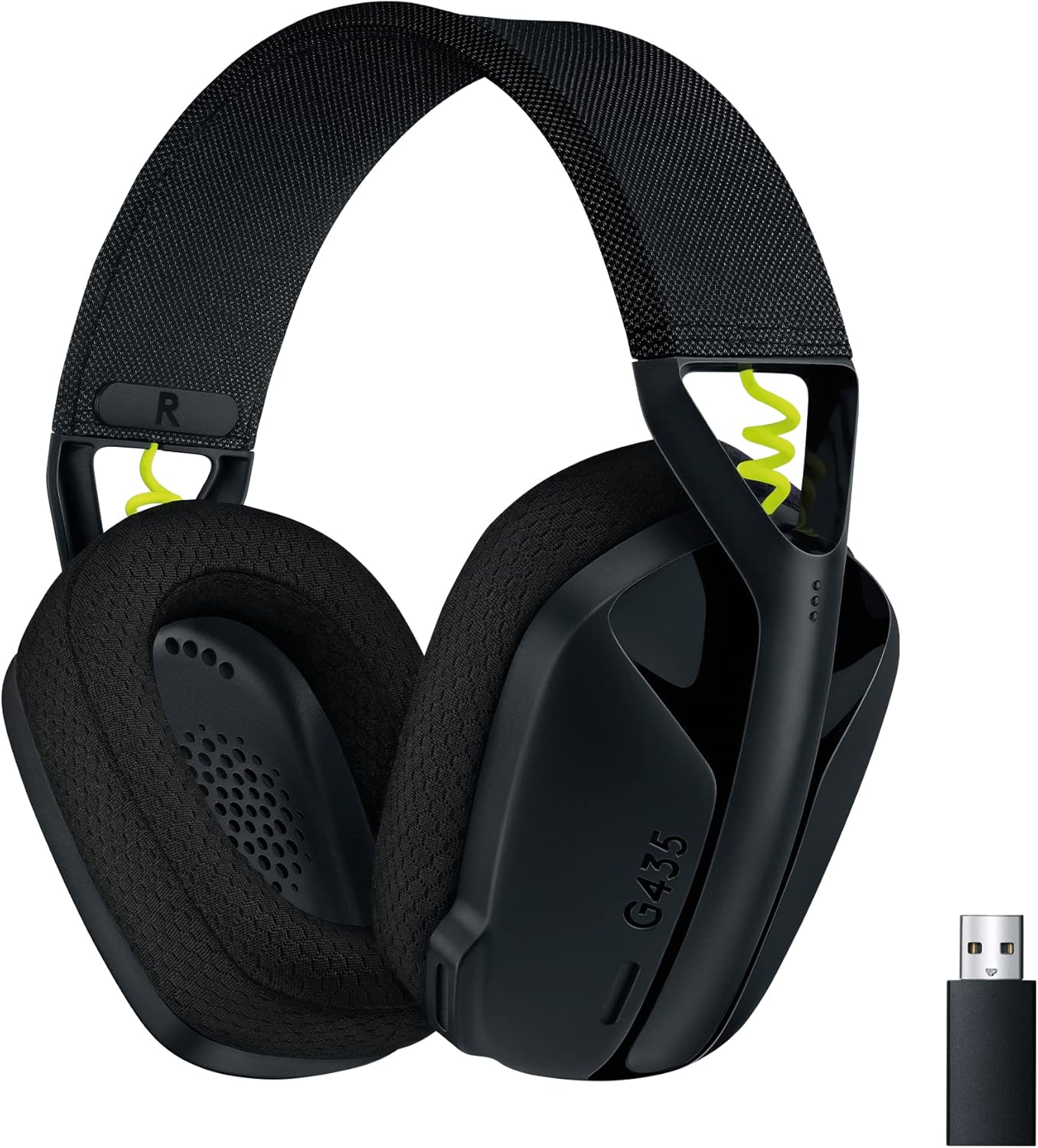
3. Logitech G435

Versatile connectivity makes the Logitech G435 the first headset combining LIGHTSPEED wireless and low-latency Bluetooth connectivity in single package. This dual-connectivity approach provides unprecedented freedom of play across PC, Mac, smartphones, PlayStation, and Nintendo Switch gaming devices without requiring separate headsets for different platforms. LIGHTSPEED wireless delivers the low-latency performance competitive gaming demands, while Bluetooth accommodates mobile devices and platforms where dongle connections prove impractical or impossible.

Lightweight construction weighing only 5.8 ounces (165 grams) makes this wireless gaming headset remarkably comfortable for all-day wear. The minimal weight prevents the neck strain and pressure point discomfort that heavier headsets create during extended gaming sessions, making marathon play sessions or full workdays wearing the headset genuinely comfortable rather than endurance tests. This lightweight design proves particularly valuable for younger users or anyone sensitive to headset weight accumulation over hours.

Superior voice quality comes from built-in dual beamforming microphones eliminating the need for protruding mic arms that some users find visually unappealing or physically cumbersome. These integrated microphones reduce background noise while capturing voice clearly, enabling effective communication during multiplayer gaming or video calls. The beamforming technology focuses on the user’s voice while rejecting ambient sounds, creating clear transmission without requiring close microphone positioning that traditional boom designs employ.

Immersive sound through carefully balanced, high-fidelity audio with 40mm drivers delivers engaging gaming audio and quality music reproduction. The headset’s compatibility with Dolby Atmos, Tempest 3D AudioTech, and Windows Sonic creates true surround sound experiences when paired with supporting games and platforms, providing competitive advantages through precise directional audio cues. Long battery life reaching 18 hours eliminates the need to stop gaming for recharging, allowing continuous playing, talking to friends, and listening to music throughout full days. Total comfort comes from design elements specifically accommodating younger players including memory foam ear cushions providing soft, conforming contact and sizing optimized for smaller head dimensions, though the adjustability accommodates a wide range of users beyond the primary demographic.

2. Sony WH-CH520

Long battery life reaching up to 50 hours provides sufficient power for multi-day road trips and long festival weekends without requiring recharging stops. This exceptional endurance eliminates battery anxiety during extended travel or events where charging access remains limited or inconvenient. Quick charging capability further extends usability—brief charging periods restore substantial battery capacity enabling continued use when depleted batteries threaten to interrupt listening. The included USB Type-C cable ensures compatibility with modern charging standards increasingly common across electronic devices.

High-quality sound customizable to personal music preferences comes through the EQ Custom feature within the Sony Headphones Connect App. This customization capability allows tailoring audio characteristics to individual taste rather than accepting fixed sound signatures that may not match preferred listening profiles. Users can emphasize bass for electronic music, enhance clarity for podcasts and audiobooks, or create balanced profiles for diverse content types. This flexibility ensures the headset adapts to listener preferences rather than forcing compromise.

Light and comfortable construction enables extended wearing without discomfort. The lightweight build prevents the pressure and fatigue heavier headsets create during all-day use. Swivel ear cups gently slip on and off, accommodating the natural putting-on and removal motions without awkward manipulation or risk of damage. The adjustable headband, cushioning, and soft ear pads work together providing comfortable fit across diverse head sizes and shapes, ensuring proper positioning and comfort distribution preventing the pressure points that develop during extended wear with poorly-fitted headsets.

Crystal-clear calls through the built-in microphone provide hands-free calling convenience. Users can manage phone conversations without removing phones from pockets or bags, maintaining communication accessibility during activities where handling phones would prove inconvenient or unsafe. Multipoint connection capability enables quick switching between two devices simultaneously, accommodating modern lifestyles where users maintain connections to both phones and computers or tablets requiring seamless transitions without manual reconnection. The headset’s availability in six colors including Black, Blue, White, Pink, Yellow, and Cappuccino allows finding color options matching personal style preferences and aesthetic sensibilities.

1. JBL Tune 510BT

JBL Pure Bass sound delivers the renowned audio signature found in famous venues worldwide, bringing professional-quality bass response to wireless headphone applications. This distinctive sound profile emphasizes powerful, impactful bass without overwhelming midrange and treble frequencies essential for balanced audio reproduction. The Pure Bass tuning creates engaging listening experiences for bass-forward music genres while maintaining clarity for vocal content and podcasts, ensuring versatility across diverse audio content types.

Wireless Bluetooth connectivity streams audio wirelessly from connected devices while supporting simultaneous connections to two devices. This dual-device capability prevents missing important calls while enjoying music or other content from primary devices—the headset automatically handles switching between sources when incoming calls arrive, eliminating the missed communication that would occur with single-device connections requiring manual switching. This seamless transition capability accommodates modern multi-device usage patterns where users maintain both phones and computers or tablets requiring audio connectivity.

Up to 40 hours of battery life with speed charge technology provides long-lasting enjoyment without frequent recharging interruptions. Listening wirelessly for up to 40 hours covers multiple days of typical use before requiring battery replenishment. The convenient Type-C USB cable recharges batteries in as little as two hours, minimizing downtime between charging cycles. Speed charge capability delivers remarkable quick-charge performance—just five minutes of charging provides two additional hours of music playback, enabling rapid power recovery during brief breaks when discovering low battery levels before extended listening sessions or important calls.

Microphone integration on the ear cup enables hands-free calling without handling connected devices. Convenient buttons positioned on the ear cup provide easy control over sound playback and call management directly from the headphones, eliminating the need to access devices for basic control functions. This accessibility proves particularly valuable during activities where reaching for devices would prove inconvenient—working out, cooking, commuting, or any situation where maintaining focus on current activities takes priority over device interaction. The foldable design enhances portability and storage convenience, allowing the headphones to collapse into compact forms fitting easily in bags or cases during travel. The comfortable construction ensures extended wearing remains pleasant rather than creating the pressure points and discomfort that plague poorly-designed headphones during all-day use. Complete Android and iOS compatibility ensures the headset functions properly with both major mobile platforms without limitations or compatibility concerns.

The Ultimate Guide to Wireless Headsets: Freedom and Versatility for Modern Audio Needs

Wireless headsets liberate users from cable constraints while delivering audio quality and communication capabilities that rival or exceed wired alternatives through advancing Bluetooth technology and sophisticated audio engineering. Modern wireless headsets serve diverse applications from professional video conferencing requiring crystal-clear voice transmission to immersive gaming demanding low-latency audio and precise directional cues, casual music listening appreciating high-fidelity sound reproduction, and hands-free calling during commutes or workouts. Unlike wired headsets tethering users to devices and creating tangles, wireless designs enable natural movement around spaces, quick device switching, and freedom from physical connection constraints that limit mobility and create cable management frustrations. Battery technology improvements extending runtime to 20-60 hours eliminate frequent charging concerns that plagued early wireless headsets, while fast-charging capabilities provide quick power recovery during brief breaks. Understanding Bluetooth standards, codec support, multi-device connectivity, and application-specific features helps navigate the expanding wireless headset market to find models matching specific usage patterns, audio quality expectations, and feature priorities that separate casual occasional use from daily dependence on wireless audio.

Understanding Wireless Audio Technology

Not all wireless headsets employ equivalent technology or deliver comparable audio quality and connectivity reliability. Understanding fundamental wireless differences helps evaluate performance claims and compatibility considerations.

Bluetooth Versions and Capabilities

Bluetooth standard evolution dramatically affects wireless headset performance. Bluetooth 5.0 and newer versions offer improved range, faster data transmission, and better power efficiency compared to older 4.2 implementations still found in budget headsets. Bluetooth 5.3 introduces connection quality improvements and reduced latency particularly valuable for gaming and video applications where audio-visual synchronization matters. Higher Bluetooth versions generally provide more stable connections, extended range, and better multi-device management, though actual performance depends on both headset and source device Bluetooth implementations working together.

Audio Codecs and Sound Quality

Bluetooth audio codecs profoundly affect sound quality and latency characteristics. Basic SBC codec provides universal compatibility but relatively limited audio quality and higher latency. AAC codec used by Apple devices offers improved quality for iOS users. aptX and aptX HD deliver enhanced audio fidelity for Android devices supporting these codecs. aptX Low Latency significantly reduces audio delay critical for gaming and video watching. LDAC provides highest quality transmission supporting Hi-Res audio. Understanding which codecs specific headsets and source devices support helps predict actual audio quality and latency performance beyond marketing specifications.

Proprietary Wireless Technologies

Some gaming headsets employ proprietary 2.4GHz wireless connections using USB dongles rather than standard Bluetooth. These dedicated wireless systems often provide lower latency than Bluetooth, making them preferable for competitive gaming where even small audio delays affect performance. However, proprietary systems limit device compatibility compared to universal Bluetooth. Dual-mode headsets offering both proprietary low-latency wireless and Bluetooth connectivity provide flexibility—gaming performance when connected via dongle, broad device compatibility when using Bluetooth mode.

Battery Life and Power Management

Rated vs Actual Runtime

Manufacturer battery life claims assume specific conditions rarely matching real-world usage. Rated runtime typically assumes moderate volume levels and specific content types. Actual battery life varies with volume level, codec selection, and whether active features like noise cancellation consume additional power. Understanding that rated specifications represent maximum potential rather than guaranteed minimum helps set realistic expectations. Reviews from actual users often provide more accurate runtime predictions across diverse usage scenarios.

Charging Technology and Quick Charge

USB-C charging has become standard on modern wireless headsets, offering faster charging and cable compatibility with other devices. Quick charge technology provides substantial runtime recovery from brief charging periods—often 5-10 minutes of charging delivers 1-3 hours of use. This capability proves invaluable when discovering low battery before important calls or gaming sessions. Some premium headsets support wireless charging adding convenience though slightly increasing price and weight. Understanding charging requirements and available technologies helps match headsets to typical usage patterns and available charging infrastructure.

Battery Degradation and Lifespan

Lithium batteries powering wireless headsets gradually degrade through charge cycles, losing capacity over months and years. Quality headsets using premium batteries and sophisticated power management maintain capacity longer than budget alternatives. Most headsets experience noticeable capacity reduction after 500-1000 charge cycles, though degradation rate depends on usage patterns and charging practices. Avoiding complete discharge before recharging and not leaving headsets on chargers continuously after reaching full charge helps maximize battery longevity. Understanding battery lifespan helps predict when replacement becomes necessary.

Microphone Quality and Communication Features

Boom vs Integrated Microphones

Boom microphone designs extending from ear cups position microphones near mouths for optimal voice pickup and noise rejection. These implementations typically deliver superior voice quality compared to integrated designs, making them preferred for professional communication and gaming where clear team coordination matters. However, boom mics add bulk and may not suit users preferring streamlined aesthetics. Integrated microphones built into headset frames offer cleaner appearance and often retractable or removable designs, though potentially compromising voice quality compared to dedicated boom implementations. Understanding primary usage determines whether boom mic advantages justify aesthetic compromises.

Noise Cancellation Technologies

Microphone noise cancellation differs from audio noise cancellation—it processes outgoing voice transmission rather than incoming audio. Beamforming microphones use multiple elements to determine sound direction, focusing on voice while rejecting ambient noise from other directions. DSP algorithms analyze audio identifying voice frequencies while filtering background sounds. Quality implementations dramatically improve communication clarity in noisy environments—household activity, traffic noise, office chatter—that would otherwise interfere with voice transmission. Premium headsets combine beamforming arrays with sophisticated processing achieving remarkable background rejection enabling clear communication from challenging acoustic environments.

Sidetone and Monitoring

Sidetone features play small amounts of the user’s own voice through headset speakers providing feedback about speaking volume and microphone functionality. This prevents the disconnected sensation of not hearing oneself that causes speaking too loudly (annoying others) or too quietly (frustrating call participants). Adjustable sidetone allows customizing feedback level matching personal preferences. Some users prefer substantial monitoring while others find it distracting. Understanding whether specific headsets offer sidetone and adjustment options helps determine communication comfort particularly for users sensitive to not hearing themselves while speaking.

Comfort and Ergonomic Design

Ear Cup Styles and Fit

Over-ear designs surround ears entirely distributing pressure on surrounding areas rather than pressing on ears themselves, generally providing superior long-term comfort. On-ear designs sit on ears rather than around them, creating more compact lightweight headsets though potentially causing ear discomfort during extended wear. Ear pad materials affect comfort—memory foam conforms to individual contours distributing pressure evenly, while basic foam may create pressure points. Breathable materials including mesh or perforated leather reduce heat buildup preventing sweaty discomfort during long sessions. Understanding personal sensitivity to ear pressure and typical session lengths helps determine whether over-ear or on-ear designs better suit individual needs.

Weight Distribution and Headband Design

Headset weight significantly affects long-term comfort. Lightweight designs under 200 grams prevent neck strain during all-day wear, while heavier models may cause discomfort during extended sessions. Weight distribution matters as much as total mass—well-balanced headsets distribute weight evenly preventing pressure concentration. Headband padding distributes force across head tops rather than creating painful pressure points. Adjustability accommodates different head sizes from children through large adults. Understanding weight tolerance and typical wearing duration helps determine whether ultra-light designs justify potential compromises in features or whether moderate weight remains acceptable.

Clamping Force Considerations

Clamping force—how tightly ear cups press against heads—affects both comfort and acoustic seal. Excessive clamping creates uncomfortable pressure causing headaches, while insufficient clamping allows headsets to slip during movement. Proper clamping balances security against comfort. Adjustable designs accommodate different preferences, though fixed clamping requires finding models matching individual tolerance. New headsets often feel tighter than after break-in periods where padding compresses slightly and frames flex somewhat. Understanding personal sensitivity to clamping pressure helps identify comfortable options.

Multi-Device and Connectivity Features

Multipoint Connection Capability

Multipoint Bluetooth allows simultaneous connections to multiple devices—typically two—enabling seamless switching when calls arrive or alternating between devices without manual reconnection. This proves invaluable for users maintaining both work computers and personal phones, enabling taking calls without disconnecting from computers or manually switching connections. Implementation quality varies—some headsets automatically handle switching while others require manual intervention. Understanding typical device usage patterns determines whether multipoint capability provides practical value or represents unused feature adding cost without benefit.

Device Switching Mechanisms

Fast device switching varies in implementation and convenience. Some headsets automatically detect activity and switch accordingly, while others require button presses. Proprietary apps sometimes enable assigning specific buttons to specific devices. Understanding switching mechanisms before purchase prevents discovering inconvenient procedures requiring excessive button combinations or app navigation. Quick switching proves particularly valuable during fast-paced workdays where rapid device transitions maintain productivity and communication responsiveness.

Cross-Platform Compatibility

While Bluetooth provides universal compatibility, some features may work only with specific platforms. Gaming headsets may offer enhanced features on specific consoles through proprietary connections while providing basic Bluetooth for other devices. Companion apps for EQ customization and firmware updates may be platform-specific—iOS-only or Android-only—limiting features for users with incompatible devices. Understanding platform requirements for full feature access prevents discovering capability limitations after purchase. Checking compatibility with all intended devices ensures headsets function as expected across entire device ecosystem.

Making the Final Decision

When selecting wireless headsets, users should honestly assess primary usage scenarios and prioritize accordingly. Professional communication users benefit most from superior microphone quality with effective noise cancellation, comfortable all-day wear, and reliable battery life. Gamers should emphasize low-latency connections, immersive audio quality, comfortable extended wear, and cross-platform compatibility. Music enthusiasts prioritize audio quality through codec support and driver quality while accepting potential compromises in microphone capability. General-use applications benefit from balanced capabilities across audio quality, comfort, battery life, and microphone performance.

Battery life should comfortably exceed typical usage between charging opportunities with margin for days when usage extends beyond normal. Quick charge capability adds flexibility for unexpected situations. Comfort becomes increasingly critical as typical wearing duration extends—testing headsets when possible reveals fit characteristics specifications cannot predict. Audio quality expectations should align with usage—casual listening accepts limitations audiophiles would reject, while professional music production demands fidelity general users may not appreciate. Microphone quality matters substantially for communication-focused applications while remaining secondary for pure listening applications.

Budget considerations should account for total ownership costs including potential battery replacement and platform-specific app requirements. Premium features justify higher costs when used regularly but waste money when rarely accessed. Understanding personal priorities, realistic usage patterns, and non-negotiable requirements versus nice-to-have features helps identify wireless headsets delivering optimal balance between capability, comfort, quality, and cost matching specific needs rather than merely impressive specification sheets that may not translate into practical daily satisfaction and productivity enhancement.

Best Power Inverter

by Treviews

Finding a dependable power inverter that delivers clean, consistent power without damaging sensitive electronics, handles surge demands without shutting down, and operates quietly without annoying noise proves challenging among countless models making bold wattage claims. This comprehensive guide showcases top-rated power inverters featuring advanced waveform technology, comprehensive safety protections, and efficient conversion that maximizes battery runtime while minimizing heat generation. Tired of inverters that shut down unexpectedly during critical moments, produce electrical noise interfering with equipment, or fail within months despite light use? These expert recommendations feature only the finest power inverters combining robust power delivery with practical features including LCD displays, remote operation, and multiple outlet configurations that accommodate diverse device needs. Ready to bring reliable AC power to remote locations, emergency situations, or mobile lifestyles without compromising equipment safety or operational convenience? These exceptional inverters blend sophisticated power electronics with durable construction that transforms DC battery sources into versatile electrical systems powering modern life anywhere.

5. Cantonape Power Inverter

Powerful output capability converts DC 12V battery power to standard AC 110V/120V 60Hz electricity suitable for powering household appliances and electronics. This robust inverter provides 3000 watts continuous modified sine wave power and 6000 watts surge capacity handling brief power spikes when motor-driven appliances start or compressors engage. The generous capacity features four AC outlets and four USB ports enabling simultaneous charging of multiple devices from single inverter installation. High conversion efficiency exceeding 90% maximizes battery runtime by minimizing wasted energy lost as heat during the DC-to-AC conversion process, ensuring batteries provide maximum useful power before requiring recharging.

Intelligent LCD display provides comprehensive real-time operating information and diagnostic capabilities. During normal operation, the display shows input voltage from the battery, output voltage being delivered to connected devices, battery capacity remaining, load capacity currently being drawn, and output frequency verification. When the inverter detects abnormal operating conditions, the LCD displays specific error codes identifying the exact problem. Code E-1 indicates low voltage protection activated preventing battery over-discharge damage. E-2 signals high voltage protection triggered by excessive input voltage. E-3 warns of overtemperature protection engagement requiring cooling before resuming operation. E-4 shows overload protection activated when connected devices exceed inverter capacity. E-5 indicates short circuit protection detected. E-6 signals repeated faults requiring shutdown and manual restart to reset the system.

Remote control convenience comes standard with included wireless controller enabling inverter ON/OFF operation from distance. This feature proves particularly valuable when inverters mount in difficult-to-reach locations like under vehicle seats, in storage compartments, or within RV utility bays. Users should note the remote controller requires a 12V 23A battery (not included) for operation. The remote capability eliminates the need to physically access the inverter every time power activation or deactivation becomes necessary, improving convenience during frequent use scenarios.

Multi-protection systems with replaceable components ensure both inverter and connected device safety. Six separate replaceable 50-amp fuses included with the package protect against overcurrent conditions that could damage the inverter or connected equipment. Six distinct protection types guard against overload conditions exceeding capacity, short circuits creating dangerous current paths, overheating from inadequate cooling or excessive loads, reverse polarity from incorrect battery connections, and under-voltage or over-voltage situations outside safe operating parameters. These comprehensive protections make batteries and appliances safer during operation. The manufacturer backs the inverter with a 12-month warranty demonstrating confidence in construction quality and reliability. Special design considerations enhance durability and performance. The durable aluminum body provides advanced heat dissipation and physical protection, while the built-in temperature-controlled cooling fan activates as needed maintaining safe operating temperatures. Isolated ground-neutral design improves electrical safety, and rugged construction allows the inverter to withstand harsh environments including vibration, temperature extremes, and challenging conditions encountered during mobile applications. Wide application versatility makes this inverter suitable for numerous scenarios. The four 120V AC outlets feature thoughtful spacing designed to easily accommodate four large plugs simultaneously without interference. Applications include powering hair dryers, microwaves, coffee machines, drills, televisions, car refrigerators, LED lights, water pumps, and electric saws. The inverter proves ideal for vacations, work trips, home emergency backup, outdoor activities, and camping where standard AC power remains unavailable.

4. Belttt Power Inverter

Powerful DC-to-AC conversion delivers 2000 watts continuous power converting 12V DC battery power to standard 110V/120V AC electricity, with up to 4000 watts peak surge capacity handling the substantial momentary power demands when motor-driven loads start. This car power inverter achieves conversion efficiency greater than 91% during normal operation, maximizing battery runtime by minimizing wasted energy. Low no-load losses mean the inverter draws minimal power when connected but not actively powering devices, preventing unnecessary battery drain during standby periods.

Pure sine wave output represents the premium inverter technology producing waveforms identical to utility grid AC power. The output waveform consistency with standard household electricity makes this inverter suitable for both inductive loads like motors and transformers plus capacitive loads including electronic equipment with switching power supplies. This clean power extends equipment service life and reduces fault rates compared to modified sine wave inverters that may cause premature wear or operational problems with sensitive devices. The pure sine wave capability enables long-term use with electrical equipment including televisions maintaining picture quality, home theater systems preserving audio fidelity, car stereos avoiding interference, and other sensitive loads that would experience degraded performance or potential damage with lower-quality power waveforms.

Intelligent LCD display integration provides high-brightness real-time monitoring showing multiple operating parameters simultaneously. The smart screen displays input voltage from the battery source, output voltage being delivered to connected equipment, battery charge status, load level indicating how much inverter capacity current devices consume, and multiple operating condition indicators enabling timely troubleshooting when problems arise. The advanced display allows independent small-range adjustment of output voltage and screen settings, enabling fine-tuning to match specific equipment requirements or user preferences for display brightness and information presentation.

Versatile connectivity options power diverse expectations through multiple outlet types. The 12V-to-110V inverter features dual standard AC sockets for conventional plug-in devices, a 20-amp outlet accommodating higher-current appliances, a 5V 2.1A USB port for charging mobile devices, a hardwire port enabling permanent installation with direct wiring, and a remote controller with 23-foot cable allowing convenient operation from distance. This solar inverter proves ideal when reliable off-grid energy becomes necessary—outdoor adventures, RV living, truck-based work requiring power tools, and any mobile application where standard AC power sources remain unavailable. Multiple safety protections ensure reliable, safe operation across diverse conditions. The pure sine wave inverter provides undervoltage protection preventing battery over-discharge damage, overvoltage protection guarding against excessive input that could harm internal components, overload protection activating when connected devices exceed capacity, overtemperature protection preventing heat-related failures, short circuit protection detecting dangerous current paths, and reverse connection protection preventing damage from incorrect battery polarity. The combination of aluminum and sturdy plastic housing ensures long-term durability withstanding vibration, temperature extremes, and physical impacts encountered during mobile and outdoor applications.

3. Ampeak Power Inverter

Ultra-high 89.37% efficiency with library-quiet 52dB operation sets this Ampeak inverter apart from less-refined competitors. The market-leading conversion efficiency ensures more stable current delivery and longer device runtime while protecting battery health by minimizing wasted energy converted to heat rather than useful electrical output. This exceptional efficiency means precious battery power serves productive purposes rather than being squandered through conversion losses that plague inferior inverters. The remarkably quiet 52-decibel operation proves perfect for overnight RV trips and peaceful campsites where annoying humming from noisy inverters would disturb sleep and disrupt the natural tranquility outdoor enthusiasts seek.

Massive power output delivers 2000 watts continuous capacity with 4000 watts peak surge capability conquering virtually any power need encountered on the road. This robust inverter runs power tools, kitchen appliances, and electronics effortlessly, serving as a reliable heavy-duty power source for trucks, RVs, and emergency home backup situations where grid power becomes unavailable. The substantial continuous rating handles sustained loads including microwaves, coffee makers, and power tools, while the generous surge capacity accommodates the brief high-current demands when motors start or compressors engage in refrigerators and air conditioning equipment.

Unmatched safety through 11 advanced protection systems prioritizes user peace of mind and equipment preservation. Fortified with critical safety features including overload protection preventing damage from excessive power demands, over-voltage and under-voltage protection guarding against battery or alternator irregularities, short circuit protection detecting dangerous current paths, and overtemperature protection preventing heat-related failures, this inverter offers double the protection systems compared to most competitors. These comprehensive safeguards protect expensive devices and vehicle electrical systems with confidence, preventing the cascading failures that can result from single-point protection deficiencies in lesser inverters.

Five-port versatility with included high-current cables accommodates simultaneous multi-device charging. Equipped with three standard AC outlets and dual 5V/3.1A USB ports, this inverter functions as the ultimate all-in-one charging station eliminating the need for separate chargers and adapters. The package includes two feet of premium 4AWG battery cables ensuring secure, high-current connections that minimize power loss and heat buildup at connection points—common failure locations in systems using inadequate wiring.

Clear LED display with smart temperature-controlled cooling maintains complete operational awareness. The bright LED shows input voltage, output power, and fault codes in real-time, enabling users to monitor performance and quickly diagnose any problems. The intelligent cooling fan employs sophisticated thermal management, only spinning up when internal temperature exceeds 122°F. This temperature-based operation ensures efficient cooling when needed while reducing dust intake and noise during light-load operation, extending inverter durability through reduced cooling system wear.

Designed for demanding real-world use from RVs to semi-trucks, this inverter handles rigorous applications. Whether powering coffee makers in truck cabs, running microwaves in RVs, or charging gadgets during camping trips, the inverter delivers robust performance through durable casing and reliable components that withstand daily use. The modified sine wave output provides stable AC power compatible with most common household, workshop, and personal electronic devices—approximately 99% of equipment on the market. This broad compatibility delivers reliable power without the premium cost associated with pure sine wave models, making it an excellent value for applications not requiring absolute waveform purity.

2. Twing Power Inverter

Substantial 1000-watt power capacity converts 12V DC battery power to standard 110V AC electricity through dual AC outlets providing continuous DC-to-AC power output. This home and outdoor inverter transforms 12V DC battery power into household-standard 110V AC, featuring two AC outlets and two advanced USB ports including Quick Charge 3.0 and 30W PD3.0 technologies. The QC 3.0 and Power Delivery 3.0 implementations enable rapid charging of compatible devices dramatically faster than standard USB charging, proving particularly valuable during brief stops where maximum charging speed becomes essential.

Fast charging capability through multiple port types accommodates diverse device requirements. The 110V AC outlets handle larger devices including laptops and tablets requiring full AC power, while the USB charging ports deliver 0-2.4 amps with up to 50-watt surge capacity for powering USB-compatible devices. The cigarette lighter adapter supports up to 150 watts surge capacity, creating versatile charging options for various equipment types. This car outlet adapter with digital display serves as essential car accessory for portable audio equipment, camping lamps, digital cameras, car refrigerators, and other devices requiring reliable mobile power.

Safety multi-protection systems guard against common failure modes that could damage the inverter or connected equipment. The integrated cooling fan maintains safe operating temperatures during sustained use, while the smart digital display provides real-time operating information. A mini slip fuse protects against over-voltage conditions exceeding safe input limits, low voltage situations risking battery over-discharge, overload scenarios when connected devices demand excessive power, short circuits creating dangerous current paths, and overheating from inadequate cooling or extreme ambient temperatures. The inverter applies ABS crashworthiness technology creating robust construction with excellent electrical insulation properties essential for automotive inverter applications.

Wide application versatility makes this inverter suitable for numerous scenarios requiring mobile AC power. The inverter connects directly to car cigarette lighters for convenient vehicle installation or connects to 12V batteries directly for emergency backup, solar power systems, or stationary applications. Typical uses include powering essential devices during hurricanes, storms, snowstorms, and power outages when grid electricity becomes unavailable. The inverter reliably charges cell phones, laptops, electric lights, digital cameras, breast pumps, and countless other electronics requiring AC power in locations where standard outlets don’t exist. This versatility makes the inverter valuable for both planned mobile power applications and unexpected emergency situations where maintaining device charging capability proves critical.

1. Bestek Power Inverter

Bestek advantage through upgraded technology from America’s leading power inverter brand and patents owner. The inverter technology upgrade extends voltage compatibility to 11-17V, including compatibility with Tesla vehicle electrical systems that operate at voltages slightly different from standard 12V automotive systems. This 300-watt inverter provides continuous DC-to-AC power with 700 watts instantaneous surge capacity handling brief high-current demands when devices start or experience momentary power spikes. The compact unit features two AC outlets and two USB ports, creating a complete mobile power solution from a single cigarette lighter connection.

Fast charging through multiple outlet types accommodates diverse device requirements efficiently. Two 110V AC outlets handle larger devices including laptops and tablets requiring full AC power for charging or operation. Dual 4.8-amp USB charging ports provide rapid charging for USB-compatible devices, delivering substantially more current than standard 1-amp USB ports found in many vehicles. This high-current USB capability enables simultaneously charging multiple smartphones, tablets, or other USB devices at maximum speed rather than the slow trickle charging that occurs with insufficient current delivery. The combination makes this inverter a requisite car accessory for anyone requiring reliable mobile device charging during travel.

Ultra-compact and lightweight design with iPhone-sized dimensions proves ideal for use during vacations, work trips, and camping adventures where space and weight constraints limit what equipment can practically be carried. The remarkably compact form factor allows storage in glove compartments, door pockets, or bags without consuming excessive space. The 32-inch cigarette lighter plug cable provides adequate length for positioning the inverter conveniently near devices requiring power, enabling placement on seats, consoles, or other convenient locations rather than dangling awkwardly from dashboard cigarette lighter sockets. This extended cable makes the power inverter compatible with virtually any vehicle configuration regardless of cigarette lighter socket positioning.

Multi-protection systems ensure safe operation protecting both the inverter and connected devices. The built-in 40-amp fuse provides primary overcurrent protection, immediately disconnecting power if excessive current flow threatens damage. Safe charging design incorporates protection against overheating from sustained high loads or inadequate cooling, under-voltage conditions that could indicate dying batteries or electrical system problems, over-voltage situations from alternator irregularities, and short circuiting creating dangerous current paths. These comprehensive protections prevent damage to expensive devices while safeguarding vehicle electrical systems from inverter-related faults.

Durable aerospace aluminum housing provides advanced protection from drops and bumps encountered during mobile use. The premium aluminum construction dissipates heat efficiently while providing impact resistance superior to plastic housings vulnerable to cracking from impacts. A smart cooling fan system maintains remarkably quiet operation, with the fan speed automatically adjusting based on operating temperature and load—running faster when the device temperature rises or when output power exceeds 70 watts. This intelligent thermal management balances cooling effectiveness against noise generation, operating quietly during light loads while ramping up cooling capacity when sustained high-power operation demands increased heat dissipation. The combination of compact design, robust protection, efficient cooling, and durable construction makes this Bestek inverter the ideal choice for road warriors requiring reliable mobile power in a package that travels well and operates dependably across diverse conditions and applications.

The Ultimate Guide to Power Inverters: Converting DC Battery Power into Versatile AC Electricity

Power inverters unlock the potential of DC battery sources by converting stored direct current into standard alternating current that powers the vast majority of household appliances, power tools, and electronic devices designed for grid electricity. These electronic transformers enable using conventional AC equipment in vehicles, boats, RVs, off-grid solar installations, and during emergencies when utility power fails. Unlike generators producing AC power through mechanical means with noise, exhaust, and maintenance requirements, inverters silently and cleanly convert existing battery power into usable electricity. Modern inverters range from compact 150-watt cigarette lighter units powering laptops and phones to massive 10,000+ watt systems running entire households during extended outages. Understanding waveform types, capacity sizing, efficiency ratings, and safety features helps navigate the expanding inverter market to find units matching specific power requirements, installation constraints, and application demands that separate occasional light use from daily dependence on inverter-supplied electricity.

Understanding Power Inverter Fundamentals

Not all inverters deliver equivalent power quality or suit the same applications. Understanding fundamental technology differences helps match inverters to specific equipment and usage patterns.

Modified Sine Wave vs Pure Sine Wave

Inverter output waveforms fundamentally affect compatibility and equipment performance. Modified sine wave inverters produce stepped approximations of smooth sinusoidal AC waveforms, creating functional but imperfect power suitable for many devices. This technology costs less and converts power slightly more efficiently than pure sine wave alternatives. However, modified sine wave power causes problems with some equipment—sensitive electronics may experience interference, some motors run hotter and less efficiently, audio equipment often produces audible hum, and certain battery chargers refuse to function properly. Pure sine wave inverters replicate utility grid power precisely, producing smooth sinusoidal waveforms identical to household electricity. This premium power works with all AC equipment without compatibility concerns, runs motors more efficiently and quietly, eliminates interference in audio/video equipment, and extends device lifespan by providing cleaner power. The cost premium for pure sine wave typically ranges from 30-100% more than equivalent modified sine wave capacity.

Continuous vs Surge Power Ratings

Inverter capacity ratings include two critical specifications—continuous power and surge power. Continuous ratings indicate how many watts the inverter can deliver indefinitely without overheating or shutting down. This specification should match or exceed the combined wattage of all devices operated simultaneously. Surge ratings indicate brief power spikes the inverter handles during motor startups, compressor engagement, or other momentary high-current demands. Many motor-driven appliances require 2-3 times their running wattage for several seconds during startup. Inadequate surge capacity causes inverters to shut down protective overload circuits even though continuous capacity theoretically suffices. Understanding both ratings prevents purchasing inverters that shut down unexpectedly when refrigerators, power tools, or other motor loads start despite adequate continuous ratings for running power.

Efficiency and Battery Runtime

Conversion efficiency dramatically affects how long batteries power connected devices. High-efficiency inverters (90%+) waste minimal energy as heat, maximizing battery runtime. Lower efficiency units (80-85%) convert substantially more battery power into waste heat rather than useful AC output. This efficiency difference compounds significantly—at 90% efficiency, a 1000-watt load draws about 1111 watts from batteries, while at 80% efficiency, the same load draws 1250 watts, requiring 12.5% more battery capacity for equivalent runtime. No-load power consumption also matters—quality inverters draw minimal current when connected but not actively powering devices, while inferior units may drain batteries substantially even during standby periods.

Critical Capacity and Sizing Considerations

Calculating Total Power Requirements

Proper inverter sizing requires accurately totaling all devices that might operate simultaneously. Each device’s wattage appears on specification labels, though some list only voltage and amperage requiring multiplication (volts × amps = watts) to determine power consumption. Conservative sizing adds 20-30% margin above calculated totals, accommodating startup surges and preventing operation near maximum capacity where efficiency decreases and component stress increases. Undersized inverters shut down repeatedly from overload protection, while grossly oversized units waste money and may operate inefficiently at very light loads.

Motor Starting Considerations

Motor-driven equipment including refrigerators, air conditioners, pumps, and power tools requires special consideration. Running wattage may be modest, but starting surge can reach 3-7 times running power for several seconds. Inverter surge ratings must accommodate these demands. Some manufacturers specify surge duration—premium units sustain surge ratings for longer periods better handling difficult motor starts. Understanding which connected devices include motors and their approximate startup multipliers prevents selecting inverters with inadequate surge capacity despite sufficient continuous ratings.

Battery Bank Capacity and Runtime

Inverter capacity means nothing without adequate battery capacity supporting desired runtime. A 1000-watt load at 12V draws approximately 84 amps from batteries (accounting for ~90% inverter efficiency). Most automotive batteries provide perhaps 60-70 amp-hours, sustaining this load under an hour before deep discharge damage occurs. Deep-cycle batteries withstand discharge better but still have finite capacity. Calculating required battery capacity involves load wattage, desired runtime, battery voltage, inverter efficiency, and safe discharge limits (typically 50% for lead-acid, 80-90% for lithium). Understanding this relationship prevents discovering inadequate runtime after inverter purchase.

Essential Installation and Safety Factors

Proper Cable Sizing and Connections

High-current DC connections require substantial cables preventing voltage drop and dangerous heat buildup. Inadequate wire gauge creates resistance that wastes power, reduces inverter performance, and risks fire from overheated connections. Cable sizing depends on inverter capacity and distance from batteries—larger inverters and longer cable runs require heavier gauge. Quality inverters include appropriately-sized cables, though custom installations may need different lengths. Battery connections should use corrosion-resistant terminals with secure mechanical connections—loose terminals create dangerous resistance and arcing. Fusing at the battery protects against catastrophic shorts in DC wiring.

Ventilation and Cooling Requirements

Inverters generate substantial heat during operation, requiring adequate ventilation for reliable performance. Enclosed installations without airflow cause premature thermal shutdowns or component damage from sustained overheating. Mounting locations should allow air circulation around inverter enclosures, with cooling fans having clear paths for intake and exhaust. Some installations benefit from supplemental fans moving air across inverter surfaces. Understanding cooling requirements prevents installations that look clean but fail due to inadequate thermal management.

Grounding and Electrical Safety

Proper grounding provides critical safety functions. Chassis grounding connects inverter metal enclosures to vehicle or installation ground, preventing enclosures from becoming energized during internal faults. Some inverters include isolated ground-neutral designs improving electrical safety for certain applications. AC output grounding depends on application—permanent installations may require conventional electrical grounding similar to household wiring, while portable vehicle applications typically leave ground floating. Understanding applicable electrical codes and safety requirements prevents potentially dangerous ground fault situations.

Common Application Scenarios

Vehicle and RV Use

Mobile applications represent primary inverter uses, providing household AC power in vehicles, RVs, boats, and trucks. Compact inverters plugging into cigarette lighters suit light loads including laptops, phones, and small appliances. Larger installations with direct battery connections handle microwaves, coffee makers, power tools, and entertainment systems. RV installations often feature permanent inverter mounting with dedicated circuit panels distributing power throughout the vehicle. Understanding which devices require power, typical usage patterns, and whether vehicle electrical systems support loads helps size appropriate inverter capacity.

Emergency Backup Power

Grid power outages create immediate needs for alternative electricity sources. Inverters connected to vehicle batteries or backup battery banks provide refrigeration, lighting, communication device charging, and medical equipment operation during emergencies. This application often emphasizes runtime over instantaneous capacity—modest loads sustained for extended periods rather than brief high-power demands. Battery charging from vehicles, generators, or solar panels extends available runtime. Planning emergency power needs helps determine appropriate inverter capacity and battery requirements ensuring critical systems remain operational during extended outages.

Off-Grid Solar Systems

Solar power systems rely on inverters converting DC battery storage into usable AC electricity. These installations range from simple cabin systems powering basic lighting and charging to comprehensive off-grid homes running full households. Solar applications often utilize larger pure sine wave inverters providing clean power for sensitive electronics and efficient motor operation. System sizing must account for seasonal solar production variations, consecutive cloudy days, and peak simultaneous loads. Understanding relationship between solar production, battery storage, and inverter capacity ensures reliable year-round power.

Portable Power for Remote Work

Construction workers, outdoor photographers, event production crews, and others requiring power at remote locations depend on portable inverter systems. These applications emphasize transportability, rapid setup, and adequate capacity for power tools, lighting, or specialized equipment. Generator-inverter combinations provide extended runtime without excessive battery capacity, though introducing noise and fuel requirements that pure battery-inverter systems avoid. Rugged construction withstanding jobsite abuse and weather exposure proves essential for professional portable applications.

Making the Final Decision

When selecting power inverters, users should begin by accurately calculating total power requirements including surge demands for motor loads. Pure sine wave inverters justify premium costs for sensitive electronics, audio equipment, or applications demanding cleanest possible power, while modified sine wave units suit basic applications with compatible devices. Capacity should include comfortable margins above calculated loads, though avoiding excessive oversizing that wastes money without performance benefits.

Installation planning addresses cable sizing, battery capacity, mounting locations, and cooling requirements before purchase. Portable versus permanently-installed designs suit different applications—vehicle accessories versus RV electrical systems. Safety features including overload, overtemperature, and voltage protection prove essential regardless of capacity or waveform. Brand reputation and warranty coverage indicate manufacturer confidence in construction quality and reliability. Budget considerations should account for total system costs including cables, batteries, and installation accessories rather than merely inverter purchase price.

Understanding intended applications, realistic power requirements, and installation constraints helps identify inverters delivering optimal balance between capacity, features, and cost. Whether enabling mobile office work from vehicles, providing emergency backup during outages, powering off-grid living situations, or simply charging devices during camping trips, quality power inverters transform DC battery sources into versatile AC electrical systems that expand freedom and maintain modern convenience regardless of distance from utility grid connections.

Best Xbox Gaming Headset

by Treviews

Finding a reliable gaming headset that balances superior sound quality, long-session comfort, and durable construction across multiple gaming platforms proves challenging among countless models making bold audio claims. This comprehensive guide showcases top-rated Xbox gaming headsets featuring spatial audio technology, noise-canceling microphones, and multi-platform compatibility that extends value beyond single-console use. Tired of uncomfortable ear cups causing pain during marathon sessions, microphones that pick up every background noise, or flimsy construction that breaks after minimal use? These expert recommendations feature only the finest gaming headsets combining premium audio drivers with breathable materials and reinforced frames that withstand years of intensive gaming. Ready to gain competitive advantages through precise directional audio while communicating clearly with teammates during crucial moments? These exceptional headsets blend advanced sound engineering with practical features that transform gaming audio from adequate background noise into tactical weapon and immersive experience.

5. HyperX Cloud III

Comfort forms the foundational DNA of the Cloud III design philosophy. Built specifically for gamers who cannot tolerate uncomfortable headsets ruining the flow of perfectly-executed full-combos, disrupting speedrun attempts, or knocking concentration out of the zone during competitive matches. The emphasis on comfort recognizes that gaming sessions often extend for hours, making superior padding and weight distribution essential rather than luxury features. Memory foam ear cushions conform to individual head shapes and ear contours, distributing pressure evenly rather than creating painful hotspots that develop during extended wear. The lightweight construction prevents neck strain that heavier headsets cause during marathon gaming sessions, while breathable materials maintain comfortable temperatures preventing the sweaty, overheated sensation that some gaming headsets create.

Audio quality receives meticulous engineering attention through custom-tuned 53mm angled drivers. HyperX audio engineers specifically tuned these drivers to provide optimal listening experiences that accent the dynamic sounds inherent in gaming environments. The angled driver positioning improves sound staging and directional accuracy compared to standard perpendicular mounting, creating more natural audio presentation. This tuning emphasizes frequencies most relevant to gaming—subtle footsteps indicating enemy positions, directional gunfire revealing threats, environmental cues providing tactical information—while maintaining excellent music and voice quality for entertainment beyond gaming applications. The substantial 53mm driver size moves more air than smaller drivers, producing fuller bass response and clearer overall sound across the frequency spectrum.

Upgraded microphone technology ensures clear communication with teammates during coordination-critical moments. The 10mm microphone captures high-quality audio for clear voice chat and calls, transmitting communication without the muffled or tinny quality that plagues inferior microphones. Noise-canceling technology actively reduces background sounds, while the built-in mesh filter omits disruptive noises that would otherwise transmit to teammates. An LED mic mute indicator provides instant visual confirmation of mute status, preventing embarrassing situations where users believe they’re muted while actually broadcasting to entire teams or vice versa where critical callouts go unheard due to unexpected muting.

Durability engineering ensures the headset survives the rigors of travel, accidents, mishaps, and even frustrated reactions to losses and defeat screens. The flexible design with aluminum frame construction provides resilience against the drops, bumps, and occasional expressions of gaming frustration that would destroy flimsier headsets. This robust construction proves particularly valuable for tournament players frequently traveling with equipment or households with multiple users where headsets experience more handling and potential abuse. DTS Headphone:X Spatial Audio includes lifetime activation amplifying audio advantage and immersion through precise sound localization and virtual 3D soundstage. This spatial audio technology helps pinpoint enemy positions in competitive games, enhances atmospheric immersion in story-driven titles, and generally improves audio presentation compared to standard stereo output. Multiple connectivity options including USB-C, USB-A, and 3.5mm ensure compatibility across PC, PS5, Xbox Series X|S, and numerous other platforms.

4. Ziumier Gaming Headset

Immersive sound through high-power 50mm neodymium magnet drivers creates compelling audio experiences that transport gamers directly into virtual battlefields. These substantial drivers provide genuine immersion where users hear everything from every direction as if physically present on the battlefield of the badlands or within any game environment. The large driver diameter moves significant air volume, producing powerful bass response for explosive effects and weapon impacts while maintaining clear midrange for dialogue and treble for environmental details. Neodymium magnets deliver superior magnetic flux density compared to standard ferrite magnets, creating more precise driver control resulting in tighter bass, clearer mids, and crisper highs across the entire frequency range.

Noise-canceling microphone technology ensures voice communication remains clear despite surrounding environmental chaos. The omnidirectional sensitive microphone with noise isolation technology enhances voice quality while reducing ambient noise that would otherwise interfere with team communication. This microphone picks up user voices clearly and loudly without requiring shouting or mouth-to-mic positioning that some gaming headsets demand for adequate pickup. The noise cancellation proves particularly valuable in busy household environments where televisions, conversations, and general activity would normally bleed into voice channels annoying teammates. Clear communication provides competitive advantages during team-based games where coordination separates winning teams from disorganized failures.

Humanized design considerations prioritize long-session comfort across diverse user populations. The lightweight construction reduces neck strain during extended gaming sessions, while breathable protein over-ear pads prevent the sweaty, uncomfortable sensation that some gaming headsets create after hours of wear. The flexible headband with thickening pads distributes pressure evenly rather than creating painful pressure points on head tops that plague poorly-designed headsets. This adjustability accommodates different head shapes and sizes from small children to large adults, making the headset suitable for entire families sharing gaming equipment rather than fitting only specific individuals while proving uncomfortable for others.

Multi-platform compatibility through standard 3.5mm audio jack ensures the headset functions across vast equipment ecosystems. This gaming headset works with PC, PS4, PS5, Xbox One, Xbox Series S/X controllers (note that Xbox One controller model 1537 requires an adapter), laptops, Mac computers, tablets, and phones. This broad compatibility protects the investment by ensuring the headset remains functional as users upgrade consoles or switch between gaming platforms. Effortless in-line controls include analog volume control wheel and mic mute switch for quick adjustments without navigating system menus or interrupting gameplay. The five-foot high tensile strength anti-winding braided cable provides adequate length without excessive slack creating tangles. Users should note the USB connection solely powers LED lighting effects and does not carry audio signals—the 3.5mm jack handles all audio transmission.

3. Ozeino Gaming Headset

Superb 7.1 surround sound technology delivers stereo surround audio creating realistic soundscapes that enhance both competitive performance and immersive entertainment. Whether engaged in high-speed FPS battles requiring precise enemy location awareness or exploring vast open-world adventures where atmospheric audio enhances immersion, this headset provides crisp highs capturing subtle environmental details, deep bass reproducing explosive impacts and weapon fire, and precise directional cues revealing threat locations. This audio advantage proves particularly valuable during competitive gaming where hearing enemy footsteps, reloads, or ability activations a split-second earlier provides tactical information enabling preemptive reactions that separate winners from eliminated players. The surround sound implementation creates convincing spatial audio where sounds appear to originate from specific locations rather than generically from left or right channels.

Cool style gaming experience enhanced by colorful RGB lights creates gorgeous gaming atmosphere adding excitement to every match. These eye-catching illumination effects complement gaming setups while maintaining primary focus on audio performance rather than sacrificing functionality for aesthetics. The lighting proves perfect for most FPS games including God of War, Fortnite, PUBG, and CS:GO, though the audio quality matters far more than visual effects for actual gameplay performance. The RGB implementation gives setups a gamer-ready appearance without the excessive bulk or power consumption that some heavily-lit gaming peripherals introduce. Users can enjoy the atmospheric lighting effects while knowing the core headset functionality focuses on delivering superior audio rather than merely looking impressive.

Great humanized design prioritizes comfort during extended gaming sessions spanning multiple hours. Comfortable and breathable permeability protein over-ear pads rest perfectly around ears rather than pressing uncomfortably against them, creating sealed acoustic environments without excessive clamping force. The adjustable headband distributes pressure evenly across head tops rather than concentrating weight on single pressure points that cause headaches. This thoughtful design provides superior comfort during marathon gaming sessions while remaining suitable for gamers of all ages from children through adults with various head sizes. The materials selection balances durability against comfort, using components that withstand regular use while maintaining soft contact surfaces against skin.

Sensitivity noise-canceling microphone features 360-degree omnidirectionally rotatable design enabling precise positioning for optimal voice pickup. This sensitive microphone incorporates premium noise cancellation and sound localization technology, reducing distracting background noise to pick up user voices clearly. The microphone ensures squadmates always hear every command clearly during crucial coordination moments where miscommunication leads to tactical failures. The flexible microphone positioning accommodates different speaking styles and allows users to position the mic away from line of sight when voice communication isn’t needed without removing it entirely. This rotatable design proves more convenient than fixed boom mics that remain in consistent positions regardless of user preferences or specific application requirements.

2. Turtle Beach Gaming Headset

Comfortable lightweight headset design takes gaming audio and comfort to elevated levels through thoughtful engineering. The Turtle Beach Recon 50X features officially licensed status for Xbox gaming, ensuring full compatibility and optimized performance with Xbox Series X|S, Xbox One, and Windows PCs. The lightweight construction prevents neck fatigue during extended gaming sessions where heavier headsets would create discomfort accumulating over hours. High-quality 40mm over-ear speakers deliver every crisp high and thundering low across the frequency spectrum, reproducing game audio with clarity and impact that inferior speakers cannot achieve. The substantial 40mm driver size provides excellent balance between sound quality and reasonable headset dimensions, avoiding the excessive bulk that even larger drivers sometimes introduce.

Immersive audio enhancement through spatial sound technology support amplifies the listening experience significantly. The Recon 50X supports advanced spatial sound technologies including Windows Sonic, Dolby Atmos, and DTS Headphone:X, creating three-dimensional soundscapes where audio appears to originate from specific locations in virtual space. These technologies prove particularly valuable for competitive gaming where precise sound localization provides tactical advantages—hearing exactly which direction footsteps approach from or where gunfire originates enables faster, more accurate reactions. The spatial audio also enhances single-player story-driven games by creating more convincing environmental atmosphere and improving overall immersion in game worlds.

Adjustable high-sensitivity microphone ensures crystal-clear voice communication with teammates during multiplayer sessions. The microphone features high sensitivity capturing voice clearly without requiring excessive volume or close positioning, while adjustability enables precise positioning for optimal pickup. The removable design provides significant versatility—users can detach the microphone entirely when watching movies or listening to music where communication capability isn’t needed, transforming the gaming headset into general-purpose headphones suitable for entertainment beyond gaming. This removable feature also prevents the protruding boom mic from creating bulk during storage or transportation when voice communication won’t be utilized.

Convenient in-line controls enable quick audio adjustments without interrupting gameplay or navigating system menus. Master volume and mic mute controls remain easily accessible along the cable, allowing instant adjustments as game audio levels fluctuate or when temporarily muting microphones becomes necessary. This immediate control access proves particularly valuable during dynamic gameplay where audio balance changes dramatically between quiet exploration and explosive combat sequences. Versatile compatibility extends beyond Xbox ecosystems—while officially licensed and optimized for Xbox platforms, the standard 3.5mm connection ensures functionality with PS5, PS4, mobile devices, and essentially any audio equipment accepting standard headphone connections. This broad compatibility protects the investment by ensuring the headset remains functional across multiple devices and platforms as technology evolves and users potentially transition between gaming ecosystems.

1. Bengoo G9000

Multi-platform compatibility ensures the headset functions across virtually every gaming ecosystem without requiring separate headsets for different devices. This gaming headset supports PlayStation 4, PlayStation 5, Xbox, Xbox Series X|S, Xbox One, PC, Nintendo 3DS, laptops, PSP, tablets, iPads, computers, and mobile phones. Users should note that older Xbox One controllers require an additional Microsoft Adapter (not included) for proper connectivity. This exceptional compatibility protects the investment by ensuring the headset remains functional regardless of which platforms users currently own or migrate toward in the future. The universal 3.5mm connection means the headset will likely remain compatible with future gaming devices continuing to support this ubiquitous standard.

7.1 surround sound delivers clear audio through strong brass construction, splendid ambient noise isolation, and high-precision 40mm magnetic neodymium drivers. Acoustic positioning precision enhances the sensitivity of speaker units, bringing vivid sound fields, exceptional sound clarity, and impactful shock-feeling audio that lesser headsets cannot reproduce. This audio quality proves perfect for various games including Halo 5 Guardians, Metal Gear Solid, Call of Duty, Star Wars Battlefront, Overwatch, and World of Warcraft Legion—essentially any title benefiting from precise directional audio cues and immersive sound design. The surround sound implementation helps pinpoint enemy locations during competitive multiplayer while enhancing atmospheric immersion during single-player campaigns where audio contributes significantly to emotional impact and environmental storytelling.

Noise-isolating microphone integrated into the headset transmits high-quality communication through premium noise-canceling features. The omnidirectional microphone picks up sounds with great sensitivity while actively removing background noise that would otherwise interfere with voice communication. This capability enables clear message delivery and reception even in chaotic game environments or noisy household settings where televisions, conversations, and general activity typically create disruptive background sounds. The long flexible microphone design allows very convenient angle adjustments, enabling users to position the mic optimally for their specific speaking patterns and preferences. This flexibility also allows positioning the mic away from the face when voice communication isn’t needed without removing it entirely from the headset.

Great humanized design ensures superior comfort and extended usability. The comfortable protein over-ear pads feature excellent air permeability preventing the sweaty, overheated sensation that some gaming headsets create during long sessions. The multi-point headbeam construction accords with human body engineering specifications, reducing hearing impairment risks and preventing heat and sweat buildup. Skin-friendly leather materials enable wearing for extended periods without developing pressure sores or discomfort that forces removal and breaks immersion. Glaring LED lights designed on ear cups highlight game atmosphere and create impressive visual effects, though the primary value remains the audio performance rather than cosmetic lighting. Effortless volume control through a rotary controller on the high tensile strength, anti-winding braided USB cable enables quick adjustments, while the key microphone mute allows instant communication control. The 49-inch cable length provides adequate reach without excessive slack creating tangles, effectively preventing cable twisting that creates annoying kinks and potential damage from repeated stress on twisted sections.

The Ultimate Guide to Xbox Gaming Headsets: Immersive Audio and Communication for Competitive Advantage

Xbox gaming headsets transform audio from simple background ambiance into critical gameplay element providing tactical information, atmospheric immersion, and essential team communication that separate casual play from competitive excellence. Unlike television speakers or basic earbuds offering generic audio, dedicated gaming headsets deliver precisely tuned soundscapes where directional cues reveal enemy positions, environmental details enhance immersion, and crystal-clear microphones enable coordination with teammates during crucial moments. Modern gaming increasingly emphasizes audio design—developers implement sophisticated 3D soundscapes where listening carefully provides genuine tactical advantages in competitive multiplayer while dramatically enhancing single-player storytelling through atmospheric audio design. Quality gaming headsets unlock these audio dimensions, revealing information and nuance that inferior audio equipment obscures or simply cannot reproduce. With options ranging from budget-friendly models to premium audiophile-grade equipment, selecting the ideal Xbox gaming headset requires understanding driver technology, spatial audio features, microphone quality, multi-platform compatibility, and comfort engineering that separates brief gaming sessions from marathon competitive climbs or immersive story-driven adventures.

Understanding Gaming Headset Audio Technology

Not all gaming headsets deliver equivalent audio quality or competitive advantages. Understanding fundamental audio technology helps separate marketing hyperbole from genuine performance capabilities.

Driver Size and Audio Quality

Driver diameter significantly influences audio characteristics and overall sound quality. Common gaming headset drivers range from 40mm to 53mm, with larger drivers generally producing fuller bass response and moving more air for impactful sound reproduction. However, driver size alone doesn’t determine quality—engineering, materials, and tuning profoundly affect actual performance. Neodymium magnet drivers offer superior magnetic flux density compared to standard ferrite magnets, creating more precise driver control resulting in tighter bass, clearer midrange, and crisper treble. Angled driver positioning improves soundstage and directional accuracy compared to perpendicular mounting, creating more natural audio presentation particularly valuable for spatial audio implementations. Custom tuning by audio engineers optimizes frequency response for gaming—emphasizing footsteps, gunfire, and environmental cues while maintaining excellent music and voice quality.

Stereo vs Surround Sound Implementation

True stereo headsets employ two drivers (one per ear) reproducing left and right audio channels. Virtual surround sound uses digital signal processing to create the illusion of multiple audio sources from stereo drivers, simulating 5.1, 7.1, or even more complex speaker arrangements. This processing analyzes audio signals and applies filtering creating directional cues that brains interpret as originating from specific locations beyond simple left-right stereo. Quality virtual surround implementations provide convincing spatial audio enhancing both competitive gameplay and immersive storytelling. However, effectiveness varies substantially between implementations—some create genuinely useful directional information while others produce muddy, artificial-sounding results that many users disable in favor of clean stereo. Understanding whether specific games support and benefit from surround processing helps determine whether this feature provides real value versus mere marketing checkbox.

Spatial Audio Technologies

Advanced spatial audio technologies including Windows Sonic, Dolby Atmos, and DTS Headphone:X represent more sophisticated approaches to three-dimensional audio reproduction than simple surround processing. These systems analyze game audio engines and apply complex filtering creating convincing height cues alongside traditional horizontal positioning. Well-implemented spatial audio allows distinguishing whether sounds originate from above, below, or level with the listener—critically important information during competitive gameplay where vertical positioning matters. These technologies require game developer support for optimal effectiveness, though they often enhance even standard stereo content through refined processing. Some implementations require licensing fees or subscriptions, while others provide free activation with compatible hardware. Understanding costs and game support helps determine whether investing in spatial audio-capable headsets provides sufficient value justifying any premium pricing.

Critical Microphone Specifications

Pickup Patterns and Noise Cancellation

Microphone pickup patterns significantly affect voice communication quality and background noise rejection. Omnidirectional microphones capture sound from all directions, potentially picking up more ambient noise but offering more positional flexibility. Unidirectional (cardioid) patterns focus primarily on sounds directly in front of the microphone, rejecting sounds from sides and rear—ideal for gaming where user voice should dominate while environmental noise gets rejected. Noise-canceling technology actively processes incoming audio, identifying and reducing background sounds while emphasizing voice frequencies. Quality noise cancellation dramatically improves communication clarity in noisy environments—household activity, televisions, and general ambient sounds that would otherwise interfere with team coordination. Understanding home environment noise levels helps determine how critical advanced noise cancellation becomes versus whether basic directionality proves adequate.

Microphone Boom Design and Adjustability

Microphone positioning dramatically affects pickup quality and user convenience. Fixed boom microphones remain in consistent positions potentially not optimal for all users’ mouth positions or speaking volumes. Flexible boom designs allow precise positioning adjusting for different facial structures and personal preferences regarding mic-to-mouth distance. Removable microphones provide versatility for non-gaming audio use, transforming gaming headsets into general headphones suitable for music or movies where protruding boom mics would be unnecessary and potentially awkward. Flip-to-mute designs offer convenient muting through simple boom positioning, though separate mute controls provide more deliberate control preventing accidental muting or unmuting during critical moments. LED mute indicators provide visual confirmation of mute status, preventing embarrassing situations where users believe they’re muted while broadcasting or miss important coordination because of unexpected muting.

Monitoring and Sidetone Features

Microphone monitoring (sidetone) plays small amounts of the user’s own voice through the headset speakers, providing feedback about speaking volume and microphone functionality. This feature prevents the disconnected sensation of not hearing oneself that causes users to speak too loudly (annoying household members) or too quietly (frustrating teammates who cannot hear adequately). Adjustable sidetone allows customizing this feedback level matching personal preferences—some users prefer substantial monitoring while others find it distracting. Understanding whether specific headsets offer sidetone and whether it’s adjustable helps determine communication comfort levels particularly for users sensitive to not hearing themselves while speaking.

Essential Comfort and Build Quality Factors

Ear Cup Design and Padding Materials

Ear cup design profoundly affects long-session comfort. Over-ear designs surround ears entirely, distributing pressure on surrounding areas rather than pressing directly on ears themselves. This design generally provides superior comfort during extended sessions compared to on-ear designs pressing against ears. Padding materials significantly influence comfort and durability. Memory foam conforms to individual head and ear shapes, distributing pressure evenly rather than creating hot spots. Breathable materials including protein leather with perforations or mesh fabrics prevent heat buildup and sweating that some gaming headsets cause during marathon sessions. Understanding personal sensitivity to heat and typical session lengths helps determine whether premium breathable materials justify potential cost increases.

Headband Construction and Weight Distribution

Headband design affects comfort and pressure distribution across head tops. Padded headbands with adequate thickness prevent painful pressure points that some minimally-padded designs create during extended wear. Adjustability accommodates different head sizes from children through large adults, ensuring proper fit across diverse user populations. Weight distribution matters as much as total weight—well-balanced headsets distribute mass evenly preventing neck strain, while poorly-balanced designs create fatigue even if relatively lightweight. Aluminum frames provide durability without excessive weight compared to heavy steel construction, while maintaining superior strength versus plastic frames vulnerable to cracking or breaking.

Cable Management and Wireless Options

Wired headsets using 3.5mm connections offer universal compatibility, no battery concerns, and zero audio latency—important for competitive gaming where even small delays affect reaction times. However, cables create potential tangles, snag hazards, and movement restrictions. Braided cables resist tangling better than standard rubber jackets while providing superior durability. In-line controls enable quick volume and mute adjustments without navigating menus. Wireless headsets eliminate cable annoyances but introduce battery life concerns, potential interference, and subtle audio latency that competitive players may notice. Understanding personal priorities regarding mobility versus simplicity and latency concerns helps determine whether wired or wireless designs better suit specific usage patterns.

Platform Compatibility and Connection Standards

Xbox-Specific Optimization vs Universal Compatibility

Officially licensed Xbox headsets guarantee full compatibility and often include platform-specific optimizations like preset audio profiles or seamless chat integration. However, universal headsets using standard 3.5mm connections function across multiple platforms protecting investments as users potentially switch ecosystems. Understanding whether headsets will exclusively serve Xbox gaming or need compatibility with PC, PlayStation, Nintendo Switch, or mobile devices influences whether platform-specific optimization or universal compatibility provides greater value. Some older Xbox One controllers require adapters for headset connectivity—verifying specific controller models ensures compatibility before purchase prevents disappointing discoveries requiring additional adapter purchases.

USB vs Analog Connections

USB connections (including USB-C and USB-A) enable digital audio transmission and can power advanced features like virtual surround processing, RGB lighting, and programmable EQ through accompanying software. However, USB headsets typically work only with devices supporting USB audio—primarily PCs and some consoles—limiting use with controllers, mobile devices, or equipment lacking compatible USB ports. Analog 3.5mm connections offer universal compatibility across vast device ecosystems from modern gaming consoles through vintage audio equipment, though limiting features to what the headset hardware provides without software control. Understanding typical usage scenarios helps determine whether USB features justify narrower compatibility or whether 3.5mm universality provides more practical long-term value.

Making the Final Decision

When selecting Xbox gaming headsets, gamers should honestly assess primary usage patterns and priorities. Competitive players prioritizing tactical audio advantages benefit most from quality drivers, convincing spatial audio, and lightweight comfort enabling marathon sessions. Story-driven single-player enthusiasts should emphasize immersive sound quality and comfort over pure competitive features. Team-based multiplayer focuses require excellent microphone quality with robust noise cancellation ensuring clear communication. Budget constraints influence available options, though understanding which features genuinely improve gaming experiences versus superficial additions helps optimize value.

Platform plans affect compatibility priorities—users committed to Xbox ecosystems may prefer officially licensed headsets with platform-specific optimization, while those gaming across multiple platforms benefit from universal compatibility protecting investments against ecosystem changes. Comfort factors including ear cup design, padding materials, and weight become increasingly critical as typical session lengths extend. Testing headsets when possible reveals personal fit and comfort preferences that specifications cannot fully predict. Understanding personal audio preferences, gaming styles, and physical comfort needs helps identify headsets delivering optimal experiences rather than merely impressive specification sheets.

The ideal Xbox gaming headset becomes an essential tool that enhances every gaming session through superior audio clarity, comfortable extended wearability, and reliable communication enabling coordination with teammates. Whether climbing competitive ladders where every audio cue matters, exploring vast story-driven worlds where atmospheric sound deepens immersion, or simply enjoying gaming with friends where clear communication strengthens social connections, quality gaming headsets transform audio from afterthought into critical element contributing to success, enjoyment, and overall gaming satisfaction.

Best Electric Stapler

by Treviews

Finding a reliable automatic stapler that consistently drives staples through thick paper stacks without jamming, maintains power throughout busy workdays, and operates quietly enough for professional environments proves challenging among countless models making bold performance claims. This comprehensive guide showcases top-rated electric staplers featuring advanced sensor technology, generous sheet capacities, and jam-free mechanisms that handle everything from routine paperwork to heavy-duty binding projects. Tired of manual staplers requiring painful downward force, bent staples that mar documents, or machines that jam repeatedly during critical deadlines? These expert recommendations feature only the finest automatic staplers combining robust driving power with practical features including reload indicators, adjustable staple placement, and dual power options that ensure uninterrupted operation. Ready to transform document binding from tedious manual task into instant, effortless automation that saves time and eliminates physical strain? These exceptional electric staplers blend sophisticated engineering with user-friendly operation that makes processing paperwork efficient and painless.

5. Afmat Electric Stapler

Large staple capacity distinguishes the Afmat electric stapler from competing models requiring frequent refilling. Unlike other electric staplers that accommodate only half to one strip of staples—creating constant interruptions as users repeatedly refill during intensive stapling sessions—this desk stapler holds two full strips totaling 210 staples at once. This generous capacity enables consecutively stapling far longer than average electric staplers without the workflow disruptions that frequent reloading creates. A red indicator light activates when remaining staple supply runs low, providing advance warning that enables proactive reloading during natural work breaks rather than discovering empty magazines mid-project. Simple release button operation pops out the staple tray effortlessly, making reloading incredibly easy without fumbling with complicated mechanisms or tight-fitting components.

Automatic operation with instant stapling response eliminates the physical effort associated with manual staplers. This automatic version represents an excellent alternative to traditional manual staplers while ranking among the best electric staplers available. Users simply insert papers deeply enough to pressurize the internal trigger sensor, and the stapler fires automatically without requiring downward hand pressure that causes soreness from repetitive banging motions. The stapling action executes very fast, processing stacks of files in an instant rather than the deliberate pressing required by manual alternatives. This automatic capability proves particularly valuable for teachers processing extensive paperwork, students managing homework assignments, artists binding portfolios, and everyone working in busy office environments or handling daily documentation requiring frequent stapling.

Twenty-five sheet capacity handles substantial document thickness using standard staples. The stapler processes up to 25 sheets using 26/6 staples, or 20 sheets with 24/6 staples when working with standard 80 gsm paper. This capable workhorse delivers jam-free performance despite stapling stacks much thicker than ordinary staplers handle reliably. The powerful driving mechanism eliminates the frustrating experience of prying bent staples from papers and re-stapling documents that manual staplers inadequately penetrated. In rare instances where excessive overloading causes sticking, pressing the release button ejects the tray for removing jammed materials, then the tray simply pushes back into position until clicking into place for resumed operation.

Dual power supply with adjustable features enhances versatility across different usage scenarios. The stapler operates using either four AA batteries or the included AC adapter. Battery power creates cordless portability for travel or mobile work, while AC operation suits fixed office, school, or studio locations where consistent power availability makes corded operation more economical. Compared with competing staplers that seem effective initially but weaken progressively until barely functioning after brief periods, this electronic stapler features solid construction and heavy-duty components providing extended longevity rated for up to 10,000 stapling cycles. Adjustable stapling distance controlled by a side button allows positioning staples at ten different locations for various binding projects. The desktop electric stapler operates with remarkably quiet performance compared to disruptive competing brands—producing lower-pitched, more acceptable sound levels. Moreover, each stapling operation completes instantly, completely outperforming heavy-duty electric staplers that process slowly while generating loud, disruptive noise.

4. Craftinova Electric Stapler

Scientific ergonomic design creates comfortable, practical operation suitable for extended use. This electric stapler adopts thoughtful ergonomic principles using safe, environment-friendly ABS material formed into streamlined shapes that perfectly fit human palm contours. The design ensures comfortable handling even during intensive stapling sessions involving hundreds of documents. Fashionable color options suit both office and family use, providing aesthetic appeal beyond purely functional appearance. The compact palm-sized dimensions make the stapler easy to position and maneuver across desks without consuming excessive workspace that larger stapling equipment demands.

Improved efficiency through automatic induction technology dramatically accelerates document processing compared to manual alternatives. The stapler employs automatic sensor technology detecting paper insertion and immediately firing staples without manual activation. Binding speed reaches three times faster than ordinary manual staplers, with strong penetration quickly binding 25 pieces of standard paper. Operating at approximately 60 stapling cycles per minute, this electric stapler greatly improves office efficiency while saving precious time otherwise consumed by manual stapling operations. The automatic operation eliminates the repetitive physical motion that causes hand and wrist fatigue during high-volume document processing, making extended stapling sessions less physically demanding.

High-precision binding capability ensures consistent, professional results across diverse applications. The built-in adjustable binding guide enables precise staple placement with binding depth reaching 0.28 inches from paper edges. This adjustability accommodates various document organization requirements and personal preferences for staple positioning. The stapler accepts both 24/6 and 26/6 standard staple sizes, providing versatility for different paper thicknesses and binding assignments. The thoughtful design avoids continuous screw displacement issues that plague lower-quality staplers, maintaining reliable performance through extensive use without mechanical degradation affecting alignment accuracy or driving consistency.

The comprehensive package includes 2000 staples and one staple remover, providing everything needed for immediate productive use without additional accessory purchases. This complete bundle approach eliminates the frustration of discovering missing components after unboxing, ensuring users can begin processing documents immediately. The dual power supply accepts either AC adapter for fixed location use or battery power for portable applications, though batteries are not included with the unit. This power flexibility enables using the stapler across various environments from traditional offices to creative studios or home offices where workspace configurations vary significantly.

3. EcoElectronix Electric Stapler Pro

High sheet capacity with automatic operation handles substantial document stacks effortlessly. Users simply enter up to 30 sheets of paper into the stapler opening without any pressing effort or downward force. The built-in sheet detection system immediately senses paper presence, and the internal sensor automatically triggers stapling action without manual button pressing or lever operation. This hands-free activation proves particularly valuable during rapid-fire document processing where constant manual triggering would create cumulative fatigue. The 30-sheet capacity exceeds many competing electric staplers, enabling binding of substantial reports, presentations, or document packets that thinner-capacity staplers cannot accommodate without splitting into multiple stapled sections.

Jam-free design eliminates the frustrating staple jams that interrupt workflow and damage documents. This heavy-duty electric stapler incorporates engineering specifically designed for smooth and efficient stapling operations that minimize jamming occurrences. The reliable jam-free performance encourages frequent stapler use without the hesitation that develops when users anticipate troublesome jams requiring time-consuming clearing procedures. Consistent, reliable operation builds user confidence in the stapler’s capabilities, leading to more efficient document processing workflows where stapling becomes automatic routine rather than potentially problematic task requiring backup manual staplers nearby.

Dual power supply provides operational flexibility across different work environments and situations. The stapler operates using either the included AC adapter or six AA batteries, accommodating various usage scenarios. AC power suits permanent desk installations in offices, schools, or studios where consistent electrical access makes corded operation economical and convenient. Battery power creates cordless portability for temporary work locations, travel situations, or mobile applications where electrical outlet proximity cannot be guaranteed. This versatile power implementation transforms a single stapler into equipment suitable for both fixed and mobile deployment rather than requiring separate dedicated units for different scenarios.

Professional appearance complements modern office aesthetics while serving as essential desk equipment. The sleek black finish and refined design integrate perfectly with contemporary office décor, sitting naturally alongside tape dispensers, writing pads, office supplies, and other desk accessories. Rather than appearing as purely utilitarian equipment, this electric stapler contributes to organized, professional workspace appearance that reflects attention to detail and commitment to quality tools. The compact footprint occupies minimal desk space while remaining easily accessible for frequent use, balancing convenience with space efficiency that matters in crowded work environments or home offices where every square inch of desk surface carries value.

2. Swingline Electric Stapler

Twenty-sheet capacity with ergonomic design balances capability with comfortable handling. The Swingline Optima 20 Compact staples up to 20 sheets at once—adequate capacity for most routine office documents, reports, and presentations without the bulk and weight that higher-capacity models introduce. Formerly referred to as Optima Grip, this model ensures comfortable handheld stapling through carefully-considered ergonomic design. The contoured shape fits naturally in hands during operation, while balanced weight distribution prevents the awkward handling that plague poorly-designed electric staplers. This handheld-friendly design proves particularly valuable for users who prefer holding staplers during operation rather than fixed desktop positioning.

Flexible stapling modes with convenient reloading accommodate different working preferences and situations. A control switch enables easy shifting between automatic and manual operating modes according to specific requirements. Automatic mode provides hands-free operation where paper insertion triggers stapling, while manual mode requires deliberate button pressing for situations demanding greater control over exact stapling timing. QuickLoad technology makes reloading staples remarkably easy compared to staplers requiring awkward manipulation of tight-fitting magazines or complicated disassembly procedures. The streamlined reload process minimizes workflow interruption when magazines require refilling, enabling quick staple replenishment and immediate return to productive document processing.

Accurate staple placement through intelligent guidance systems ensures professional-looking results. The built-in Intelligent Paper Alignment Guide assists with proper paper positioning for consistent staple placement relative to page edges. The Stack Height Gauge helps verify sheet counts match stapler capacity before attempting binding, preventing jams from overloading while eliminating guesswork about whether document stacks fall within acceptable thickness ranges. These thoughtful features prevent common stapling problems including misaligned staples creating sloppy appearance or attempting to staple excessive sheets causing jams and potentially damaged documents.

Powered mobility with quality assurance provides operational flexibility backed by manufacturer confidence. The stapler operates using battery power with four AA batteries required (not included) or the included AC adapter for fixed-location use. This dual power capability creates truly mobile stapling when battery-powered or convenient desk operation when AC-connected. Users should note the stapler is not compatible with rechargeable batteries—standard alkaline batteries provide proper performance. Swingline demonstrates confidence in this high-quality stapler by backing it with a limited seven-year warranty and 100% performance guarantee. This substantial warranty coverage indicates the manufacturer expects reliable, long-term performance rather than short product lifespan requiring premature replacement, providing buyers with confidence in the purchase as genuine equipment investment rather than disposable commodity.

1. Bostitch Electric Stapler

Revolutionary speed advantage through Impulse Drive Technology transforms stapling efficiency dramatically. Bostitch Impulse Drive Technology enables users to immediately remove paper stacks after the stapler pierces sheets—no waiting required for machine retraction like competing electric staplers demand. This three-times-faster stapling speed compared to standard electric staplers dramatically accelerates document processing during high-volume binding sessions. The immediate availability of stapled documents creates smooth workflow where completed stacks accumulate rapidly rather than backing up while waiting for staplers to complete cycles. This speed advantage proves particularly valuable for administrative staff processing large document volumes, teachers binding class sets, or anyone managing substantial paperwork requiring rapid turnaround.

No-jam technology eliminates the frustrating staple jams that plague inferior staplers and interrupt productive workflows. All Bostitch staplers benefit from high-quality manufacturing processes and premium materials, but this electric stapler incorporates unique no-jam technology specifically developed by Bostitch engineers for electric stapler applications. This proprietary engineering addresses the specific jamming mechanisms that affect electric staplers differently than manual models, creating remarkably reliable operation even during intensive use with diverse paper types and thicknesses. The dependable jam-free performance encourages confident, frequent stapler use without the hesitation that develops when users anticipate troublesome jams requiring clearing.

Thoughtful convenience features enhance the overall user experience significantly. The refill alert light eliminates guessing about staple supply status—the indicator illuminates when the stapler runs low on staples, enabling proactive magazine refilling before complete depletion interrupts workflow. A hidden staple storage compartment recognizes that automatic stapler users typically process substantial document volumes consuming many staples. This integrated storage eliminates constant trips to supply closets for refills, keeping additional staple strips conveniently accessible exactly where they’re needed. Easy push-button reloading simplifies magazine refilling—a simple button press pops out the magazine for inserting new staple strips without complicated disassembly or tight-fitting components requiring excessive force or manipulation.

Exceptional capacity with comprehensive package inclusion delivers immediate, long-term productivity. The heavy-duty stapler handles up to 45 sheets—truly substantial capacity for extra-large stapling tasks that would require multiple staples or complete impossibility with standard staplers. This remarkable capacity accommodates thick reports, comprehensive presentations, or any binding requirement involving substantial page counts. The value pack includes 5000 staples and a staple remover, providing everything necessary for extensive immediate use without additional purchases. This complete package approach demonstrates understanding that electric stapler purchasers intend serious, ongoing use rather than occasional light duty—the substantial staple supply and included removal tool reflect realistic high-volume usage expectations. The combination of superior speed, jam-free reliability, convenient features, and massive capacity makes this Bostitch electric stapler the ultimate choice for demanding document processing environments where performance, reliability, and efficiency justify premium investment.

The Ultimate Guide to Electric Staplers: Automating Document Binding for Modern Offices

Electric staplers revolutionize document binding by eliminating the physical effort and inconsistency inherent in manual stapling, transforming repetitive tasks into effortless automation that saves time while reducing physical strain. Unlike manual staplers requiring repeated downward force that creates hand and wrist fatigue during high-volume processing, electric staplers employ motorized mechanisms driving staples through paper stacks with simple paper insertion or button pressing. Office environments processing substantial document volumes benefit tremendously from electric stapler efficiency—administrative staff binding reports, teachers preparing class materials, medical offices assembling patient documentation, and countless other applications where frequent stapling justifies automation investment. Modern electric staplers offer impressive capabilities including sheets capacities rivaling heavy-duty manual staplers, jam-free operation through sophisticated feeding mechanisms, and convenience features like reload alerts and adjustable staple positioning. Understanding capacity specifications, power options, operating modes, and reliability factors helps navigate the expanding electric stapler market to find models matching specific volume requirements, workspace constraints, and performance expectations that separate occasional use from intensive daily processing.

Understanding Electric Stapler Technology

Not all motorized staplers employ equivalent mechanisms or deliver comparable reliability. Understanding fundamental technology differences helps evaluate performance claims and longevity expectations.

Driving Mechanisms and Motor Types

Electric staplers use various mechanisms for generating staple-driving force. Solenoid-driven systems employ electromagnetic coils creating magnetic fields that rapidly accelerate metal drivers forward, propelling staples through paper stacks. This approach delivers very fast cycle times with compact motor assemblies but requires substantial instantaneous power draw. Spring-loaded systems use motors compressing mechanical springs that release stored energy driving staples—proven technology offering excellent reliability with lower peak power demands. Impact-driven mechanisms employ rapidly-rotating components striking staple drivers, creating high force levels suitable for maximum sheet capacity. Some premium models feature brushless motors delivering superior efficiency, longer lifespan, and quieter operation compared to traditional brushed motors that generate more noise and experience gradual performance degradation through brush wear.

Sensor Technology and Activation Methods

Automatic activation through paper detection sensors represents the pinnacle of hands-free operation. Optical or mechanical sensors detect paper insertion into the throat, automatically triggering stapling without manual button pressing. This activation method proves highly efficient during rapid document processing where constant manual triggering would slow workflow. Button-activated systems require deliberate pressing for each staple cycle, providing greater control over exact stapling timing at slight speed sacrifice. Dual-mode staplers offer both automatic sensor activation and manual button operation, accommodating different user preferences and application requirements. Understanding which activation method specific models employ helps predict workflow compatibility—fully automatic suits high-volume repetitive processing, while button activation better serves applications requiring careful timing or intermittent use.

Power Management and Supply Options

Battery-powered operation provides true portability and flexibility in placement without electrical outlet constraints. Most battery-powered electric staplers use AA batteries—typically four to six cells—providing reasonable runtime before replacement becomes necessary. However, battery costs accumulate significantly with intensive use, and performance may degrade as batteries deplete. AC-powered operation through wall adapters eliminates ongoing battery costs while ensuring consistent power delivery, though restricting placement to locations near electrical outlets. Dual power models accepting both battery and AC operation maximize versatility, functioning as portable staplers when battery-powered or fixed desk equipment when AC-connected. Understanding typical usage patterns helps determine whether portability justifies battery operation costs or whether fixed placement makes AC power more economical.

Critical Performance Specifications

Sheet Capacity and Staple Sizes

Sheet capacity ratings indicate maximum paper thickness staplers reliably handle. Entry-level electric staplers typically process 15-20 sheets—adequate for routine documents but limiting for thicker reports or presentations. Mid-range models handling 25-30 sheets accommodate most office applications including substantial reports and multi-page forms. Heavy-duty electric staplers processing 40-50 sheets enable binding very thick documents that would require multiple staples or prove impossible with lesser staplers. However, maximum capacity assumes standard 20-pound copy paper—denser paper stock or mixed media reduce effective capacity. Standard staple sizes include 26/6 for typical 20-30 sheet applications and 24/6 for thinner stacks, with some heavy-duty models accepting specialized heavy-duty staples for maximum capacity. Understanding typical document thickness requirements helps select appropriate capacity avoiding frustrating limitations or unnecessary capability excess.

Jam Prevention and Clearing

Jam frequency dramatically affects electric stapler usability—models jamming regularly create frustration and workflow interruption despite theoretical performance advantages. Quality staplers incorporate precise staple feeding mechanisms, proper throat geometry, and adequate driving force that minimize jamming through sound engineering rather than relying on users to prevent jams through careful technique. Some manufacturers claim proprietary jam-prevention technology through specific design features or manufacturing processes. When jams do occur, clearing mechanisms vary substantially in convenience. Tool-free jam clearing through simple magazine release enables quick problem resolution, while staplers requiring partial disassembly or specialized tools create extended downtime. Understanding jam clearing procedures before purchase prevents discovering inconvenient requirements after commitment.

Operating Speed and Cycle Time

Operating speed measured in staples per minute indicates processing throughput under ideal conditions. Speeds ranging from 30-60 staples per minute prove adequate for typical office use, while intensive processing environments benefit from 60+ staple rates. However, cycle time between successive staples affects practical workflow more than maximum rate. Staplers ready to fire immediately upon completing previous cycles enable natural working rhythm, while those requiring noticeable recovery time disrupt workflow pace. Some electric staplers allow removing stapled documents before the machine fully retracts, dramatically improving effective throughput compared to models requiring waiting for complete cycles. This feature proves particularly valuable during high-volume processing where seconds saved per staple accumulate substantially across hundreds of documents.

Essential Features and Usability Considerations

Magazine Capacity and Reload Convenience

Staple magazine capacity determines how many fasteners staplers hold before requiring refilling. Capacities typically range from one full strip (100-105 staples) to two strips (200-210 staples), with some models accommodating even more. Higher capacity reduces reload frequency during intensive use, though creating slightly larger, heavier units. Reload convenience varies significantly—quick-release magazines that pop out with button pressing enable fast, easy refilling, while tight-fitting designs requiring force or complicated latching frustrate users and slow reload processes. Reload indicators using lights or mechanical displays alert users when staple supplies run low, enabling proactive refilling during natural work breaks rather than discovering empty magazines mid-document. Some premium models include built-in staple storage compartments keeping spare strips conveniently accessible rather than requiring supply closet trips.

Adjustable Staple Positioning

Fixed staple position staplers place fasteners at predetermined distances from paper edges—typically around 0.5 inches. Adjustable positioning systems enable varying this distance through sliding guides or electronic settings, accommodating different document organization preferences and binding requirements. Some users prefer staples closer to edges maximizing usable page area, while others position staples further from edges preventing tears near staple locations. Adjustable depth control allows fine-tuning exactly how far staples penetrate from paper edges, providing customization matching specific needs. Multiple position settings enable switching quickly between preferred locations for different project types without fixed compromise.

Noise Levels and Workplace Compatibility

Operating noise significantly affects electric stapler suitability for various environments. Loud staplers disrupt quiet offices, libraries, or shared workspaces where noise discipline matters. Quieter models using refined mechanisms and sound-dampening construction prove less disruptive, enabling use in noise-sensitive environments without disturbing colleagues or patrons. Noise characteristics matter beyond pure decibel levels—high-pitched whining or harsh mechanical sounds prove more annoying than lower-pitched, muffled operation at equivalent volume. Testing staplers or reviewing user feedback about noise helps predict workplace compatibility, particularly important in open office layouts or professional environments where excessive noise would prove unacceptable.

Ergonomics and Physical Design

Ergonomic considerations affect comfort during extended use periods. Staplers used primarily on desks benefit from stable bases and convenient throat access allowing smooth paper insertion and removal. Handheld-style electric staplers require comfortable grip contours, balanced weight distribution, and appropriate size fitting various hand dimensions. Overly large or heavy staplers create handling difficulties and accelerate fatigue, while excessively compact designs may lack stability or capacity for serious applications. Button placement affects operational convenience—easily-reached buttons enable natural operation, while awkwardly-positioned controls frustrate users and slow processing. Aesthetic design matters for visible desk placement—attractive staplers complement professional office décor, while purely utilitarian appearance may warrant drawer storage between uses.

Practical Application Scenarios

High-Volume Office Processing

Administrative departments processing substantial daily document volumes represent primary electric stapler beneficiaries. Binding reports, assembling presentation packets, organizing forms, and countless other tasks involving frequent stapling justify automation investment through cumulative time savings and reduced physical strain. The efficiency improvements compound dramatically—even saving five seconds per staple accumulates to significant time savings across hundreds or thousands of daily stapling operations. Staff processing documents continuously benefit most from maximum capacity, fastest cycling, and robust reliability handling intensive use without performance degradation or frequent maintenance.

Educational Environments

Teachers and school administrators handle enormous paperwork volumes including homework packets, test materials, handouts, and administrative documents requiring frequent binding. Electric staplers dramatically reduce time spent on these mechanical tasks, freeing educators for actual teaching activities rather than tedious document preparation. The speed advantage proves particularly valuable during deadline pressure—preparing last-minute materials for class periods or processing grading requiring rapid turnaround. Student workers and teaching assistants also benefit from easier, faster stapling when helping prepare course materials or managing administrative tasks.

Medical and Legal Offices

Healthcare facilities and legal practices generate substantial documentation requiring binding—patient files, medical records, legal briefs, discovery documents, and case files accumulate rapidly. Electric staplers enable efficient document assembly while reducing physical strain on staff repeatedly binding thick files throughout workdays. The consistent, professional appearance of properly-driven staples maintains document quality standards important in these fields. Jam-free reliability proves critical—delays from troublesome staplers during time-sensitive situations create unacceptable disruptions in fast-paced professional environments.

Home Office and Small Business

Home-based professionals and small business owners handling moderate document volumes benefit from electric stapler convenience without high-volume application costs justifying premium equipment. Mid-range electric staplers offering 20-25 sheet capacity, reliable performance, and reasonable pricing provide excellent value for these applications. The reduced physical effort proves particularly valuable during occasional intensive projects involving substantial binding—quarterly reports, client presentation packets, or similar periodic high-volume requirements where manual stapling would prove exhausting.

Making the Final Decision

When selecting electric staplers, users should honestly assess typical document volumes and thickness requirements. Occasional users binding modest document volumes may find manual staplers adequate, while those processing substantial daily paperwork justify electric automation through cumulative efficiency gains. Sheet capacity should match typical document thickness with comfortable margins—selecting staplers barely meeting maximum requirements risks frequent jams or inadequate penetration, while excessive capacity creates unnecessary equipment bulk and cost.

Power requirements depend on mobility needs and usage intensity. Battery operation suits portable applications or locations without convenient electrical access, though intensive users should calculate cumulative battery costs potentially exceeding AC operation economics. Dual-power models maximize flexibility accommodating both scenarios. Reliability factors including jam prevention, manufacturer reputation, and warranty coverage prove critical for equipment serving as essential office infrastructure—unreliable staplers create workflow disruptions justifying premium investment in proven, durable models.

Convenience features including reload indicators, quick magazine access, adjustable positioning, and quiet operation enhance daily usability beyond basic performance specifications. Budget considerations should account for total ownership costs including staples, batteries if applicable, and potential replacement if reliability proves inadequate. Starting with clear understanding of document processing patterns, typical sheet thicknesses, and workspace constraints helps identify electric staplers delivering optimal balance of capability, reliability, and value.

The ideal electric stapler becomes an indispensable office tool that eliminates physical strain while accelerating document processing, paying dividends through improved efficiency and reduced fatigue across countless binding operations. Whether managing high-volume administrative work, preparing educational materials, organizing professional documentation, or handling moderate home office requirements, quality electric staplers transform tedious manual tasks into effortless automation that enhances productivity while making paperwork management less physically demanding and more professionally executed.

Best Cordless Nail Gun

by Treviews

Finding a reliable battery-powered nailer that drives nails consistently without jamming, maintains adequate power throughout the charge, and handles various materials proves challenging among countless models making bold performance claims. This comprehensive guide showcases top-rated cordless nail guns featuring advanced battery technology, adjustable depth control, and safety mechanisms that prevent accidental firing while maintaining productivity. Tired of dragging compressors and hoses around job sites, dealing with jammed nails that halt progress, or struggling with underpowered tools that leave fasteners protruding? These expert recommendations feature only the finest cordless nailers combining robust driving force with practical features including LED work lights, tool-free jam clearing, and ergonomic designs that reduce fatigue during extended projects. Ready to experience the freedom of cordless operation without sacrificing the power and reliability that professional-quality finish work demands? These exceptional nail guns blend cutting-edge battery technology with thoughtful engineering that transforms fastening tasks from frustrating ordeals into efficient, satisfying work.

5. Silvel Cordless Brad Nailer

Two distinct nailing modes provide versatility across different project requirements and working conditions. Single firing mode delivers one nail at a time, meeting the precision demands of fine woodwork where each fastener placement requires careful attention and exact positioning. This mode proves invaluable during detailed trim installation, cabinet assembly, or any application where accuracy matters more than speed. Contact firing mode achieves continuous and rapid firing effects ideal for high-volume applications like flooring underlayment, sheathing, or situations where numerous fasteners require quick installation without individual positioning concerns. Switching between these operational modes takes only seconds through simple controls, enabling workers to handle everything from detailed precision work to high-speed production tasks without changing tools or complicated adjustments.

Battery capacity designed for extended work sessions eliminates the frustrating mid-project power depletion that interrupts workflow and productivity. This cordless brad nailer includes two 2000mAh large-capacity batteries providing sufficient power for substantial work periods without constant recharging breaks. These batteries have successfully passed rigorous 1500 charging cycle testing, ensuring durability and longevity that justifies the investment through years of reliable service. The dual battery inclusion means one battery can charge while the other powers the tool, creating virtually unlimited runtime for full workdays without waiting for single battery recharging that would otherwise create frustrating downtime.

Adjustable nail depth functionality accommodates diverse materials and applications through simple knob adjustment. Users can modify the depth setting at the top of the tool according to different wood densities and material thicknesses requiring appropriate fastener penetration. When encountering harder woods than typical applications, simply turning the adjustment knob increases nail depth for stronger impact force ensuring complete fastener seating. This design protects work surfaces and materials by enabling correct nail depth settings that prevent over-driving causing dimples or under-driving leaving proud fasteners requiring manual setting. Proper depth adjustment proves particularly crucial for finish carpentry where fastener heads must sit precisely flush or slightly countersunk for filler application.

Humanized design considerations enhance user experience throughout extended project durations. Lightweight construction reduces operator fatigue during project execution—important advantages when installing hundreds of linear feet of trim or completing other high-volume fastening applications. The generous 100-nail magazine capacity reduces downtime caused by frequent reloading that interrupts rhythm and slows overall progress. Integrated LED lighting improves visibility while working in poorly-lit spaces like closets, under stairs, or any dim areas where shadows obscure work surfaces. Ergonomic design ensures comfortable operation through balanced weight distribution and grip contours that reduce hand strain during prolonged use, making extended work sessions less physically demanding.

4. Metabo Cordless Brad Nailer

Mechanical spring drive system provides reliable power for driving brad nails up to 2 inches long into various materials. Unlike pneumatic systems requiring compressed air or gas cartridge systems needing replacement charges, this mechanical approach delivers consistent driving force through engineered spring compression activated by battery power. The spring-driven mechanism proves particularly effective for finish carpentry applications where 18-gauge brad nails fasten trim, molding, and other lightweight materials requiring secure attachment without splitting risks that larger fasteners introduce.

Long-lasting battery performance ensures extensive work capability between charging sessions. The included 2.0Ah 18V battery with integrated fuel gauge delivers approximately 700 nails per charge—sufficient capacity for completing substantial trim installations or multiple smaller projects without interruption. The fuel gauge provides real-time battery status visibility, enabling proactive charging decisions before complete depletion that would halt work at inconvenient moments. This capacity allows professional contractors and serious DIYers to maintain productivity throughout typical workdays without carrying multiple spare batteries or scheduling frequent charging breaks that disrupt project flow.

Compact dimensions with lightweight construction enhance usability in challenging installation scenarios. The low center height design fits into tight spaces where larger nailers cannot access—under stair treads, inside cabinet corners, or other confined areas where clearance limitations exclude bulkier tools. Weighing just 5.5 pounds, this nailer remains maneuverable during overhead work, extended horizontal installations, or any situation where tool weight contributes to operator fatigue. The light weight combined with balanced design reduces the physical strain inherent in holding tools at awkward angles or overhead positions for extended periods.

Fast response between successive fasteners eliminates the ramp-up time that plagues some battery-powered nailers. The tool fires immediately upon trigger activation without delays for power buildup or cycling, maintaining work pace efficiency comparable to pneumatic nailers. Bright LED lighting illuminates work areas, particularly valuable when working in dimly-lit spaces, under cabinets, or in corners where ambient lighting fails to reach work surfaces adequately. Simple tool-less depth adjustment allows quick modifications matching material characteristics without hunting for Allen wrenches or screwdrivers. The nailer accepts 5/8-inch to 2-inch 18-gauge brad nails, covering the full range of typical finish carpentry applications. Cordless operation eliminates gas cartridges, hoses, and noisy compressors that complicate job sites and limit mobility, providing the convenience of truly portable fastening power.

3. Neu Master Nail Gun

Versatile 2-in-1 design combines brad nailing and stapling capabilities in a single cordless tool. This battery-powered nail gun drives 1/4-inch narrow crown staples ranging from 5/8-inch to 1-inch lengths, plus 18-gauge brad nails from 5/8-inch to 1-1/4-inch sizes. This dual functionality eliminates the need for separate tools when projects require both fastener types—upholstery work might use staples for fabric attachment and brad nails for frame assembly, while cabinet installation could employ staples for backing panels and brad nails for face trim. The convenience of switching between fastener types without changing tools saves time and reduces the number of specialized implements requiring purchase and storage.

Broad application range makes this tool valuable across numerous project types. The battery-powered nail gun serves as the go-to solution for woodworking projects including furniture construction, thin-trim installation requiring delicate fastening, upholstery work attaching fabric to frames, and diverse DIY projects like building pet houses, craft projects, or home repairs. The 18-gauge fastener size proves ideal for applications requiring secure attachment without the splitting risks that larger fasteners introduce into thin materials or near board edges where larger nails might crack wood.

Cordless portability delivers the freedom to work anywhere without electrical outlet proximity or compressor placement limitations. Enhanced by spiral-driven technology, this brad nailer enables tackling projects in remote locations, outdoor settings, or any situation where power access would otherwise restrict work. The elimination of cords creates safer work environments by removing tripping hazards while enabling natural movement around workpieces without constant awareness of cord positioning. This true mobility transforms projects that would prove awkward or impossible with corded tools into straightforward tasks completed with natural movement and positioning.

Safety design prioritizes accident prevention through durable contact safety mechanisms. The nailer requires full depression against the working surface before firing becomes possible, preventing accidental nail discharge that could cause injuries or mar finished surfaces. The safety lock must release only when LED indicator lights activate, then the trigger can engage to drive fasteners. This sequential safety system ensures operators maintain conscious control throughout the firing process rather than allowing inadvertent activation from simple trigger contact. Efficient battery technology features an upgraded 2.4-amp charger accelerating the charging time for the 2.0Ah battery compared to standard charging systems. The optimized battery capacity drives up to 2000 nails on single charges, dramatically enhancing productivity by minimizing charging interruptions during intensive fastening sessions or full workdays involving substantial trim installations.

2. Worx Nitro Brad Nailer

Advanced nailing power utilizing NailForce Air Impact Technology secures brad nails up to 2 inches into hardwood materials that would resist lesser nailers. This electric nail gun proves perfectly versatile for wide-ranging applications including fastening panel molding, installing window trim, attaching small baseboards, and numerous other finish carpentry tasks requiring reliable fastener penetration without surface damage. The innovative driving technology delivers impact force comparable to pneumatic systems while maintaining the convenience and portability advantages of battery operation, eliminating the compromises that historically plagued cordless fastening tools.

Battery compatibility within the extensive Worx Power Share platform maximizes value and convenience. The same Power Share batteries that run this cordless brad nailer conveniently power over 140 additional tools spanning power tool categories, outdoor power equipment, and lifestyle products within the Worx ecosystem. This battery interchangeability eliminates the frustrating battery proliferation that occurs when acquiring tools from multiple manufacturers each requiring proprietary battery systems. Users building Worx tool collections leverage existing battery investments across expanding tool arsenals without purchasing redundant charging infrastructure or maintaining separate battery inventories for different tool lines.

Rapid firing capability delivers up to 80 nails per minute, completing jobs at fast, efficient paces that rival pneumatic nailer productivity. This firing rate proves particularly valuable during high-volume applications like baseboard installation throughout entire homes, extensive crown molding projects, or any situation where hundreds of fasteners require quick installation. The speed advantage reduces labor hours for professional contractors while making large DIY projects less daunting through dramatically reduced installation time compared to manual nailing or slower fastening alternatives.

Cordless freedom eliminates the cumbersome equipment associated with pneumatic nail guns. This battery-powered cordless nailer leaves behind hoses creating tripping hazards, noisy compressors disturbing neighbors and making job site communication difficult, and gas cartridge systems requiring periodic replacement and proper disposal. The convenient flexibility of cordless operation with innovative Air Impact Technology streamlines nail firing while enabling work in remote locations, tight spaces, or any scenario where pneumatic system setup would prove impractical or impossible.

Tool-free jam release capability quickly clears stuck nails, maintaining productivity when occasional jams occur during intensive use. The easily-accessible jam clearing mechanism requires no tools or complicated disassembly, allowing operators to resolve jams in seconds rather than minutes lost hunting for hex keys or removing multiple components. Improved nail safety through anti-ejection design offers greater peace of mind compared to competing products. This cordless nail gun keeps nails securely contained when opening the magazine or performing jam clearing procedures, preventing the dangerous nail ejection that can occur with lesser designs where fasteners fly free during magazine access. Reloading convenience comes from the quick-load magazine design saving time through effortless reloading processes. The integrated low nail indicator alerts operators when magazine replenishment becomes necessary, preventing the frustration of attempting to fire from empty magazines. Dry fire lockout prevents tool operation when magazines are empty, protecting the driving mechanism from damage that repeated dry firing inflicts on internal components while preventing wasted trigger pulls and unnecessary tool cycling.

1. Linknal Cordless Brad Nailer

Cordless convenience eliminates the equipment complexity and mobility limitations of traditional pneumatic systems. The Linknal cordless nail gun operates exclusively on battery power, bidding farewell to compressors requiring electrical outlets and occupying valuable workspace, hoses creating tangled obstacles and limiting working radius, and costly gas cartridges requiring periodic replacement and disposal. This battery-exclusive operation offers complete flexibility to work anywhere—remote locations without power access, outdoor projects, or simply moving freely around job sites without constant awareness of hose positioning. The impressive capacity drives up to 1300 nails per charge, providing ample power for substantial projects or full workdays of trim installation without mid-project battery swaps interrupting workflow.

Efficiency bundle inclusion provides everything needed for immediate productivity without hunting for compatible accessories. The comprehensive package includes two 20V MAX 2.0Ah lithium-ion batteries enabling alternating use—one battery powers the tool while the other charges, creating virtually unlimited runtime during intensive work sessions. The included charger ensures batteries remain ready, while 1000 included 18-gauge nails provide sufficient fasteners for getting started on projects immediately. This complete bundle approach maximizes productivity without the frustration of discovering missing components after beginning projects, eliminating trips to hardware stores for forgotten accessories or compatible consumables.

Performance adjustability through dual operating modes caters to varying nailing requirements across different project types. The 18-gauge brad nailer features both Sequential and Contact modes matching specific application demands. Sequential mode delivers precision for careful work where each fastener requires deliberate placement and exact positioning—finish carpentry, cabinet assembly, or any application where accuracy supersedes speed. Contact mode enables rapid firing for high-volume applications where speed and efficiency matter more than individual fastener precision. The nail gun delivers exceptional results in both operational situations, providing flexibility that single-mode tools cannot match. Additionally, the depth adjustment knob ensures optimal performance across different materials by allowing fastener penetration customization matching wood densities, material thicknesses, and application requirements preventing over-driving or under-driving problems.

Safety design prioritizing accident prevention ensures confident, secure operation. Nails can only fire when the contact trip receives full depression against work surfaces, eliminating accidental discharge possibilities from simple trigger contact without proper tool positioning. This safety mechanism provides utmost confidence and security throughout work sessions, particularly valuable in busy work environments or when fatigue might compromise concentration toward project completion. User-friendly features enhance the overall operating experience significantly. The dry-fire lockout feature promptly reminds operators to install nails in timely fashion, preventing unnecessary marks on work materials that would otherwise occur from firing the tool without fasteners present. Built-in LED lighting ensures precise nailing even in low-light conditions—closets, under stairs, dim corners, or any poorly-illuminated workspace where shadows would otherwise obscure exact fastener placement. The adjustable belt hook accommodates either left or right attachment according to user preferences and dominant-hand orientations, providing carrying convenience that adapts to individual working styles rather than forcing awkward positioning around fixed mounting points.

The Ultimate Guide to Cordless Nail Guns: Freedom and Power for Modern Fastening

Cordless nail guns revolutionize fastening applications by delivering pneumatic-equivalent power without compressors, hoses, or gas cartridges that complicate job sites and limit mobility. Battery technology advances transformed these tools from underpowered novelties into legitimate alternatives to pneumatic systems, offering comparable driving force with dramatically superior portability and convenience. Professional contractors appreciate cordless nailers for trim carpentry, cabinet installation, and finish work where dragging compressors and managing hoses proves impractical. Homeowners discover these tools enable DIY projects previously requiring expensive pneumatic equipment rentals or tedious manual nailing. Unlike pneumatic systems requiring setup time, noise tolerance, and power source proximity, cordless nailers work anywhere with simple battery installation. The technology continues advancing rapidly, with newer models delivering more power per charge, faster cycling, and enhanced reliability. Understanding motor types, battery capacities, safety features, and application-appropriate specifications helps navigate the expanding cordless nailer market to find tools matching specific project requirements, frequency of use, and performance expectations.

Understanding Cordless Nailer Technology

Not all battery-powered nail guns employ equivalent driving mechanisms or deliver comparable performance. Understanding fundamental technology differences helps evaluate marketing claims against actual capability.

Driving Mechanisms: Spring, Solenoid, and Gas

Cordless nailers utilize three distinct mechanisms for generating fastener-driving force. Spring-driven systems compress mechanical springs through battery-powered motors, releasing stored energy to drive fasteners. This proven technology delivers reliable, consistent results with minimal complexity and excellent durability. Solenoid-driven systems use electromagnetic coils generating magnetic fields that accelerate metal drivers forward, propelling fasteners into materials. This approach offers very fast cycling times and compact designs but requires substantial instantaneous power draw from batteries. Gas-driven systems use battery power to ignite small gas charges propelling fasteners—essentially miniature combustion engines. These deliver exceptional power approaching pneumatic performance but require gas cartridge purchases and create exhaust byproducts. Understanding which technology specific models employ helps predict performance characteristics, maintenance requirements, and operating costs beyond initial purchase prices.

Battery Technology and Power Management

Lithium-ion batteries revolutionized cordless tool performance through high energy density, minimal self-discharge, and absence of memory effect plaguing older battery chemistries. Voltage ratings indicate nominal battery potential—18V and 20V systems dominate cordless nailer markets, offering good balance between power delivery and reasonable size/weight. Amp-hour ratings indicate capacity—2.0Ah batteries provide baseline performance while 4.0Ah and larger capacities extend runtime substantially. However, larger batteries add weight and bulk, creating handling tradeoffs. Brushless motors maximize battery efficiency by eliminating brush friction that wastes energy as heat, extending runtime significantly compared to brushed motor equivalents. Power management systems regulate battery discharge preventing over-discharge damage while maintaining consistent performance as batteries deplete. Understanding these factors helps evaluate whether advertised runtime claims reflect realistic working conditions versus idealized laboratory testing.

Fastener Types and Gauge Standards

Brad nailers fire 18-gauge brad nails—thin fasteners ideal for finish carpentry, trim work, and applications requiring minimal visual impact. Brad nails range from 5/8-inch to 2-inches long, covering most trim and molding thicknesses. Finish nailers use heavier 15 or 16-gauge nails providing more holding power for applications like baseboards, crown molding, and door/window casings where greater strength matters. Staple guns fire wire staples in various crown widths and leg lengths suited for upholstery, underlayment, and applications where fastener heads must be wide enough to prevent pull-through. Some cordless nailers offer 2-in-1 functionality handling both brads and staples through magazine/nose changes, maximizing versatility. Understanding which fastener types and sizes specific projects require helps determine appropriate tool specifications avoiding capability mismatches discovered mid-project.

Critical Performance Specifications

Driving Power and Penetration Depth

Driving power determines whether nailers successfully seat fasteners flush into materials or leave them protruding requiring manual setting. Adequate power must overcome material resistance, driving fasteners to proper depths without excessive force that would damage work surfaces. Hardwoods like oak and maple require substantially more driving force than softwoods like pine or cedar. Nailers rated for 2-inch fasteners into hardwood demonstrate robust power handling demanding applications, while those limited to softwood or shorter fasteners suit lighter-duty work. Adjustable depth control allows fine-tuning fastener seating matching specific materials and applications—flush seating for paint-grade work, slight countersinking for filler application, or raised positioning preventing over-driving into delicate materials. Understanding typical materials and fastener sizes for intended projects helps determine whether specific nailers provide adequate power avoiding frustrating performance limitations.

Firing Rates and Cycle Times

Firing rate indicates how many fasteners tools can drive per minute under ideal conditions. Rates of 60-80 nails per minute enable rapid progress on high-volume applications, approaching pneumatic nailer productivity. Slower rates around 30-40 nails per minute remain adequate for typical finish carpentry where careful positioning matters more than raw speed. Cycle time—the interval between successive firings—affects workflow rhythm more than maximum rate. Tools with near-zero cycle time allow natural working pace without waiting for recovery, while those requiring a full second or more between shots disrupt rhythm and slow overall progress. Recovery time varies with remaining battery charge—tools maintaining consistent cycle time throughout battery depletion provide better real-world performance than those slowing significantly as batteries drain.

Magazine Capacity and Reload Convenience

Magazine capacity determines how many fasteners tools hold between reloads. Capacities of 100+ nails suit production work minimizing reload frequency, while 50-70 nail capacities prove adequate for typical residential trim work. Quick-release magazines enable fast reloading without tools or complicated latching mechanisms. Top-loading designs allow adding fasteners without removing magazines entirely, though requiring clear overhead space. Rear-loading systems work better in confined spaces but generally require complete magazine removal. Low-fastener indicators alert operators before complete depletion, enabling proactive reloading during natural work breaks rather than discovering empty magazines mid-fastener. Jam-clearing accessibility proves critical—tools requiring extensive disassembly to clear jams create frustrating downtime, while tool-free jam release mechanisms resolve problems in seconds maintaining productivity.

Essential Safety Features

Contact Trip Mechanisms

Contact trip safety mechanisms prevent unintended firing by requiring firm pressure against work surfaces before firing becomes possible. Sequential trip modes require deliberate trigger activation after proper contact, maximizing safety during careful precision work. Contact actuation modes allow rapid firing by maintaining trigger pressure while repeatedly pressing tool against surfaces—efficient for production work but requiring greater operator awareness preventing accidental discharge. Adjustable trip selection lets operators choose appropriate mode for specific applications. Anti-ejection designs prevent fasteners from flying free when opening magazines or clearing jams—important safety consideration preventing injuries from loose fasteners ejected under spring pressure during magazine access.

Dry Fire Prevention

Dry fire lockout mechanisms prevent tool operation when magazines are empty, protecting internal components from damage that repeated firing without fasteners inflicts. This feature also prevents wasted trigger pulls and confusion about why fasteners aren’t appearing. Low-fastener indicators provide advance warning before complete magazine depletion, enabling proactive reloading. Some implementations use LED lights, others mechanical indicators, and some emit warning sounds—understanding which methods specific tools employ helps operators develop awareness habits matching indicator types.

Depth Adjustment and Over-Penetration Prevention

Tool-less depth adjustment allows quick modifications without hunting for adjustment tools that inevitably disappear mid-project. Clearly-marked adjustment scales help achieve consistent settings across multiple tools or projects. Proper depth adjustment prevents over-driving that damages work surfaces or breaks fasteners, while eliminating under-driving leaving proud fasteners requiring manual setting. Materials vary in density even within same species—learning to adjust depth settings matching encountered conditions improves results significantly. Testing adjustments on scrap pieces prevents marring finished surfaces with incorrect settings.

Practical Application Considerations

Trim Carpentry and Finish Work

Trim installation represents primary cordless brad nailer application—baseboards, crown molding, window/door casings, chair rails, and decorative trim elements. Brad nails provide adequate holding power while minimizing splitting risks in thin moldings or near material edges. Their small head size proves less visually obtrusive than larger fasteners, particularly important for stain-grade work where fastener holes remain partially visible. Proper technique includes holding trim firmly against walls during fastening preventing gaps, using appropriate fastener lengths achieving adequate penetration into substrates without blowing through thin materials, and maintaining consistent angles producing uniform appearance. Corner joints often require careful fastener placement preventing split-out through material edges—pre-drilling pilot holes eliminates splitting risks when working near ends or in particularly brittle materials.

Cabinet Installation and Assembly

Cabinet installation benefits tremendously from cordless nailers enabling quick, secure attachment of face frames, crown molding, light rail molding, and various trim elements. The cordless format proves particularly valuable inside cabinet interiors where hoses would prove unwieldy. Cabinet assembly operations including attaching backs, securing shelving, and joining frame components proceed quickly with brad nailers, though structural joints may require screws or larger fasteners providing greater shear strength. Understanding which connections handle by brad nails versus requiring mechanical fasteners prevents assembly failures from inadequate attachment methods. The rapid fastening capability dramatically reduces cabinet installation time compared to manual nailing or pre-drilling for screws.

Furniture Building and Repairs

Furniture construction and repair applications leverage cordless nailers for attaching moldings, securing backs and bottoms, assembling drawers, and numerous detail work requiring fasteners. The portability advantage proves particularly valuable for on-site repairs where bringing compressors would prove impractical. Brad nails work well for non-structural attachments and decorative elements, though primary structural joints typically require screws, dowels, or other mechanical fasteners providing greater strength. Understanding wood movement and grain direction helps prevent splitting or future joint failures—fasteners should accommodate seasonal wood expansion and contraction rather than rigidly constraining movement that leads to splitting or joint failure.

Upholstery and Fabric Applications

Staple capability in 2-in-1 nailer/staplers serves upholstery work attaching fabric to furniture frames, installing carpet padding, securing underlayment, and various applications where wide-crown staples provide better holding for flexible materials than narrow brads. Staple depth must be carefully controlled preventing over-driving that breaks staple legs or under-driving leaving proud staples creating lumps beneath fabric. Natural working positions often involve awkward angles and overhead reaches—lightweight cordless tools reduce fatigue significantly compared to heavier pneumatic staplers. The cordless format eliminates hose snags in fabric materials or interference with stretched upholstery during fastening operations.

Making the Final Decision

When selecting cordless nail guns, users should honestly assess intended applications and usage frequency. Occasional DIYers completing periodic trim projects thrive with entry-level cordless nailers offering adequate power and reliability for intermittent use without professional-grade costs. Regular users including remodeling contractors and serious hobbyists benefit from mid-tier tools delivering enhanced power, longer runtime, and superior durability justifying premium investment through extended service life. Professional finish carpenters demand top-tier nailers providing pneumatic-equivalent power, extensive battery life, and proven reliability under daily intensive use across diverse challenging applications.

Fastener size requirements guide tool selection—projects primarily involving thin trim up to 3/4-inch thick suit 18-gauge brad nailers firing fasteners up to 2 inches, while heavier applications benefit from 15 or 16-gauge finish nailers. Dual-mode capability (brads and staples) maximizes versatility for mixed projects, though dedicated tools often deliver superior performance within specific applications. Battery ecosystem compatibility matters significantly—users owning other cordless tools should strongly consider staying within existing battery platforms avoiding proliferation of incompatible charging systems and battery inventories.

Weight and ergonomics affect usability during extended use—testing multiple models reveals preferences for balance, grip comfort, and control placement. Tool-free jam clearing and depth adjustment dramatically improve user experience compared to tools requiring constant fumbling for adjustment tools. Adequate magazine capacity and fast reload mechanisms minimize downtime during production work. Safety features appropriate to user experience and application risk should factor heavily into selection—more automated safeties suit occasional users while experienced professionals may prefer minimal interference with rapid work pace.

The ideal cordless nail gun balances power, runtime, ergonomics, and features against budget constraints while matching specific application requirements. Whether completing occasional home improvement projects, regularly building furniture, professionally installing trim, or tackling upholstery work, quality cordless nailers deliver the freedom of battery operation with sufficient power for reliable results. Understanding technology fundamentals, realistic performance expectations, and proper techniques ensures cordless nailers become indispensable tools that expand project capabilities while eliminating the complications and limitations of pneumatic systems that previously dominated fastening applications.

Best Stand Mixer

by Treviews

Finding a reliable stand mixer delivering consistent results across everything from delicate meringues to heavy bread dough without motor strain or bowl instability proves challenging among countless models making bold performance claims. This comprehensive guide showcases top-rated stand mixers featuring powerful motors, generous bowl capacities, and planetary mixing action that ensures thorough ingredient incorporation every time. Tired of hand mixing that exhausts arms, inconsistent results from underpowered mixers, or machines that walk across countertops during operation? These expert recommendations feature only the finest stand mixers combining robust construction with versatile attachments and multiple speed settings that handle any recipe with professional-quality results. Ready to elevate baking capabilities with equipment that makes complex recipes accessible while saving time and physical effort? These exceptional mixers blend time-tested engineering with practical features that transform kitchens into efficient baking stations capable of producing everything from everyday cookies to ambitious multi-layer cakes.

5. CHeflee Stand Mixer

Durability combined with stylish design defines the CHeflee stand mixer’s appeal to modern home cooks. The powerful 660W pure copper motor provides substantial mixing capacity for demanding recipes, while the sleek streamlined design with integrated LED lights serving as stylish power indicator buttons creates an appliance that complements contemporary kitchen aesthetics. This kitchen mixer achieves the perfect balance between looks and functionality—it performs as impressively as it appears on countertops, making it worthy of permanent display rather than storage in cabinets between uses.

The 6.5-quart food-grade stainless steel bowl with convenient handle offers ample capacity for preparing diverse recipes spanning multiple culinary categories. This generous size accommodates everything from multiple batches of cookies to substantial bread loaves, birthday cake batters requiring room for thorough mixing, or mashed potatoes for large family gatherings. The substantial capacity reduces the need for multiple mixing sessions when preparing larger quantities, saving considerable time during holiday baking marathons or meal preparation for crowds. The included transparent anti-splash lid helps prevent mess by containing ingredients during mixing operations, particularly valuable when incorporating dry ingredients that tend to create dust clouds or when mixing at higher speeds that might otherwise splatter ingredients beyond the bowl.

Precise speed control through six optimized settings plus pulse function enables proper technique across different mixing requirements. The 6-speed controller allows ranges from gentle stirring for delicate folding operations to vigorous blending for thorough incorporation of dense ingredients. The powerful planetary mixing action—where the attachment rotates around the bowl while simultaneously spinning on its own axis—proves ideal for handling challenging preparations including bread dough, thick cake batters, stable meringues, and properly whipped cream. An additional pulse setting enables quick blitzing operations when brief bursts of power suit specific recipe steps better than continuous mixing.

Unique design considerations enhance practical usability during actual kitchen operations. The tilt-head design allows easy access to install or uninstall the bowl and various attachments without fighting against locked mechanisms or awkward angles that complicate accessory changes. The mixer base incorporates six powerful silicone suction cups that keep the machine remarkably stable during operation even when processing heavy, resistant mixtures. This stability prevents the frustrating counter-walking behavior that plagues lighter or less-stable mixers, ensuring the appliance remains exactly where positioned regardless of mixing intensity or dough resistance.

4. Hamilton Beach Electric Stand Mixer

Thorough mixing with complete bowl coverage stems from the Hamilton Beach mixer’s planetary mixing action. As mixing proceeds, each stand mixer attachment rotates around the entire bowl perimeter while simultaneously spinning at the selected speed. This planetary movement pattern ensures ingredients receive consistent mixing action from every angle rather than creating dead zones where flour pockets or unmixed butter might hide. The thorough mixing action provides complete bowl coverage that eliminates the need for stopping mid-recipe to scrape down sides manually—a time-saving convenience that also ensures more consistent results across different recipe types.

Power sufficient for challenging mixing tasks comes from the robust 300-watt motor maintaining constant speed regardless of ingredient thickness or density. No matter how thick bread dough becomes or how heavy cookie dough resists mixing, this kitchen stand mixer maintains the selected speed without bogging down or requiring reduced mixing loads. This consistent power delivery proves particularly valuable when kneading bread dough that starts as separate ingredients but gradually develops gluten structure creating substantially more resistance. Motors that slow under load produce inconsistent results and inadequate gluten development, while this mixer’s steady performance ensures reliable outcomes matching recipe expectations.

Mixing versatility through three included attachments handles diverse culinary applications. The dough hook excels at kneading pizza dough, bread dough, and other yeast-based preparations requiring gluten development. The flat beater attachment proves ideal for mixing cookie dough, cake batters, and combining ingredients for numerous recipes. The whisk attachment whips cream, beats eggs, and creates stable meringues requiring air incorporation. These three versatile attachments enable everything from everyday baking tasks to specialized preparations without requiring additional accessory purchases.

Durable construction and practical features enhance long-term usability. The stainless steel bowl withstands year after year of mixing without developing the wear patterns, stains, or odor absorption that can affect lesser materials. The removable splatter shield fits on top when needed, containing ingredients during vigorous mixing while allowing ingredient additions through the feed opening. Dishwasher-safe components simplify cleanup significantly—bowls and attachments go directly into the dishwasher rather than requiring hand washing that discourages frequent mixer use. Seven speeds handle every mixing task from slowly folding and gently combining delicate ingredients on the first speed through beating dense mixtures or whipping cream at top speed. This wide speed range covers every mixing task across the full spectrum of baking and food preparation applications.

3. KitchenAid K45SS

Built to endure decades of regular use, the KitchenAid K45SS features durable metal construction demonstrating the brand’s commitment to long-lasting performance. The all-metal construction ensures this mixer handles whatever mixing challenges home bakers present without the flex, vibration, or premature wear that plastic components introduce. With 59 touchpoints around the mixer bowl, the beater reaches virtually every portion of the bowl interior for exceptional mixing results. This comprehensive coverage eliminates flour pockets hiding at bowl bottoms or butter chunks escaping incorporation along bowl sides—common frustrations with mixers featuring inadequate bowl coverage patterns.

The 4.5-quart stainless steel bowl provides sufficient capacity for most home baking projects. This size accommodates up to eight dozen cookies in a single batch using the flat beater and 28-gram dough portions—substantial volume eliminating the need for multiple mixing sessions during holiday baking or large family gatherings. The dishwasher-safe bowl simplifies cleanup, encouraging frequent mixer use rather than discouraging baking due to cleanup concerns. While slightly smaller than some competitors, this capacity suits typical home baking needs without the excessive bulk and weight that larger bowls introduce when recipes don’t require maximum capacity.

Ingredient addition convenience comes from the tilt-head design providing excellent bowl access. Bakers can easily add ingredients, scrape bowl sides if needed, or switch attachments by simply tilting the motor head back and locking it in position. This accessibility proves particularly valuable during recipes requiring sequential ingredient additions at specific mixing stages—the head locks securely in place during mixing, then releases easily when access becomes necessary. This design proves more convenient than bowl-lift models requiring two-handed bowl positioning and offering less intuitive access.

Ten speeds provide precise control for nearly any task or recipe across the complete spectrum of mixing applications. From gently stirring ingredients together on the lowest speed through whipping cream at speed eight, this range delivers thorough ingredient incorporation matched to specific recipe requirements. Lower speeds accommodate delicate folding operations where excessive agitation would deflate carefully beaten egg whites or whipped cream. Higher speeds create the vigorous beating necessary for developing cake batter structure or achieving stiff peaks in meringues. The extensive KitchenAid attachment ecosystem—over ten available attachments—enables making everything from fresh pasta to burgers, veggie noodles, ice cream, and countless other preparations. This attachment compatibility transforms the mixer from specialized baking tool into versatile kitchen workstation handling diverse culinary tasks far beyond basic mixing operations.

2. Cuisinart Stand Mixer

Superior function delivering power, precision, and performance defines the Cuisinart stand mixer’s capabilities. The generous 5.5-quart capacity accommodates substantial recipe batches without requiring multiple mixing sessions, while the powerful 500-watt motor provides ample power for challenging mixing tasks including heavy bread dough and dense cookie batters. Die-cast metal construction ensures durability and stability during operation—this mixer won’t flex, vibrate excessively, or walk across countertops even when processing resistant mixtures. Twelve speeds allow for nuance and excellence in performing diverse preparation tasks, providing finer control increments than models offering fewer speed options. This expanded speed range enables bakers to dial in precisely the right mixing intensity for specific recipe steps rather than approximating between widely-spaced speed settings.

Must-have features demonstrate thoughtful design addressing practical baking needs. The polished stainless steel bowl combines durability with elegant appearance suitable for serving directly from the mixing bowl when appropriate. The tilt-back head provides convenient access for adding ingredients, installing attachments, or removing the completed mixture. A single power outlet accepts optional attachments that extend mixer functionality beyond basic mixing operations, transforming the appliance into a versatile food preparation workstation. This power take-off enables attachment-driven applications including pasta extrusion, meat grinding, and various specialized food processing tasks.

Comprehensive inclusion of essential attachments eliminates immediate accessory purchases. The chef’s whisk handles whipping tasks including cream, egg whites, and meringues requiring substantial air incorporation. The dough hook kneads bread dough, pizza dough, and other yeast-based preparations requiring gluten development through mechanical working. The flat mixing paddle tackles cake batters, cookie doughs, and general mixing applications across numerous recipes. The splash guard with integrated pour spout contains ingredients during vigorous mixing while enabling easy liquid additions through the spout opening. An instruction manual and recipe book help new users understand mixer capabilities and provide inspiration for trying diverse recipes showcasing the appliance’s versatility.

Optional attachments and multiple color choices enable personalization matching kitchen aesthetics and expanding functionality. Available attachments include pasta extruder for creating various pasta shapes, pasta roller and cutters for making fresh flat noodles and lasagna sheets, ice cream maker for frozen dessert preparation, meat grinder for fresh ground meat, and spiralizer for creating vegetable noodles. The mixer comes in multiple attractive finishes including Silver Lining, Onyx, Periwinkle Blue, Ruby Red, White Linen, and Robin’s Egg, allowing selection matching existing kitchen décor or personal aesthetic preferences. This customization capability ensures the mixer complements rather than clashes with carefully coordinated kitchen designs.

1. Aucma Stand Mixer

Powerful motor performance with variable speed control forms the foundation of the Aucma stand mixer’s capabilities. The 660W high-performance pure copper motor delivers substantial power for handling demanding mixing tasks, while the sturdy ABS housing provides durable protection for internal components. Six optimized speeds with integrated pulse function provide access to multipurpose functionality across a variety of recipes. This thoughtful speed range accommodates gentle stirring through vigorous beating without excessive options that complicate operation. Despite the powerful motor, operation noise remains remarkably low at 76 decibels or less—significantly quieter than many competing mixers that create disruptive noise levels discouraging frequent use in open-concept living spaces where kitchen noise carries into adjacent rooms.

Large capacity with convenient features characterizes the generous 6.5-quart stainless steel bowl. This substantial capacity meets virtually all kitchen needs for home cooks, easily handling large batches of cakes, multiple bread loaves, dozens of cookies, substantial pastry preparations, numerous muffins, and waffle batters for feeding crowds. The dual handles prove more convenient for holding and transporting the bowl compared to single-handle designs that create unbalanced lifting, especially when the bowl contains heavy mixtures. These handles simplify moving the bowl from mixer to counter for scraping or to the oven for baked goods, reducing the awkward juggling that occurs with bowls lacking adequate grip points.

Tilt-head design with attractive exterior styling combines function with form. The tilt-head mechanism allows easy access to install or uninstall the bowl and various accessories without complicated locking mechanisms or awkward angles that frustrate users. This intuitive design means even first-time users can confidently change attachments and remove bowls without consulting instructions. The kitchen mixer features a stainless steel decoration belt and blue LED light serving as an attractive power indicator. The housing with two-layer painting creates a shining, beautiful appearance that makes this mixer worthy of permanent countertop display in kitchens where aesthetics matter alongside functionality.

Multiple attachment set provides comprehensive mixing capability right from the initial purchase. The Aucma stand mixer includes three essential mixing accessories covering the full spectrum of typical baking applications. The whisk attachment handles whipping tasks including cream, egg whites, and meringues requiring air incorporation for volume and stability. The dough hook kneads bread dough, pizza dough, and other preparations requiring gluten development through mechanical working. The mixing beater tackles general mixing tasks including cake batters, cookie doughs, and combining ingredients across countless recipes. The included splash guard with convenient access hatch enables adding ingredients during mixing without creating mess—the hatch opens for ingredient additions while the guard remains in place containing splatter, eliminating the need to stop mixing and remove the entire shield for simple additions. This comprehensive accessory package means bakers can tackle virtually any recipe immediately without supplemental purchases or waiting for additional attachments to arrive.

The Ultimate Guide to Stand Mixers: Essential Kitchen Workhorses for Serious Bakers

Stand mixers represent transformative investments for home bakers, converting labor-intensive hand mixing into effortless mechanical precision while enabling recipes that would prove impractical or impossible through manual effort alone. Unlike hand mixers requiring constant holding and producing inconsistent results through human fatigue, stand mixers deliver tireless mechanical power freeing bakers to perform other tasks while mixing proceeds. The planetary mixing action—where attachments simultaneously rotate around the bowl while spinning on their own axis—ensures thorough ingredient incorporation that hand mixing rarely achieves, producing more consistent results with better texture and rise. Beyond basic mixing, quality stand mixers accept specialized attachments transforming them into versatile food preparation workstations handling pasta making, meat grinding, vegetable spiralizing, and numerous other culinary tasks. With options ranging from compact entry-level models to professional-grade powerhouses, selecting the ideal stand mixer requires understanding motor power, bowl capacity, speed control, construction quality, and attachment ecosystems. This comprehensive guide explores everything home bakers need to know about stand mixers, helping navigate specifications and features to find machines matching baking ambitions, kitchen space constraints, and budget considerations.

Understanding Stand Mixer Fundamentals

Not all stand mixers deliver equivalent performance or longevity. Understanding fundamental design differences helps separate genuine kitchen investments from disappointing purchases requiring premature replacement.

Planetary vs Non-Planetary Mixing Action

Planetary mixing action represents the gold standard in stand mixer design, borrowed from commercial bakery equipment. During planetary mixing, the attachment follows an orbital path around the bowl perimeter while simultaneously rotating on its own axis—like planets orbiting the sun while spinning. This dual-motion pattern ensures the attachment reaches virtually every portion of the bowl interior, eliminating dead zones where ingredients escape mixing. The beater makes dozens of contact points around and across the bowl during each revolution, thoroughly incorporating ingredients without requiring manual scraping or repositioning. Non-planetary designs where attachments simply rotate in place without orbiting create unmixed zones along bowl edges and bottoms, forcing bakers to stop frequently for manual scraping. Quality stand mixers universally employ planetary action, making this feature essentially non-negotiable rather than optional luxury.

Direct Drive vs Belt Drive Systems

Motor power transmission methods significantly affect reliability and performance characteristics. Direct drive systems connect motors directly to mixing attachments through gear trains, creating efficient power transfer with minimal losses. This approach handles heavy loads well and maintains consistent speed under resistance. However, direct drive systems experience more wear on internal gears, particularly when overloaded beyond design capacity. Belt drive systems use rubber belts transferring power from motors to mixing mechanisms, creating somewhat less efficient transmission but offering protection against overload—belts slip rather than stripping gears when encountering excessive resistance. Belt systems typically operate more quietly and tolerate occasional overload better, though belts eventually require replacement as they stretch and wear. Premium stand mixers employ all-metal gear trains with proper lubrication lasting decades with appropriate use, while budget models may use plastic gears vulnerable to premature failure under heavy loads.

Tilt-Head vs Bowl-Lift Designs

Stand mixers employ two distinct mechanisms for bowl attachment and head positioning. Tilt-head designs feature motor heads hinged at the rear, tilting backward to provide bowl and attachment access. This approach offers intuitive operation, compact profile, and easy ingredient addition. Most entry and mid-range mixers use tilt-head design maximizing convenience for typical home baking applications. Bowl-lift designs employ lever mechanisms that raise and lower mixing bowls relative to stationary motor heads. This design handles larger bowl capacities and heavier loads without the tipping concerns that might affect tilt-head models when processing very heavy mixtures. Professional and high-capacity mixers typically employ bowl-lift design optimizing stability and power transfer, though sacrificing some access convenience compared to tilt-head alternatives. Understanding typical usage patterns helps determine which design best suits individual needs.

Critical Performance Specifications

Motor Power and Wattage Ratings

Motor power fundamentally determines what mixing tasks stand mixers handle successfully. Entry-level mixers featuring 250-300 watt motors adequately handle basic cake batters and cookie doughs but struggle with bread dough or heavy mixtures. Mid-range mixers offering 400-500 watts handle most home baking applications including artisan bread dough, though extended kneading of multiple loaves may strain these motors. Professional-grade machines featuring 500+ watts effortlessly process any mixture home bakers reasonably prepare, maintaining consistent speed under heavy loads that would bog down lesser motors. However, wattage alone doesn’t tell complete performance stories—gear ratios, cooling systems, and overall design quality affect whether rated power translates into reliable mixing capability. Some manufacturers rate motors optimistically, making real-world performance testing and user reviews valuable for verifying advertised specifications.

Bowl Capacity and Practical Limits

Bowl capacity ratings indicate total volume, though practical working capacity typically runs 60-75% of stated maximums for optimal mixing performance. A 4.5-quart mixer works well for batches up to roughly 3 quarts of actual mixture, while larger batches cause ingredients to climb beater shanks or overflow during vigorous mixing. Smaller bowls suit couples or small families primarily baking single-batch recipes, while larger families or enthusiastic bakers benefit from 5.5-6.5 quart capacities accommodating doubled recipes or large single batches. Oversized bowls create problems when mixing small quantities—ingredients spread too thin for effective mixing, with small amounts hiding beneath beaters without adequate contact. Understanding typical recipe sizes and whether batch-doubling occurs frequently helps determine appropriate capacity rather than simply maximizing bowl size assuming larger always equals better.

Speed Range and Control Precision

Speed control ranges from basic three-speed designs to sophisticated twelve-speed systems offering fine-tuned adjustment. Minimum speeds matter significantly—mixers that start too fast for gentle folding or initial flour incorporation create dust clouds and splattered ingredients. Lower starting speeds between 40-60 RPM enable controlled ingredient addition and delicate operations. Maximum speeds around 200-250 RPM provide sufficient whipping power for cream and meringues without excessive splatter. The number of intermediate speeds determines adjustment precision—more speeds allow dialing in exactly the right mixing intensity for specific recipe steps. However, beyond roughly eight speeds, additional options provide diminishing returns as speed differences become indistinguishable during actual use. Electronic speed controls maintaining constant speed under varying loads outperform basic mechanical controls that allow speed variations when resistance changes.

Essential Features and Practical Considerations

Attachment Variety and Compatibility

Standard stand mixer attachments include flat beaters for general mixing, wire whisks for whipping, and dough hooks for kneading. Flat beaters work for cake batters, cookie doughs, mashed potatoes, and numerous general applications. Wire whisks incorporate air for whipped cream, beaten eggs, and meringues. Dough hooks mechanically develop gluten in bread dough, pizza dough, and yeast-based preparations. Beyond these basics, specialized attachments dramatically expand mixer capabilities. Pasta rollers and cutters create fresh homemade pasta and noodles. Meat grinders produce fresh ground meat for burgers and sausages. Food processors attachments chop vegetables and prepare numerous ingredients. Spiralizers create vegetable noodles for health-conscious cooking. Ice cream maker attachments produce frozen desserts. Grain mills grind fresh flour from whole grains. Understanding whether specific attachments exist for desired applications and verifying compatibility with chosen mixer models prevents disappointing capability limitations discovered post-purchase.

Construction Quality and Material Durability

Construction materials significantly affect longevity and performance. All-metal construction including die-cast metal housings, metal gear trains, and metal mounting systems withstand decades of regular use without the flexing, cracking, or stripping that plague plastic components. Premium mixers use stainless steel bowls resisting staining, odor absorption, and damage from acidic ingredients, while some budget models employ plastic or coated bowls vulnerable to crazing and discoloration. Attachment materials matter too—metal attachments prove more durable than plastic alternatives, particularly for dough hooks experiencing substantial stress during kneading. Surface finishes ranging from baked enamel to chrome plating affect both aesthetics and cleaning ease. Seamless construction without crevices where flour and dough might accumulate simplifies maintenance and prevents bacterial growth in difficult-to-clean areas.

Stability and Counter Space Requirements

Stand mixer stability prevents dangerous situations and protects countertop surfaces. Heavy bases with suction cups or rubber feet keep mixers planted during operation, preventing the counter-walking that occurs with lighter or poorly-stabilized units. Mixers should weigh enough that their mass contributes to stability—excessively lightweight mixers lack the inertia resisting movement when processing resistant mixtures. However, excessive weight creates portability problems for users who store mixers between uses rather than leaving them permanently displayed. Footprint dimensions affect counter space requirements and storage feasibility. Compact designs suit small kitchens or users with limited counter space, while larger mixers require dedicated areas or convenient storage locations. Height matters too—mixers must fit beneath upper cabinets when positioned for use, with tilt-head designs requiring additional clearance when heads tilt backward for bowl access.

Ease of Cleaning and Maintenance

Dishwasher-safe bowls and attachments dramatically simplify cleanup compared to hand-wash-only designs. However, some bakers prefer hand washing certain attachments to prevent the slight dulling that dishwasher detergents cause to polished surfaces. Splash guards contain ingredients during mixing but require their own cleaning. Removable components simplify cleaning compared to permanently attached guards requiring careful wiping. Smooth exteriors without excessive crevices or textured surfaces clean easily with damp cloths. Flour tends to settle into every crevice, making simpler designs preferable from maintenance perspectives. Motor ventilation slots occasionally need compressed air cleaning to prevent flour accumulation that might impede cooling. Understanding cleaning requirements relative to usage frequency helps determine whether specific designs suit individual tolerance for maintenance tasks.

Common Mixing Applications and Techniques

Bread Dough Kneading

Stand mixers excel at bread dough kneading, developing gluten through mechanical working that would exhaust arms if performed manually. Dough hooks engage dough as it climbs the hook during rotation, stretching and folding gluten proteins into organized networks creating bread structure. Optimal kneading speed typically falls in lower-medium range—excessively fast speeds generate too much heat through friction, potentially affecting yeast activity and final texture. Kneading duration varies by flour type and desired gluten development, generally ranging from 6-10 minutes. Properly kneaded dough passes the windowpane test—stretching a small portion creates a thin, translucent membrane without tearing. Dough should clear bowl sides during final kneading stages, forming a cohesive mass around the hook rather than sticking extensively to bowl surfaces. Understanding dough consistency and mixer strain signs prevents overloading motors beyond capacity.

Cake Batter Mixing

Cake batter mixing requires balancing thorough ingredient incorporation with preventing overdevelopment of gluten that would create tough, chewy cakes rather than tender crumb. The creaming method—beating butter and sugar together before adding eggs and dry ingredients—creates air pockets that expand during baking, producing light texture. Lower speeds suit initial dry ingredient incorporation, preventing flour clouds and allowing gradual hydration. Medium speeds develop batter structure through emulsification and air incorporation. Overbeating after flour addition activates gluten excessively, creating dense cakes. Scraping bowl sides ensures complete incorporation without flour pockets. Proper mixing produces smooth, lump-free batter with slight gloss from proper emulsification. Understanding signs of properly mixed batter versus undermixed or overworked results prevents common cake failures.

Whipping Cream and Meringues

Whipping cream and beating egg whites for meringues require maximum air incorporation, utilizing stand mixer whisks at higher speeds. Starting at lower speeds prevents splatter before foam begins forming, then increasing to higher speeds once initial structure develops. Cold cream whips more reliably than warm cream—chilling bowls and whisks helps maintain proper temperature. Overbeating cream transforms smooth whipped texture into broken, grainy butter—stopping when soft or stiff peaks form as desired prevents this. Egg whites require absolutely clean, grease-free equipment—any fat prevents proper foam formation. Adding sugar gradually after initial foam develops creates stable meringue. Soft peaks gently bend over while stiff peaks stand upright, with texture progressing from foamy to creamy to firm as beating continues. Understanding these progression stages prevents underbeating or overbeating that compromise final results.

Cookie Dough and Dense Mixtures

Cookie dough presents substantial resistance requiring adequate motor power and appropriate mixing techniques. The creaming method produces cookies with proper texture and rise—inadequate creaming creates dense, flat cookies lacking desirable texture. Brown sugar clumps require thorough breaking down during creaming for consistent results. Starting at lower speeds when adding flour prevents flour explosions, gradually increasing once initial incorporation occurs. Many cookie doughs benefit from brief final mixing by hand to prevent overdevelopment while ensuring complete incorporation. Drop cookie dough should hold soft peaks while remaining somewhat fluid. Rolled cookie dough firms enough to handle without excessive stickiness. Understanding proper dough consistency for different cookie types guides mixing duration and intensity, preventing tough cookies from overworked dough or crumbly cookies from inadequate mixing.

Making the Final Decision

When selecting stand mixers, home bakers should honestly assess typical usage patterns and recipe complexity. Occasional bakers making simple cakes and cookies thrive with entry-level mixers offering adequate power for basic applications without premium costs. Regular bakers tackling diverse recipes including bread, elaborate cakes, and large batch productions justify mid-range investments delivering superior performance and durability. Serious bakers and bread enthusiasts benefit from professional-grade mixers providing tireless power for demanding applications and extensive attachment ecosystems supporting diverse culinary pursuits beyond basic baking.

Bowl capacity should match typical recipe sizes and frequency of batch doubling or tripling. Speed range proves more important than sheer number of speeds—adequate low speed for controlled starts and sufficient high speed for proper whipping matter more than having twelve options versus eight. Construction quality determines longevity—all-metal designs justify premium costs through decades of reliable service, while plastic components in budget mixers create replacement risks within years. Attachment compatibility matters for those interested in expanding beyond basic mixing—verifying desired attachments exist and work with chosen models prevents disappointment.

Counter space and storage capacity affect practical usability. Mixers remaining permanently displayed require aesthetic appeal and reasonable footprint. Stored mixers must fit available cabinet space and remain light enough for regular retrieval without discouraging use. Color and finish options allow aesthetic coordination with existing kitchen designs. Warranty coverage and customer service reputation provide confidence in long-term support. Starting with clear understanding of baking goals, typical recipe types, and kitchen constraints helps identify mixers delivering optimal balance of capability, quality, and value.

The ideal stand mixer becomes an indispensable kitchen partner that expands culinary capabilities, improves consistency, and makes baking more enjoyable through reliable mechanical assistance. Whether preparing simple weeknight cookies, elaborate celebration cakes, or artisan bread requiring extensive kneading, quality stand mixers deliver the power, precision, and versatility that transforms baking from occasional frustration into consistent success that builds confidence and encourages increasingly ambitious culinary adventures.

Best Shortwave Radio

by Treviews

Finding a reliable shortwave receiver delivering clear reception across multiple bands without excessive static or frustrating tuning difficulties proves challenging among countless models making bold sensitivity claims. This comprehensive guide showcases top-rated shortwave radios featuring advanced DSP chips, comprehensive band coverage, and intuitive controls that make discovering global broadcasts accessible to everyone. Tired of radios with weak signals, confusing interfaces, or batteries that drain before enjoying extended listening sessions? These expert recommendations feature only the finest shortwave receivers combining powerful reception capabilities with practical features including preset memory, multiple power options, and quality audio output that brings the world to listeners. Ready to explore international news, educational programming, and distant stations that standard AM/FM radios cannot reach? These exceptional radios blend sophisticated reception technology with user-friendly operation that transforms shortwave listening from technical challenge into rewarding hobby.

5. Qodosen DX-286

Portable design makes the Qodosen DX-286 remarkably convenient for various usage scenarios. Measuring just 5.27 inches wide by 2.99 inches high by 1.18 inches deep, this small and lightweight radio fits easily into pockets for carrying during entertainment activities or educational pursuits. The compact dimensions suit travel perfectly, whether exploring new locations or simply moving between rooms at home. The portability doesn’t compromise functionality—this remains a fully-capable shortwave receiver that happens to travel exceptionally well, making it suitable for kitchen counters, office desks, bedroom nightstands, and outdoor adventures alike.

Multiple functions elevate this radio beyond simple broadcast reception. The FM stereo LW MW SW full-band DSP receiver incorporates band ATS (automatic tuning system) that simplifies finding active stations across the radio spectrum. Impressive 1000-memory storage capacity allows listeners to save favorite stations for instant access without manually tuning frequencies repeatedly. Practical features include sleep timer functionality for falling asleep to broadcasts, alarm clock capabilities for waking to radio programs, and universal time display helping listeners coordinate with international broadcast schedules that often operate on UTC timing rather than local time zones.

Comprehensive band coverage with ultra-high sensitivity defines the DX-286’s reception capabilities. Equipped with the DSP TEF6686 radio chip specifically designed to enhance receiving sensitivity, this radio demonstrates excellent selectivity and ultra-high sensitivity across all supported bands. The 360-degree rotating antenna easily captures stations by adjusting position for optimal signal strength. Frequency coverage includes FM stereo from 64-108MHz for local stations, AM from 520-1710kHz for news and talk programming, extensive SW coverage from 1711-27000kHz for international shortwave broadcasts, and LW from 144-519kHz for specialized long-wave services. This comprehensive range ensures listeners can explore virtually any band of interest.

Sound quality receives attention through careful component selection and circuit design. High-quality materials and components enable the radio to output excellent audio performance across all broadcast types, whether enjoying vocal programs or musical content. The backlit LCD screen proves particularly valuable for night use, allowing frequency and setting adjustments without turning on room lights that would disturb others. An external antenna interface provides expandability for serious listeners—connecting external antennas dramatically improves signal reception and expands the radio’s effective range, transforming good reception into exceptional performance for distant or weak stations.

4. Jazmm Shortwave Radio

Ease of operation stands as a defining characteristic of the Jazmm shortwave radio’s design philosophy. The simple and intuitive button layout ensures a hassle-free user experience that eliminates the confusion often associated with feature-rich radios. Listeners can easily switch between stations with just one click, while the ability to save up to 40 preset stations enables quick access to favorite frequencies without manual tuning each session. The clear LCD display with backlighting features large digital characters particularly helpful for elderly users adjusting frequencies in low light conditions. A big high-performance speaker provides loud, clear sound that easily fills rooms with quality audio, ensuring everyone can enjoy broadcasts without straining to hear.

Two power supply modes provide exceptional versatility for diverse usage scenarios. The built-in high-capacity 4000mAh rechargeable battery ensures extended usage time far exceeding smaller battery capacities found in competing radios. A quick five-hour charge using the included Type-C cable provides up to 18 hours of uninterrupted listening pleasure—sufficient for entire days of continuous operation without recharging concerns. Additionally, the radio supports four D-cell batteries (not included), making it ideal for use during power outages or outdoor adventures where electrical outlets remain unavailable. This dual power system ensures the radio continues functioning regardless of circumstances, whether hiking and camping where battery operation proves essential, or home use where rechargeable convenience reduces ongoing battery costs.

MP3 music player functionality with two-tone mode expands capabilities beyond traditional radio reception. This portable shortwave radio not only receives various radio programs but also supports playback of MP3 files from micro SD cards and USB devices. Listeners can enjoy favorite songs and audio content wherever they go, transforming the radio into a complete portable entertainment system. The thoughtful design includes high and low two-tone modes matching different listening moods and content types. Whether enjoying light and cheerful pop songs or romantic lyric music, users can select appropriate tone modes according to song styles, optimizing audio characteristics for specific musical genres or spoken content.

NOAA weather alert functionality provides critical safety capabilities for emergency preparedness. Highly sensitive reception captures early warning signals from meteorological departments, with seven NOAA stations available to receive latest weather information for specific areas. The system alerts listeners before hurricanes, rainstorms, and tornadoes strike, enabling advance preparation that keeps families safe during severe weather events. Sleep timer functionality with 10-90 minute settings helps conserve battery life—users simply set desired sleep duration and the transistor radio automatically turns off, preventing battery waste during overnight use. Lock key functionality prevents accidental button presses that might change settings or turn off the radio unexpectedly. Comprehensive 12-month warranty and 24/7 customer service support ensure buyers receive assistance whenever needed, making this transistor radio an excellent gift for homes, elderly relatives, family members, and friends.

3. XHdata D219

Easy operation and convenient usability define the XHdata D-219’s approach to shortwave radio design. This portable radio measures just 4.92 by 1.1 by 2.95 inches, small enough to position anywhere without consuming valuable space. The compact size belies its capabilities—this remains a fully functional shortwave receiver despite dimensions suitable for placing on crowded shelves, nightstands, or office desks. Basic but effective functions streamline the listening experience through intuitive operation requiring just three simple steps to tune favorite radio bands. This straightforward approach proves particularly convenient for elderly users and children who might struggle with complex multi-button interfaces or cryptic menu systems found on more elaborate receivers.

Three-band world radio coverage provides access to diverse broadcast content. Frequency range spans 64-108MHz for FM programming, 520-1710kHz for AM stations, and 4.75-22.0MHz for shortwave band reception. This combination enables listening to local FM music and news stations, AM talk radio and sports broadcasts, plus international shortwave programming from distant countries broadcasting news, education, and cultural content impossible to receive on standard AM/FM-only radios. The shortwave capability particularly appeals to listeners interested in international perspectives, language learning, or simply experiencing broadcasts from cultures worldwide.

Great reception capabilities stem from sophisticated technology implemented in compact form. The DSP chip provides excellent shortwave receiving sensitivity and selectivity while delivering better anti-interference performance indoors where signals often suffer from electronic noise and physical obstructions. A 21-inch long antenna with 360-degree rotation strengthens FM and AM reception significantly, allowing precise positioning for optimal signal capture. This adjustable antenna proves particularly valuable for shortwave listening where minor position changes dramatically affect reception quality. Long-distance stations that remain buried in static with fixed antennas emerge clearly when the rotating antenna finds the optimal angle for their signal paths. Outdoor use benefits even more from the antenna’s reach, picking up distant stations that indoor reception cannot capture.

Good sound quality ensures enjoyable listening experiences across various audio content types. The premium built-in speaker delivers clear and loud sound meeting the demands of outdoor activities, family gatherings, and group listening situations where multiple people need to hear broadcasts clearly. A 3.5mm earphone jack accommodates those preferring private listening spaces, whether to avoid disturbing others during quiet hours or to focus intently on faint distant stations requiring concentration to decode. Two power source options provide flexibility for different usage scenarios. The radio operates on DC-IN 5V power cord for home use where continuous power availability makes corded operation convenient, while battery power using two AA 1.5V batteries ensures functionality during emergency power outages. The common AA battery format means replacements remain easily obtainable even during outdoor excursions—if batteries deplete away from power sources, convenience stores and many other retailers carry replacements enabling extended operation far from home.

2. Retekess V115

AM FM SW radio capabilities with adjustable AM mode step (9/10K) cater specifically to radio enthusiasts who appreciate tuning flexibility. For radio fans who enjoy listening to international radio stations and learning about news, education, and cultural programming from around the world, the shortwave band represents the best choice for accessing content unavailable through local broadcasting. The adjustable AM step accommodates different regional broadcasting standards—some countries space AM stations 9kHz apart while others use 10kHz spacing, making this adjustability essential for clear reception when traveling or seeking international AM stations.

Digital radio functionality brings modern convenience to shortwave listening. The Retekess V115 supports automatic search and storage of radio stations, eliminating tedious manual frequency hunting that discouraged many potential shortwave listeners in earlier decades. Manual key input of frequencies remains available for those who prefer direct frequency entry when they know specific station frequencies they wish to hear. A particularly valuable feature enables the radio to retain the last setting before turning off, allowing listeners to resume exactly where they left off rather than starting from default settings each session—a convenience appreciated during daily use that reduces setup time.

MP3 music player functionality transforms this radio into a versatile portable audio system. Inserting a TF card enables listening to saved audio files, with the radio supporting all repeat modes including single repeat, directory repeat, and random play. For users with extensive audio libraries containing thousands of files, the ability to directly enter track numbers eliminates clicking “next” countless times to reach desired content—a thoughtful feature demonstrating attention to real-world usage patterns. This capability makes the radio a perfect solution for offline listening during camping trips, commutes, or any situation where streaming services remain inaccessible or would consume excessive mobile data.

Recording radio functionality appeals particularly to musicians and audio enthusiasts who appreciate capturing broadcasts for later review or archival. Inserting a TF card enables recording both external audio inputs and radio sound, with three recording quality settings allowing users to balance file size against audio fidelity. Daily recording of high-quality audio files provides better listening experiences compared to lower-quality recordings that sacrifice clarity. The rechargeable design equipped with 1000mAh rechargeable BL-5C lithium battery enables playing while charging, providing flexibility for extended listening sessions. Full charging requires approximately four to five hours, delivering six to eight hours of operation at medium volume levels. This long battery life ensures the radio serves reliably for listening to news during outdoor activities or emergency power outages, making it an excellent addition to emergency preparedness kits where reliable information access during crises proves invaluable.

1. Greadio GR-T26

New upgraded LCD display with best reception technology defines the Greadio GR-T26’s modern approach to shortwave radio design. Equipped with a large LCD screen, listeners can easily and clearly view each AM, FM, and shortwave station while tuning the knob on this portable radio. The long antenna combined with advanced DSP chip ensures ultra-strong stable radio signals for listening to favorite music, NPR programming, sports broadcasts, and news stations whether at home or outdoors. This reliable reception means never missing preferred stations, creating relaxed radio time spent with family and friends enjoying this AM FM radio’s capabilities without frustrating signal dropouts or excessive static that ruins listening experiences.
Simple operation with convenient usability addresses common complaints about overly complicated modern radios. Unlike competing radios that prove too small to operate comfortably, this shortwave radio features dimensions large enough for easy use by both elderly individuals and children. Large tuning knobs prove simple to adjust even for those with limited dexterity or vision challenges, while the clear LCD screen remains readable from comfortable viewing distances. A sturdy handle facilitates outdoor transport without awkwardly balancing the radio or risking drops during movement. Beyond basic radio functions, integrated time setting provides clock functionality visible on the LCD display—this isn’t just an FM radio but also serves as a practical clock, bringing added convenience to daily life through this dual-purpose design approach.

Two powerful charging methods ensure continuous operation across diverse circumstances. Indoor use benefits from AC power that allows plugging the included charging cable into wall outlets for all-day radio listening without battery concerns. During power outages, inserting four D-cell batteries (not included) enables continued operation for receiving broadcast news in real-time when grid power fails. D-cell batteries remain easily found in most households and retail stores, ensuring replacement batteries can be obtained quickly during emergencies or extended outdoor activities. Keeping this portable radio in homes provides peace of mind knowing reliable information access remains available regardless of power grid status during storms or other emergencies affecting electrical service.

Good sound quality through premium speaker components enhances listening enjoyment significantly. The built-in two-watt speaker delivers big, impressive sound that easily fills rooms with favorite music or sports game broadcasts. Selectable high/low tune modes allow listeners to optimize audio characteristics according to personal preferences and content types, providing excellent choices for radio enthusiasts who appreciate sonic customization. A 3.5mm earphone jack accommodates private listening for those wanting personal audio space without disturbing others nearby. This portable radio proves ideal for picnics, camping trips, or parties where it creates good memories with friends through shared listening experiences. The combination of powerful reception, intuitive operation, flexible power options, and quality audio output makes this shortwave radio an excellent gift choice for radio lovers, elderly relatives appreciating straightforward controls, and anyone valuing reliable access to diverse broadcast content across AM, FM, and shortwave bands.

The Ultimate Guide to Shortwave Radios: Unlocking Global Broadcasting and Emergency Communications

Shortwave radios open windows to the world that standard AM/FM receivers cannot access, delivering international broadcasts, emergency weather information, and distant stations transmitting across thousands of miles through the unique propagation characteristics of shortwave frequencies. Unlike local broadcasting limited by line-of-sight transmission, shortwave signals bounce off the ionosphere, enabling reception from opposite sides of the planet with appropriate equipment and atmospheric conditions. These specialized receivers serve diverse audiences including international news enthusiasts monitoring multiple perspectives on global events, emergency preparedness advocates requiring reliable communication when local infrastructure fails, hobbyists exploring the technical challenges of distant station reception, and language learners immersing themselves in authentic foreign broadcasts. With options ranging from affordable portable models to sophisticated tabletop receivers featuring computer control and recording capabilities, selecting the ideal shortwave radio requires understanding band coverage, sensitivity specifications, tuning methods, and feature sets that separate casual listening devices from serious DX equipment. This comprehensive guide explores everything listeners need to know about shortwave radios, helping navigate technical specifications and practical considerations to find receivers matching listening goals, technical comfort levels, and budget constraints.

Understanding Shortwave Radio Fundamentals

Not all radios claiming shortwave capability deliver equivalent performance or frequency coverage. Understanding fundamental technology differences helps separate marketing claims from genuine capability.

Shortwave Frequency Bands and Propagation

Shortwave frequencies span approximately 1.6-30 MHz, divided into numerous bands allocated to different services including international broadcasting, amateur radio, maritime communications, and various utility services. Different frequency ranges exhibit dramatically different propagation characteristics—lower shortwave frequencies (below 10 MHz) typically provide better nighttime reception as the ionosphere changes after sunset, while higher frequencies often perform better during daylight hours. Seasonal variations, solar activity cycles, and geographic factors all influence which frequencies deliver best reception at specific times and locations. Quality shortwave radios provide continuous coverage across the entire shortwave spectrum rather than gaps that miss important broadcast bands. Some regions also use medium wave (AM) and long wave bands for broadcasting, making multi-band coverage valuable for listeners wanting comprehensive access to various transmission types.

Analog vs Digital Tuning Systems

Traditional analog tuning uses variable capacitors adjusted by knobs connected to mechanical dial indicators showing approximate frequencies. This classic approach offers tactile feedback and continuous tuning feel that some listeners prefer, though accuracy suffers and returning to specific frequencies proves difficult without careful notation. Digital tuning employs synthesizers that lock onto precise frequencies displayed numerically, enabling exact tuning and memory presets that recall stations instantly. Digital displays also facilitate features like direct frequency entry via keypads, automatic scanning, and integration with RDS data providing station identification. Modern shortwave radios almost universally employ digital tuning due to its accuracy and feature enablement, though some premium models offer analog-feeling controls for traditionalists who appreciate the tuning experience beyond mere technical precision.

DSP Technology and Selectivity

Digital Signal Processing chips revolutionized portable shortwave receiver performance by implementing filtering, noise reduction, and signal enhancement through software algorithms rather than purely analog circuitry. DSP enables features like adjustable bandwidth for separating closely-spaced stations, notch filters for eliminating interference tones, and noise blankers reducing impulse noise from electrical sources. Selectivity—the ability to separate desired stations from adjacent frequency signals—proves critical on crowded shortwave bands where powerful stations often create interference for weaker neighbors. Quality DSP implementations dramatically improve listening experience compared to older purely analog designs, making DSP presence a significant consideration when evaluating modern shortwave receivers. However, DSP quality varies substantially between implementations—premium receivers feature sophisticated algorithms that preserve audio quality while rejecting interference, whereas budget implementations may introduce artifacts or processing delays that degrade rather than enhance reception.

Essential Performance Specifications

Sensitivity and Signal-to-Noise Ratio

Sensitivity specifications indicate the minimum signal strength required for usable reception, typically measured in microvolts. Lower numbers indicate better sensitivity—receivers requiring 1 microvolt signals perform better than those needing 5 microvolts. However, raw sensitivity numbers can mislead without context. Signal-to-noise ratio specifications indicate how much stronger received signals appear compared to background noise—higher ratios mean clearer reception with less hiss and static. Premium receivers combine excellent sensitivity with superior noise performance, pulling weak signals from background noise that buries them on inferior equipment. Budget receivers sometimes achieve decent sensitivity but suffer from poor noise performance that limits practical usability despite impressive-sounding specifications. Real-world reception capabilities depend on both specifications working together plus overall circuit quality that specifications sheets cannot fully capture.

Dynamic Range and Overload Resistance

Dynamic range describes receivers’ ability to handle simultaneously both weak distant stations and powerful nearby signals without distortion or interference. Receivers with limited dynamic range may distort when strong local FM stations overload input stages while tuned to distant shortwave frequencies, creating spurious signals and interference that mask desired reception. Overload resistance particularly matters in urban environments surrounded by powerful broadcast transmitters, cellular towers, and other strong RF sources that can overwhelm receivers lacking adequate filtering and gain distribution. Premium receivers employ sophisticated filtering and RF gain control preventing overload while maintaining sensitivity for weak signals—a challenging engineering balance that separates professional equipment from consumer-grade designs.

Frequency Stability and Drift

Frequency stability indicates how precisely receivers maintain tuned frequencies as temperature changes during operation. Inferior receivers may drift significantly during warm-up periods or ambient temperature shifts, requiring constant retuning to maintain station lock. This proves particularly frustrating with digital modes like RTTY or PSK31 requiring stable tuning for decoding. Quality receivers use temperature-compensated oscillators or oven-controlled crystal oscillators maintaining stability measured in parts per million across operating temperature ranges. Listeners primarily interested in voice broadcasting tolerate more drift than digital mode enthusiasts requiring rock-solid frequency stability for successful decoding. Understanding intended usage helps determine whether frequency stability specifications matter significantly or represent secondary concerns compared to audio quality and general reception performance.

Critical Features and Usability Considerations

Memory Presets and Tuning Methods

Memory preset capability transforms shortwave listening from tedious frequency hunting into convenient station access. Entry-level receivers may offer 10-40 memory positions, adequate for casual listeners tracking favorite stations. Serious DX enthusiasts benefit from hundreds or thousands of memory positions organizing extensive station databases by band, region, or language. Beyond quantity, memory organization matters—receivers grouping presets into pages or folders simplify navigation compared to cycling through hundreds of sequential memories hunting specific stations. Direct frequency entry via numeric keypads dramatically speeds tuning compared to up/down buttons requiring dozens of presses to traverse megahertz ranges. Automatic tuning systems that scan bands and store active stations help beginners discover broadcasts without knowing specific frequencies, lowering entry barriers for newcomers exploring shortwave listening.

Audio Quality and Speaker Design

Audio quality determines listening enjoyment during extended sessions. Tinny speakers with limited frequency response make music broadcasts and voice programming fatiguing to hear, while quality speakers with adequate bass response and clear midrange deliver pleasant listening experiences. Larger radios accommodate bigger speakers delivering fuller sound, though compact portables necessarily compromise audio for size. Many serious listeners use external speakers or quality headphones rather than relying on built-in speakers, making headphone jack quality and external speaker outputs important considerations. Tone controls, bass/treble adjustments, or selectable audio characteristics help optimize sound for different broadcast types—speech programming benefits from enhanced midrange clarity, while music broadcasts sound better with fuller bass response. Some receivers offer multiple bandwidth settings affecting audio quality and selectivity tradeoffs—wider bandwidth provides better audio fidelity but reduces ability to reject interference, while narrower bandwidth improves selectivity at cost of somewhat muffled audio.

Power Options and Battery Life

Power flexibility proves essential for shortwave radios serving both home listening and portable/emergency applications. AC power provides convenience for fixed installations where carrying batteries creates unnecessary expense and environmental waste. Battery operation enables portable use and emergency functionality when grid power fails. D-cell batteries offer longest life but add weight and bulk, while AA batteries provide reasonable capacity in more compact form. Rechargeable battery integration eliminates ongoing battery costs and reduces waste, though requiring regular recharging discipline and eventual battery replacement as rechargeable cells degrade. Some receivers offer multiple power options including AC, disposable batteries, and built-in rechargeables, maximizing versatility across different usage scenarios. Battery life specifications help predict how long receivers operate on single charge or battery set—six to eight hours suits brief portable use, while 15-20 hours enables extended emergency operation or multi-day camping trips without recharging.

Display Characteristics and Illumination

Display quality affects usability especially during low-light conditions. Backlit LCD displays enable nighttime operation without external lighting that would disturb others or compromise night vision. Adjustable backlighting brightness accommodates different preferences and ambient light conditions. Display information density varies from basic frequency indication to comprehensive data including signal strength, battery status, memory position, time, and various status indicators. Larger displays prove easier to read from comfortable distances, particularly benefiting older users or those with vision limitations. Analog-style frequency dial displays appeal to traditionalists appreciating classic radio aesthetics, while purely numeric displays maximize information density. Understanding personal preferences and typical usage scenarios helps determine which display characteristics matter most versus representing unnecessary complexity or cost.

Weather Alert and Emergency Functionality

NOAA Weather Radio Capabilities

NOAA weather radio broadcasts continuous weather information on seven VHF frequencies between 162.400-162.550 MHz, with alert tones preceding urgent weather warnings. Receivers with dedicated NOAA weather radio functionality automatically monitor assigned frequency and activate alerts when warnings broadcast, providing advance notice of severe weather including tornadoes, hurricanes, floods, and winter storms. Some implementations remain actively monitoring weather frequency even while tuned to other bands, ensuring alerts aren’t missed. Alert sensitivity adjustments prevent false alarms from distant transmitters while ensuring local warnings activate reliably. Geographic coverage varies with terrain—flat areas may receive signals from 40+ miles, while mountainous regions experience much shorter range. Understanding local NOAA transmitter locations and typical reception range helps determine whether weather radio functionality provides practical value versus theoretical capability rarely useful due to location factors.

Emergency Preparedness Applications

Shortwave radios excel during emergencies when local power and communication infrastructure fail. Unlike internet-dependent devices or cellular phones relying on tower networks, shortwave reception requires only functioning radio and antenna, continuing to deliver information when modern communication fails. Emergency kits benefit from including shortwave receivers providing access to international broadcasts continuing when local stations cease operation, plus shortwave’s distance-reaching ability that may capture emergency information from regional transmitters when local sources remain silent. Battery operation proves essential for emergency applications—receivers requiring AC power provide little value during extended power outages. Combination AM/FM/shortwave/weather band receivers maximize emergency utility by accessing whatever broadcasts remain operational across multiple bands. Understanding that reception conditions during disasters may differ from normal—damaged infrastructure altering propagation, interference from emergency equipment, etc.—sets realistic expectations for emergency radio performance.

Listening Strategy and Station Discovery

Understanding Broadcast Schedules

International shortwave broadcasters maintain complex schedules varying by frequency, time, and target region. Stations direct programming toward specific geographic areas during hours when propagation favors those regions, changing frequencies multiple times daily as ionospheric conditions shift. Broadcast schedules published online and in shortwave listener publications list frequencies, times, and target areas for major stations, dramatically simplifying station finding compared to random tuning. Schedule awareness explains why specific frequencies carry programming during certain hours but remain silent at other times—stations haven’t ceased broadcasting, they’ve simply moved to different frequencies better suited to current propagation conditions. Listeners new to shortwave benefit from following published schedules until developing intuition about band conditions and likely stations.

Band Conditions and Propagation Prediction

Solar activity, seasons, and time of day dramatically affect shortwave propagation. High solar activity generally improves higher frequency propagation while disrupting lower bands during geomagnetic storms. Lower frequencies like 4-10 MHz perform best at night and during winter, while 15-25 MHz excel during daylight summer periods. Online propagation prediction tools forecast likely communication paths between locations based on current solar conditions, helping listeners identify promising frequencies and times. Understanding propagation patterns transforms frustrating experiences where “nothing works” into informed expectations about which bands offer best reception prospects given current conditions. Patient observation develops intuitive feel for propagation that experienced listeners leverage unconsciously—recognizing when conditions support distant reception versus when only nearby powerful stations penetrate prevailing conditions.

Recording and Documentation

Serious DX enthusiasts often record broadcasts for later review, program archiving, or signal analysis. Digital recorders or computer-based recording via audio connections capture broadcasts in higher quality than most built-in radio recording functions, though requiring external equipment. Recording enables reviewing difficult-to-decode station identifications, documenting rare stations for DX credit claims, or preserving programming of historical interest. Legal and ethical considerations around recording vary by jurisdiction and broadcast source—some stations encourage recording and redistribution, while others maintain copyright restrictions. Logging software helps document reception including frequency, time, location, conditions, and subjective audio quality ratings. Systematic documentation reveals patterns in personal reception capabilities, identifies antenna or receiver problems through comparative analysis, and creates valuable records supporting DX achievements or equipment evaluations.

Making the Final Decision

When selecting shortwave radios, listeners should honestly assess intended primary uses and technical comfort levels. Casual listeners wanting occasional access to international broadcasts thrive with affordable portable models offering basic tuning and adequate sensitivity without feature complexity that goes unused. Emergency preparedness applications prioritize battery life, multiple band coverage including NOAA weather, durable construction, and simple operation under stress. Serious DX enthusiasts justify premium receivers featuring superior sensitivity, multiple antenna inputs, computer control options, and sophisticated features supporting their hobby’s technical demands.

Portability requirements influence form factor choices significantly. Pocket radios sacrifice audio quality and ease of use for ultimate portability, while larger portable models balance carrying convenience with better performance and usability. Tabletop receivers maximize performance and feature sets while requiring dedicated space and sacrificing any pretense of portability. Budget considerations should account for accessories beyond base radio costs—quality headphones dramatically improve listening experience, external antennas extend reception capabilities far beyond built-in whips, and recording equipment preserves broadcasts for later enjoyment. Starting with clear understanding of listening goals and realistic usage patterns prevents expensive purchases gathering dust when reality doesn’t match initial enthusiasm.

The ideal shortwave radio balances reception capabilities with practical features matching personal listening patterns and technical interests. Whether monitoring international news for diverse perspectives, maintaining emergency communication options when modern infrastructure fails, exploring the technical challenges of distant station reception, or simply enjoying unique programming unavailable through local broadcasting, quality shortwave receivers unlock global content that transforms radio from background noise into window on the world delivering information, education, and entertainment from cultures and locations far beyond local transmission range.

Best 2 Person Kayak

by Treviews

Finding the perfect tandem kayak presents unique challenges balancing space, maneuverability, and comfort for two paddlers with different skill levels and preferences. This comprehensive guide showcases top-rated 2 person kayaks featuring innovative designs that maintain directional control, provide ample storage, and accommodate various water conditions from calm lakes to mild rivers. Tired of kayaks that feel cramped, tipsy, or require exhausting effort to paddle in straight lines? These expert recommendations feature only the finest tandem options delivering spacious cockpits, enhanced stability systems, and ergonomic seating that keeps both paddlers comfortable throughout extended adventures. Ready to explore waterways together with equipment that enhances rather than hinders the paddling experience? These exceptional kayaks blend thoughtful engineering with practical features that make tandem paddling accessible and enjoyable for couples, families, and friends seeking shared outdoor experiences.

5. Intex Dakota K2

The Intex Dakota K2 delivers complete tandem kayaking capability through its comprehensive included package. This inflatable 2-person kayak measures 10.25 feet long and arrives with a pair of 86-inch long oars along with a quick-inflating air pump, providing everything needed to start paddling immediately after unpacking. The generous design comfortably accommodates up to 400 pounds total weight capacity, supporting two average adults plus gear without compromising performance or safety margins. This substantial capacity ensures paddlers don’t need to carefully calculate weight distribution or leave essential equipment behind to stay within limits.

Performance on the water receives enhancement through the innovative dual-skeg system specifically designed for speed and agility. The long skeg excels at maintaining straight-line tracking during distance paddling, reducing the constant steering corrections that exhaust paddlers and slow progress. When navigating tight spaces or changing direction, the short skeg allows quick and easy turns that respond immediately to paddle input. This dual-skeg approach provides versatility across different paddling situations rather than forcing compromises between tracking stability and maneuverability.

Construction durability addresses the primary concern many paddlers have regarding inflatable kayaks. Heavy-duty vinyl material features engineering specifically designed to resist punctures, ensuring reliable performance even in challenging environments with rocks, branches, or rough shoreline conditions. Three separate air chambers provide redundancy that prevents complete deflation if one chamber develops a leak, while the inflatable I-beam floor adds substantial rigidity that creates a stable paddling platform rather than the flexible, unstable feeling of simpler inflatable designs.

Practical usability extends beyond water performance to include thoughtful handling features. The kayak remains easy to manage both in and out of the water thanks to convenient grab lines and sturdy carry handles positioned on the front and back sections. These features prove invaluable when transporting the inflated kayak from vehicle to water or repositioning it along shorelines. Inflatable seats with backrests offer removable and adjustable positioning that accommodates different paddler heights and comfort preferences. The included package rounds out with two dry bags for protecting valuables and electronics from water exposure, plus a dedicated carry bag that simplifies transporting the kayak and all accessories when deflated.

4. Advanced Elements AE1007-R

Enhanced stability represents the cornerstone advantage of the Advanced Elements AdvancedFrame design. The kayak’s wide beam design combined with multi-layer material construction delivers superior balance that remains steady even in choppy water conditions. This stability inspires confidence for paddlers who might feel uncertain in tipsy, narrow kayaks, making it particularly suitable for beginners or those paddling with children. The predictable handling allows paddlers to focus on enjoying surroundings rather than constantly compensating for unstable craft that threatens to capsize with minor weight shifts.

Ultimate durability stems from robust construction featuring multiple protective layers. A durable outer cover provides the first line of defense against punctures and abrasion, while internal aluminum ribs create a rigid frame structure that maintains the kayak’s shape under load. This hybrid approach combines the portability benefits of inflatable kayaks with performance characteristics approaching rigid hard-shell models. The aluminum rib integration prevents the flexible, sluggish handling common with purely inflatable designs, creating responsive paddling that tracks well and maintains efficiency across various water conditions. Years of reliable use become realistic expectations rather than optimistic hopes with this level of construction quality.

Generous capacity accommodates two paddlers comfortably with a maximum weight capacity reaching 550 pounds. This substantial limit exceeds most competing tandem kayaks, making it perfect for larger paddlers, extended camping trips requiring significant gear loads, or families wanting to include children along with two adults. The kayak maintains performance even when approaching capacity limits rather than becoming dangerously unstable or riding so low that waves wash over the deck.

Superior comfort ensures extended trips remain enjoyable rather than becoming endurance tests. The kayak’s supportive seating system and ample legroom feature ergonomic design that reduces fatigue during long hours on the water. Paddlers can maintain proper posture without cramping or developing the lower back pain that plagues uncomfortable kayak seats. Easy portability completes the package—the kayak deflates and packs into the included duffel bag for convenient storage and transportation. This compact storage capability makes it ideal for apartment dwellers without garage space or travelers wanting to bring kayaking equipment on vacations without requiring roof racks or trailers.

3. Intex Challenger Inflatable Kayak

SuperStrong construction defines the Challenger K2’s durability advantage through enhanced molecular formulation PVC. This advanced material provides superior strength and durability compared to standard vinyl used in economy inflatable kayaks, ensuring high impact and abrasion resistance that withstands encounters with rocks, rough beaches, and underwater obstacles. The molecular enhancement process creates material that resists punctures and tears while maintaining the flexibility necessary for compact deflation and storage.

Low-profile design optimizes the Challenger K2 for its intended environments. The streamlined shape sits low on the water, reducing wind resistance that can blow higher-profile kayaks off course or make paddling exhausting during breezy conditions. This design proves perfect for easy paddling in lakes and mild rivers where calm to moderate conditions predominate. The profile creates stable, predictable handling that builds confidence for paddlers still developing their skills or introducing children to kayaking.

Cockpit design prioritizes space and comfort through removable and adjustable seats. The spacious configuration provides plenty of room for legs and gear, eliminating the cramped feeling that makes some tandem kayaks uncomfortable after short periods. Paddlers can stretch legs, shift positions, and store items within easy reach rather than wedging everything into limited storage areas. The removable skeg attaches to the kayak’s underside, providing directional stability that makes maintaining straight and steady courses significantly easier. This removable design allows paddlers to detach the skeg when navigating shallow water or tight spaces where the protruding skeg might catch on obstacles.

Practical specifications suit recreational tandem paddling perfectly. The inflated size measures 11.6 feet long by 2.6 feet wide by 1.3 feet high, creating a substantial but manageable craft. Weight capacity reaches 400 pounds, accommodating two adults with reasonable gear loads. The kayak folds compactly into the included carry bag, allowing easy transportation in vehicle trunks without requiring roof racks or specialized carrying systems. The complete package includes deluxe 86-inch kayak paddles and a high-output pump, providing everything needed except personal flotation devices to begin paddling immediately upon arrival at the water.

2. Perception Rambler 13.5

The roomy two-person design maintains impressive maneuverability despite its tandem configuration. While providing space for two paddlers, the Rambler retains the responsive handling characteristics of smaller single kayaks, making it easy to turn and navigate through varied water conditions. The design can be configured for solo paddling through installation of four deck loops, providing versatility for situations where only one person wants to paddle or when companions have scheduling conflicts. This adaptability extends the kayak’s usefulness across different scenarios rather than limiting it strictly to tandem applications.

Product specifications establish the Rambler as a substantial recreational kayak. Dimensions measure 162 inches long by 34 inches wide, creating generous width that enhances stability significantly compared to narrower designs. Deck height reaches 15.5 inches, providing adequate freeboard to keep paddlers dry in small waves or wake from passing boats. The kayak weighs 78 pounds, manageable for two people to carry reasonable distances but substantial enough to require teamwork or wheeled cart assistance for longer portages. Weight capacity reaches an impressive 550 pounds, accommodating larger paddlers or significant gear loads for extended day trips. Six scupper holes drain water that splashes onto the deck, preventing pooling that adds weight and creates discomfort.

Construction quality stems from one-piece rotational molding that creates seamless, durable kayaks without weak points from joined sections. This manufacturing process produces kayaks that withstand years of use and abuse without developing leaks or structural problems. Paddles are not included, allowing paddlers to select preferred paddle styles and lengths matching their specific needs. The design suits all skill levels, from complete beginners to experienced paddlers wanting a stable recreational kayak for relaxed outings.

Versatility extends across multiple water environments. The Rambler performs well on lakes, ocean bays with light surf, and even slow-moving rivers where rapids and strong currents remain absent. Large rear open storage provides space for coolers and other gear that larger groups or longer trips require. An additional molded-in center seat accommodates children or even dogs, making family outings more inclusive. The roomy molded-in seats simplify entry and exit for anyone regardless of flexibility or experience level. Removable padded seat and backrest systems include adjustable support that customizes comfort for different body types and paddling durations, ensuring everyone remains comfortable throughout the adventure.

1. Intex 68307EP

Easy transport capabilities make the Explorer K2 exceptionally practical for paddlers without dedicated kayak storage or transport vehicles. Lightweight and compact design ensures the kayak remains easy to assemble without requiring unusual strength or technical knowledge. The Boston valve system enables rapid inflation and deflation in minutes rather than the extended pump sessions required by some inflatable designs. Paddles disassemble into sections that store conveniently with the deflated boat in the included carrying bag, creating a complete portable package. This portability allows paddlers to take kayaking adventures wherever travels lead, from local lakes to vacation destinations, without logistics challenges that discourage spontaneous paddling opportunities.

Adventure readiness defines the Explorer K2’s design philosophy. This kayak excels at exploring lakes and mild rivers with companions, providing sporty and fun experiences through streamlined design that makes paddling easy rather than exhausting. The bright yellow color with sporty graphics creates high visibility in water, an important safety feature that helps other boaters spot the kayak from distance. This visibility proves particularly valuable on busy waterways where powerboats might otherwise overlook low-profile kayaks, or in emergency situations where rescue teams need to locate paddlers quickly.

Stability forms the foundation of confident paddling experiences. Rugged vinyl construction built for performance creates a sturdy kayak that inspires confidence rather than anxiety. The inflatable I-beam floor provides rigid support that eliminates the flexible, unstable feeling of simpler inflatable designs. Low-profile deck design keeps the center of gravity low, while high-buoyancy side chambers enhance stability through increased flotation that resists tipping. These features combine to create stable, comfortable, and functional paddling experiences suitable for beginners and experienced paddlers alike. The removable skeg provides exceptional directional movement, dramatically reducing the steering corrections needed to maintain straight courses that otherwise waste energy and slow progress.

Two-person capacity with 400-pound maximum weight capacity accommodates typical adult paddlers with reasonable gear loads. When fully inflated, the kayak measures 10.3 feet long by 3 feet wide by 1.8 feet high, creating dimensions that balance portability with interior space. The width provides stability without creating excessive water resistance, while the length tracks well without becoming unwieldy in tight spaces. This size represents the ideal compromise for recreational tandem paddling where extreme performance takes backseat to accessibility, versatility, and ease of use that makes getting on the water simple rather than complicated.

The Ultimate Guide to 2 Person Kayaks: Shared Adventures on the Water

Two person kayaks open waterways to shared experiences that solo paddling cannot replicate, transforming quiet individual pursuits into social adventures where companions explore together, share observations, and create memories impossible when paddling separately. Whether introducing children to paddling, enjoying romantic sunset excursions, or simply preferring companionship during outdoor activities, tandem kayaks provide the platform for these shared experiences. Unlike solo kayaks where each person needs their own craft and trailer space, tandem designs consolidate equipment while offering advantages including shared paddling effort on long distances, ability to bring less experienced paddlers who couldn’t manage solo kayaks, and practical benefits like one person paddling while the other photographs wildlife or enjoys scenery. With options ranging from affordable inflatables to premium hardshell models featuring various lengths, widths, and specialized features, selecting the ideal 2 person kayak requires understanding how design choices affect stability, speed, storage capacity, and the overall paddling experience. This comprehensive guide explores everything paddlers need to know about tandem kayaks, helping navigate the options to find models that match skill levels, intended water conditions, storage constraints, and budget considerations.
Understanding Tandem Kayak Design Types

Not all 2 person kayaks employ equivalent design philosophies or suit the same paddling scenarios. Understanding fundamental design differences helps match kayaks to specific needs and preferences.

Inflatable Tandem Kayaks

Inflatable designs dominate the entry-level and recreational tandem kayak market through their combination of affordability, portability, and adequate performance for calm water conditions. Modern inflatable kayaks bear little resemblance to pool toys—they employ multiple air chambers for redundancy, drop-stitch floors for rigidity, and durable materials resisting punctures far better than early designs. Inflatable kayaks deflate into bags fitting in vehicle trunks or closets, solving storage challenges that prevent many people from owning hardshell kayaks requiring garage space or outdoor racks. Setup requires 10-15 minutes for inflation, manageable but not instant like grabbing a hardshell from storage. Performance limitations include slower speeds, less efficient tracking, and greater wind susceptibility compared to rigid kayaks. However, for recreational paddling on lakes and calm rivers where extreme performance isn’t priorities, quality inflatable tandem kayaks deliver satisfying experiences at fraction of hardshell costs.

Sit-on-Top Hardshell Kayaks

Sit-on-top designs place paddlers on top of the hull rather than inside cockpits, creating open, accessible platforms particularly popular for recreational tandem paddling. This design offers several advantages—easy entry and exit for people with limited flexibility, self-draining through scupper holes that prevent water accumulation, and less claustrophobic feelings for paddlers uncomfortable with enclosed cockpits. Sit-on-top tandems typically feature molded seats and greater stability than touring designs, making them ideal for casual paddling, fishing, or situations where paddlers frequently enter and exit the water. The open design means paddlers get wetter from splashes compared to sit-inside kayaks, though this proves welcome in warm weather while potentially uncomfortable in cold conditions. Hardshell construction provides superior performance, durability, and longevity compared to inflatables, though requiring appropriate storage space and transport capabilities.

Sit-Inside Touring Tandems

Sit-inside tandem kayaks with enclosed cockpits offer better protection from water and elements while providing more efficient paddling for longer distances. These designs typically feature narrower beams and longer lengths that track straighter and move faster through water compared to recreational models. The enclosed cockpits keep paddlers drier and warmer, important advantages during cooler weather or when paddling in waves that would drench sit-on-top occupants. Touring tandems often include features like sealed bulkheads creating dry storage compartments, deck rigging for securing gear, and rudder or skeg systems for directional control. These kayaks suit more serious paddlers tackling longer distances, overnight trips, or challenging conditions where recreational designs would prove inadequate. The performance advantages come with tradeoffs including higher costs, more difficult entry/exit especially for less flexible paddlers, and need for spray skirts during rough conditions.

Critical Performance Characteristics

Stability: Primary vs Secondary

Kayak stability divides into two distinct types affecting paddling experience differently. Primary stability describes how stable the kayak feels when sitting upright and flat on calm water—high primary stability makes kayaks feel rock-solid and confidence-inspiring for beginners, while low primary stability creates tippy feelings that concern inexperienced paddlers. Secondary stability describes how stable the kayak becomes when tilted on edge—high secondary stability prevents capsizing when leaned significantly, while low secondary stability means the kayak continues rolling once tipped past certain angles. Wider, flatter-bottomed kayaks maximize primary stability, ideal for beginners and recreational paddling where confidence matters more than performance. Narrower kayaks with rounded hulls often sacrifice primary stability for superior secondary stability and speed, suiting experienced paddlers comfortable with initial tippiness in exchange for better performance. Tandem kayaks generally emphasize primary stability since carrying two people makes capsizing more consequential and recovery more difficult than with solo kayaks.

Tracking and Maneuverability Balance

Tracking refers to how well kayaks maintain straight courses without constant steering corrections, while maneuverability describes how easily they turn when desired. These characteristics exist in tension—improvements in one typically compromise the other. Longer kayaks track better but turn sluggishly, while shorter kayaks turn easily but require more steering effort to maintain straight lines. Tandem kayaks face particular tracking challenges since two paddlers rarely coordinate perfectly, with inevitable timing differences creating steering forces. Skegs and rudders help tandem kayaks track straighter by providing directional stability that compensates for imperfect paddling synchronization. Removable skegs offer compromise solutions—attached during long straight sections for easy tracking, removed for navigating tight spaces requiring frequent turning. Understanding intended use helps prioritize these competing characteristics appropriately.
Weight Capacity Considerations

Advertised weight capacities represent maximum safe loads including paddlers, gear, and anything else aboard. However, experienced paddlers recognize that approaching maximum capacity dramatically degrades performance and safety. Well-loaded tandems should remain 20-30% below stated maximums for optimal performance—this margin maintains adequate freeboard preventing waves from washing over decks, preserves responsive handling rather than sluggish wallowing, and provides safety buffer for unexpected conditions. Two average adults typically weigh 300-400 pounds combined, meaning tandem kayaks rated for 400 pounds offer minimal gear capacity before reaching problematic loading levels. Ratings of 500-600 pounds provide comfortable margins for two adults plus camping gear, coolers, or children, maintaining good performance across realistic loading scenarios.

Essential Features and Considerations

Seating Comfort and Adjustability

Seating quality dramatically affects enjoyment during multi-hour paddling sessions. Hard, thin seat pads create pressure points causing numbness and discomfort within 30-60 minutes, while well-padded seats with proper back support allow comfortable paddling for hours. Adjustable seats accommodating different paddler heights prove essential for tandem kayaks shared between people of varying sizes. Removable seats simplify cleaning and allow customization by swapping for upgraded aftermarket options. Sit-on-top kayaks typically feature molded seats that cannot adjust, though paddlers can add aftermarket cushions for improved comfort. Inflatable kayaks often include inflatable seats adjusting firmness through air pressure—firmer for back support during long paddles, softer for lounging during breaks.

Storage Capacity and Accessibility

Adequate storage determines whether tandem kayaks suit intended activities. Day paddling requires minimal storage—perhaps small dry bag for keys, phones, and snacks. Extended day trips need cooler space, extra clothing, and safety gear. Overnight camping demands substantial waterproof storage for sleeping bags, tents, food, and cooking equipment. Sit-on-top kayaks typically feature open storage areas with bungee deck rigging, easily accessible but exposed to splashing. Sit-inside touring kayaks provide sealed hatches with watertight bulkheads protecting gear from water but limiting access during paddling. Inflatable kayaks often include D-rings for securing dry bags but lack the structured storage of hardshells. Evaluating typical gear requirements against kayak storage capabilities prevents discovering inadequate capacity after purchase.

Transportation and Storage Requirements

Hardshell tandem kayaks measuring 12-15 feet long and weighing 60-80+ pounds create transportation and storage challenges requiring advance planning. Roof racks or trailers become necessary for vehicle transport, along with assistance loading/unloading or mechanical aids like kayak carts. Storage requires garage space, outdoor racks, or kayak storage facilities—options unavailable to apartment dwellers or those with limited property. Inflatable tandems solve these problems through compact storage and car-trunk transportability, though requiring inflation time and offering reduced performance. Folding kayaks represent middle-ground solutions, offering near-hardshell performance while disassembling into manageable pieces, though at premium prices. Honest assessment of available storage space and transport capabilities should heavily influence design type selection.

Material Durability and Maintenance

Hardshell kayaks constructed from rotational-molded polyethylene offer excellent durability and impact resistance while remaining relatively affordable. These kayaks withstand being dragged across gravel, bouncing off rocks, and general abuse that destroys lesser materials. UV exposure gradually degrades polyethylene over years, though proper storage and UV protectant treatments extend lifespan significantly. Composite materials including fiberglass and carbon fiber reduce weight while increasing cost and requiring more careful handling to prevent damage. Inflatable kayaks made from PVC or similar materials resist punctures surprisingly well, though sharp objects can damage them, necessitating repair kits and careful launching/landing procedures. Regular maintenance including cleaning, inspection for damage, and proper storage extends lifespan regardless of material type.

Paddling Technique and Coordination

Synchronization and Communication

Successful tandem paddling requires coordination and communication that solo paddlers never develop. Paddlers must synchronize paddle strokes to avoid inefficient conflicting efforts—one paddler typically calls cadence or both learn to feel each other’s rhythm. The bow paddler focuses on stroke power and frequency, while the stern paddler handles most steering through sweep strokes and rudder control. Clear communication about direction changes, speed adjustments, or stops prevents confusion and frustration. Couples or partners paddling together regularly develop natural coordination, while occasional tandem paddlers benefit from pre-paddle discussions about expectations and communication methods.

Weight Distribution and Trim

Proper weight distribution affects kayak performance dramatically. Heavier paddlers should sit in rear positions where their weight aids steering rather than making kayaks bow-heavy and difficult to control. Gear should be distributed to balance kayaks fore-and-aft, preventing excessive weight toward either end that causes inefficient hull positioning in water. Side-to-side balance matters too—lopsided loading creates constant lean requiring paddle corrections to maintain straight tracking. Taking moments before launching to properly arrange paddlers and gear prevents annoying handling issues that plague entire paddle sessions.

Solo Paddling Conversion

Many tandem kayaks can be paddled solo by repositioning from tandem seats to center positions, though performance suffers compared to purpose-built solo kayaks. Solo paddling tandem kayaks from rear seats creates bow-light conditions causing windcocking where wind catches the elevated bow and constantly turns kayaks off course. Some tandems include center seat positions optimizing solo paddling balance, while others require paddlers to adapt to non-ideal positioning. Understanding solo paddling capabilities matters for situations where partners can’t paddle together but kayak ownership remains worthwhile for periodic tandem use.

Safety Considerations

Stability in Challenging Conditions

Tandem kayaks carrying two people face greater capsize consequences than solo kayaks—two people require rescue, recovery proves more difficult, and cold water immersion affects multiple individuals. Selecting kayaks with adequate stability for intended conditions and paddler skill levels represents critical safety consideration. Beginners should prioritize high primary stability even at cost of performance, while experienced paddlers can handle tippier designs offering speed advantages. Conditions should match skill and equipment—calm lakes suit any kayak, while wind, waves, or currents demand more capable designs and experienced paddlers.

Personal Flotation Devices

Life jackets represent non-negotiable safety equipment regardless of swimming ability or confidence. Modern kayaking-specific PFDs offer comfortable designs that don’t restrict paddling movement while providing reliable flotation during emergencies. Both paddlers must wear properly-fitted PFDs at all times on water—statistics show drowning victims often had flotation devices aboard but not worn. Children require PFDs specifically designed for their smaller sizes and weights—adult PFDs cannot adequately float children and may slip over their heads in water.

Weather and Water Conditions

Understanding and respecting weather forecasts and water conditions prevents dangerous situations. Wind creates waves, makes paddling exhausting, and can blow kayaks off course or prevent return to launch points. Cold water temperatures pose severe hypothermia risks if capsizing occurs—water below 60°F can incapacitate swimmers within minutes. Paddlers should check weather forecasts, understand local water patterns including currents and tides, and err toward caution when conditions seem marginal. Carrying communication devices like VHF radios or waterproof phones enables emergency contact if situations deteriorate unexpectedly.

Making the Final Decision

When selecting 2 person kayaks, paddlers should honestly assess intended use frequency and conditions. Casual recreational paddlers venturing onto calm lakes several times per season can thrive with affordable inflatable tandems offering adequate performance without storage hassles or significant investment. More frequent paddlers tackling varied conditions justify hardshell investments delivering superior performance and durability despite transport and storage requirements. Sit-on-top designs suit warm weather paddling, family outings, and situations valuing accessibility over performance, while sit-inside kayaks better serve serious paddlers tackling longer distances or cooler conditions.

Budget considerations should include hidden costs beyond initial purchase—hardshells require roof racks or trailers, paddles, PFDs, and potentially storage rental fees. Inflatable kayaks include pumps and paddles but may need upgrades for better performance. Comfort features including quality seats justify premium costs through dramatically improved enjoyment during long paddles. Stability should match skill levels honestly—aspirational purchases of performance-oriented kayaks that exceed current abilities often gather dust as owners discover they’re not comfortable paddling tippy designs.

The ideal 2 person kayak balances performance expectations with practical constraints while matching paddler skill levels and intended conditions. Whether introducing family members to paddling, enjoying casual recreation with friends, or pursuing serious tandem touring adventures, quality tandem kayaks transform water access from solitary pursuits into shared experiences that create lasting memories and deepen relationships through outdoor adventures experienced together rather than separately.

Establishing strong wireless coverage for barns, yards, garages, or outdoor spaces presents unique challenges that standard indoor routers simply cannot overcome. This comprehensive guide showcases top-rated outdoor WiFi access points featuring weatherproof construction, long-range capabilities, and advanced technologies that maintain stable connections despite environmental obstacles. Tired of weak signals that drop during video calls, frustrating buffering during outdoor entertainment, or complete connectivity loss in distant buildings? These expert recommendations feature only the finest outdoor access points delivering gigabit speeds, PoE convenience, and IP-rated durability that withstands rain, dust, and temperature extremes. Ready to blanket entire properties with seamless WiFi coverage that performs reliably regardless of weather conditions or distance from the main router? These exceptional options blend enterprise-grade engineering with practical installation that transforms outdoor connectivity challenges into solved problems.

5. UeeVii CPE450

The UeeVii CPE450 delivers a complete network suite solution designed specifically for extending connectivity across significant distances. This comprehensive kit integrates the CPE450 outdoor wireless bridge with the WR3000K WiFi6 router to easily achieve point-to-point wireless network expansion between buildings or structures. Adding a slave-side router effectively boosts signal strength throughout the receiving location, meeting diverse networking needs that range from basic internet access to bandwidth-intensive applications. This thoughtful pairing eliminates the guesswork involved in assembling compatible components, providing everything needed for successful long-distance network extension in a single package.

Enhanced connectivity capabilities center on the dual 100Mbps Ethernet ports that provide reliable wired connections at both transmission points. The 5.8G outdoor WiFi bridge delivers data transfer speeds reaching up to 300Mbps between point-to-point bridges, offering performance perfectly suited for stable network extension across properties. This versatile system effortlessly extends networks to old houses, barns, shops, or garages that previously suffered from complete connectivity absence. Property owners can share internet connections with neighbors or family members in separate structures, potentially saving on duplicate subscription fees while maintaining quality connectivity for all users.

Surveillance applications benefit tremendously from this point-to-point wireless bridge system. The setup connects IP cameras for monitoring large areas including lanes, yards, or farms without requiring complex wiring installations that would prove costly and time-consuming. This wireless approach saves both installation time and ongoing costs compared to traditional hardwired surveillance networks, while maintaining the reliability necessary for security applications.

Impressive transmission capabilities extend up to 3 kilometers in barrier-free conditions, providing exceptional range for most residential and small commercial properties. The built-in 14dBi high-gain directional antenna requires clear line of sight between transmission points for optimal performance, with face-to-face positioning recommended for best results. The upgraded bridge features flexible power supply options—the LAN2 port supports both non-standard 24V/48V and standard 48V power supply, while LAN1 supports non-standard 24V/48V configurations. This flexibility ensures compatibility with various power infrastructure situations encountered across different properties. The included dual-band WiFi6 router comes equipped with WiFi 6 technology and a six-antenna design that enhances signal coverage and data efficiency throughout the receiving location. Supporting both 2.4G and 5.8G dual-band frequencies, this gigabit router provides stable, smooth connections anywhere throughout homes or buildings, completing the comprehensive networking solution.

4. BrosTrend AC1200

The BrosTrend AC1200 outdoor access point delivers consistent WiFi performance regardless of weather conditions affecting outdoor spaces. Strong, reliable WiFi reaches backyards, gardens, and pool areas through rugged construction specifically engineered for outdoor deployment. The IP65-rated housing protects sensitive electronics from rain and dust infiltration, while 6kV lightning protection and 8kV ESD shielding safeguard the equipment against electrical surges that frequently damage unprotected outdoor electronics. This comprehensive environmental protection ensures the access point continues functioning through storms, temperature extremes, and challenging conditions that would disable lesser equipment.

High-speed AC1200 dual-band technology provides impressive performance across both frequency bands. The outdoor wireless access point delivers speeds reaching 867 Mbps on the 5 GHz band and 300 Mbps on the 2.4 GHz band, supporting up to 60 simultaneous device connections without performance degradation. MU-MIMO technology, 2×2 streams, and Wave 2.0 implementation ensure seamless connections even when multiple devices compete for bandwidth. This robust connectivity supports demanding applications including HD streaming, video conferencing, and bandwidth-intensive work tasks performed from outdoor locations.

Coverage reliability stems from the wired Ethernet uplink connecting the access point directly to the main router. This dedicated backhaul connection provides dependable outdoor WiFi range extending up to 656 feet from the access point location, perfect for maintaining strong signals from backyard entertainment areas to poolside relaxation spots. The substantial coverage radius ensures property owners can utilize WiFi throughout expansive outdoor spaces without experiencing the dead zones or weak signals common with indoor router range extension attempts.

Signal strength receives enhancement through two adjustable 5 dBi omni-directional antennas working in combination with Beamforming technology. This intelligent signal focusing extends coverage while directing more powerful, consistent signals from the access point toward connected devices across outdoor spaces. The result creates more stable connections with better throughput compared to standard broadcasting patterns. Gigabit Ethernet connectivity and comprehensive PoE support streamline installation significantly. The 1000 Mbps Ethernet port ensures backhaul connections never bottleneck network performance, while power delivery through the single Ethernet cable eliminates the need for nearby power outlets that rarely exist in ideal access point mounting locations. The included Passive PoE injector supports cable runs up to 164 feet, while compatibility with standard 802.3af/at/bt PoE switches extends maximum distance to 263 feet, providing exceptional flexibility for strategic access point placement.

3. AdaLov CF-EW84

Superior outdoor adaptability defines the AdaLov CF-EW84’s core engineering philosophy. Designed specifically for challenging outdoor environments, the wireless access point features IP66 protection rating that withstands heavy rain, sandstorms, and extreme weather conditions while maintaining stable WiFi coverage. This ruggedized construction ensures reliable operation through conditions that would quickly damage standard networking equipment, making it suitable for exposed locations experiencing harsh seasonal weather patterns.

High-speed dual-band technology delivers impressive wireless performance across both frequency ranges. Equipped with advanced 2.4GHz and 5.8GHz dual-band capabilities, the access point provides wireless transmission rates reaching up to 1200Mbps for smooth streaming, online gaming, and video conferencing applications. This substantial bandwidth supports multiple simultaneous users engaged in demanding activities without noticeable performance degradation that would compromise user experience.

Efficient anti-interference capabilities ensure consistent signal quality even in challenging radio frequency environments. External high-gain antennas deliver strong signals with 360-degree full coverage patterns, reducing signal attenuation and interference problems even in complex environments including mountains, beaches, and forests where obstacles and reflections typically create connectivity challenges. This robust signal propagation maintains usable connections across varied terrain that defeats standard access points.

Installation convenience receives priority through the hold-pole mounting design enabling quick and straightforward setup. The system requires no professional installation skills—users simply follow basic instructions to complete mounting and configuration in minimal time. Durable construction incorporates waterproof, lightning-proof, moisture-proof, and frost-proof features that ensure reliable operation through any weather conditions encountered across different climates and seasons.

Power supply implementation utilizes standard 48V PoE that allows both data and power transmission through a single network cable. This approach dramatically reduces installation costs by eliminating separate power cable runs while improving equipment stability through centralized power management. Extended WiFi coverage capabilities make this access point ideal for large outdoor areas including campuses, parks, and cafes, ensuring strong and consistent connectivity across entire properties. The 200-meter network coverage radius provides substantial reach that accommodates most outdoor deployment scenarios without requiring multiple access points or complex mesh configurations.

2. Wavlink AX1800

Extreme outdoor environment readiness represents the defining characteristic of the Wavlink AX1800’s engineering. Built for all weather conditions, the access point features IP67 waterproof enclosure rating that exceeds typical outdoor equipment standards. The robust construction incorporates 15kV ESD protection and 6kV lightning protection, enabling the extender to withstand rain, snow, extreme winds, and even direct thunderstorm exposure without damage or performance degradation. High-gain fiberglass tube antennas deliver powerful WiFi coverage that penetrates obstacles and maintains signal strength across large outdoor areas including farms, estates, and expansive gardens where distance and environmental factors challenge conventional equipment.

Unmatched speed capabilities stem from cutting-edge WiFi 6 technology implementation. Users experience blazing-fast internet speeds through the latest wireless standard that dramatically improves efficiency compared to previous WiFi generations. Dual-band support across 5GHz and 2.4GHz frequencies minimizes interference and congestion, offering smooth HD streaming, responsive gaming, and fast browsing even in remote outdoor spaces distant from the main network infrastructure. WiFi 6’s advanced features including OFDMA and improved MU-MIMO support ensure multiple devices receive consistent performance simultaneously.

Installation simplicity receives attention through comprehensive PoE support. The absence of nearby power outlets—a common challenge in outdoor access point deployment—becomes irrelevant with 802.3AF/AT PoE compatibility. This outdoor access point receives both power and data through a single Ethernet cable, allowing flexible installation in any outdoor location including hard-to-reach areas where running separate power lines would prove impractical or impossible. Installation notes remind users that while the access point itself withstands weather exposure, the PoE converter requires protection from moisture and should be installed in weatherproof enclosures or indoor locations.

Long-range reliable coverage stems from sophisticated antenna and amplification systems. Equipped with four 8dBi high-gain antennas and dual integrated signal boosters, this outdoor WiFi extender delivers extended signal coverage and stable wireless performance over impressive distances. The built-in PA (Power Amplifier) boosts output power for stronger signal transmission, while the LNA (Low Noise Amplifier) minimizes interference from competing radio sources, ensuring strong signal quality in challenging RF environments. This combination of high-gain antennas and intelligent amplification creates coverage that reliably serves areas where standard equipment provides only intermittent, frustrating connectivity. Starlink compatibility expands the access point’s usefulness for rural properties relying on satellite internet, effectively extending Starlink coverage across entire properties including RV sites and remote campsites.

1. AdaLov CPE660

Extended network reach defines the CPE660’s primary value proposition, delivering connectivity across distances up to 3 kilometers (1.9 miles) that far exceed standard WiFi equipment capabilities. This impressive range proves ideal for seamlessly connecting distant buildings, barns, shops, farms, garages, warehouses, and Starlink setups where traditional cable runs would prove prohibitively expensive or physically impossible. The system also excels at connecting remote security camera installations, eliminating the need for costly trenching and cable burial while maintaining the bandwidth necessary for reliable video surveillance.

High-speed data transfer operates on the 5.8GHz frequency band, providing data speeds reaching 300Mbps for fast and stable connections supporting bandwidth-intensive applications. This substantial throughput accommodates multiple simultaneous users, HD video streaming, large file transfers, and other demanding network activities without the performance bottlenecks that plague slower wireless bridge solutions. The 5.8GHz frequency selection also minimizes interference from crowded 2.4GHz channels saturated with competing WiFi networks, cordless phones, and other common household devices.

Dual 100Mbps Ethernet ports provide versatile connectivity options at both transmission endpoints. These two LAN ports enable seamless integration with various devices including CCTV camera systems, additional access points for local WiFi distribution, and network hubs serving multiple wired devices. This dual-port configuration eliminates the need for additional switches in many installations, simplifying deployment and reducing equipment costs. The advanced 14dBi high-gain antenna ensures strong, directional signal transmission and reception that optimizes long-distance network performance by focusing radio energy into narrow beams rather than broadcasting omnidirectionally with signal strength dilution.

Versatile mounting options accommodate diverse installation scenarios through included adjustable bracket mounts. These two mounting brackets offer flexible installation on walls or poles with both vertical and horizontal adjustment capabilities for optimal signal alignment between transmission points. Precise antenna positioning proves critical for maximum performance across kilometer-scale distances, making these adjustment options essential rather than merely convenient. Easy plug-and-play installation minimizes setup complexity through pre-programmed WDS mode that enables effortless deployment without needing to access the graphical user interface. This user-friendly approach makes the system quick to deploy even for users without extensive networking expertise, reducing installation time and eliminating configuration errors that could compromise performance.

Durable outdoor design ensures reliable operation through challenging environmental conditions. Built with an IP65-rated enclosure, the CPE660 provides waterproof and dustproof protection resistant to harsh weather conditions including rain, snow, dust storms, and temperature extremes. This ruggedized construction guarantees reliable performance throughout years of outdoor exposure, protecting the investment and ensuring continuous connectivity regardless of seasonal weather patterns or environmental challenges encountered across different climates and geographical locations.

The Ultimate Guide to Outdoor WiFi Access Points: Extending Reliable Connectivity Beyond Interior Walls

Outdoor WiFi access points solve connectivity challenges that defeat standard indoor networking equipment, extending reliable wireless coverage to yards, gardens, barns, workshops, and distant structures where signals traditionally fade to nothing. Unlike indoor routers designed for climate-controlled environments and limited range, outdoor access points feature weatherproof construction, high-gain antennas, and power-over-Ethernet capabilities that enable strategic placement for optimal coverage. These specialized devices transform connectivity deserts into fully-networked spaces supporting entertainment, security systems, work activities, and smart home devices across entire properties. With various technologies including WiFi 6, point-to-point bridges, and mesh systems offering different approaches to outdoor networking, selecting the ideal solution requires understanding range requirements, bandwidth needs, and installation constraints. This comprehensive guide explores everything property owners need to know about outdoor WiFi access points, helping navigate technical specifications and deployment options to find solutions that deliver reliable connectivity matching specific property layouts and usage requirements.

Understanding Outdoor Access Point Technologies

Not all outdoor WiFi solutions employ equivalent approaches or suit the same deployment scenarios. Understanding fundamental technology differences helps match solutions to specific connectivity challenges.

Traditional Outdoor Access Points

Standard outdoor access points connect to existing networks through wired Ethernet backhaul, broadcasting WiFi signals across outdoor areas. These devices function similarly to indoor access points but feature weatherproof enclosures, higher transmission power, and antenna systems optimized for outdoor propagation. Traditional access points excel at extending existing networks into yards, patios, and nearby outdoor spaces within several hundred feet of the main router. They support multiple simultaneous client connections, making them ideal for areas where numerous devices need connectivity. However, their effectiveness remains limited by the need for Ethernet cable runs from the main network to the access point location, potentially requiring professional installation for cable routing through walls or underground conduit.

Point-to-Point Wireless Bridges

Wireless bridge systems create dedicated connections between two locations without requiring physical cables between endpoints. These point-to-point (PtP) solutions prove invaluable for connecting buildings separated by distances that make Ethernet cable runs impractical or impossible. One bridge unit connects to the main network via Ethernet, then wirelessly transmits data to a second bridge unit at the remote location, which provides Ethernet connectivity for devices or additional access points. Bridge systems can extend networks across distances ranging from hundreds of meters to several kilometers, depending on antenna quality and clear line-of-sight availability. Point-to-multipoint (PtMP) configurations allow one master unit to serve multiple remote locations simultaneously, though total bandwidth gets shared among all connections rather than dedicated to single links like PtP arrangements.

WiFi 6 and Advanced Standards

WiFi 6 (802.11ax) represents the latest wireless standard offering substantial improvements over previous generations. Outdoor access points incorporating WiFi 6 technology deliver higher speeds, improved efficiency with multiple simultaneous devices, better performance in congested radio frequency environments, and enhanced power efficiency for battery-powered client devices. OFDMA technology allows WiFi 6 access points to serve multiple devices simultaneously within single transmission windows rather than serving devices sequentially, dramatically reducing latency and improving responsiveness. For properties with numerous WiFi devices or users engaged in bandwidth-intensive activities, WiFi 6 access points justify their premium cost through tangibly better performance compared to older WiFi 5 (802.11ac) equipment.

Essential Environmental Protection Features

IP Rating Standards Explained

Ingress Protection (IP) ratings indicate how effectively enclosures protect internal components from environmental intrusion. The two-digit rating system addresses solid particle protection (first digit) and liquid protection (second digit). IP65 rating—common in outdoor access points—indicates complete dust protection and protection against water jets from any direction, suitable for most outdoor installations. IP66 rating adds protection against powerful water jets, while IP67 rating includes immersion protection up to one meter depth for 30 minutes. Higher IP ratings provide greater confidence for installations in particularly harsh environments or locations prone to flooding, though properly installed IP65 equipment suffices for typical outdoor deployment scenarios.

Lightning and Surge Protection

Outdoor networking equipment faces substantial risk from lightning strikes and electrical surges that rarely threaten indoor devices. Quality outdoor access points incorporate surge protection circuitry rated in kilovolts (kV) that indicates the maximum surge voltage the equipment can withstand. Basic protection starts around 2-4kV for smaller surges, while premium equipment features 6-15kV protection for substantial lightning-induced surges. Properties in regions experiencing frequent thunderstorms benefit significantly from higher protection ratings that may prevent equipment replacement after storms. However, no built-in protection guarantees survival of direct lightning strikes—proper grounding and installation following electrical codes provide the most reliable lightning protection for outdoor installations.

Temperature Range Capabilities

Operating temperature ranges determine whether access points function reliably through seasonal extremes. Consumer-grade outdoor equipment typically operates within -20°C to +60°C (-4°F to +140°F), adequate for most temperate climates. Properties in regions experiencing extreme cold winters or intense summer heat should verify equipment specifications accommodate expected temperature ranges with comfortable margins. Extreme temperatures affect not only electronic components but also battery performance in PoE-powered devices, with both excessive heat and severe cold reducing effective battery capacity and potentially causing premature failures in equipment lacking adequate thermal design.

Critical Performance Specifications

Wireless Speed and Frequency Bands

Maximum wireless speeds indicated in product specifications represent theoretical maximums rarely achieved in real-world conditions. AC1200 rating indicates combined maximum speeds of 1200 Mbps across both frequency bands—typically 300 Mbps on 2.4GHz and 867 Mbps on 5GHz. Actual throughput depends on client device capabilities, distance, obstacles, and radio frequency interference. Dual-band operation provides significant advantages—2.4GHz offers better obstacle penetration and longer range but suffers from more interference and lower maximum speeds, while 5GHz delivers faster speeds with less interference but reduced range and obstacle penetration. Quality outdoor access points support both bands simultaneously, allowing client devices to connect using whichever frequency provides optimal performance for their specific location and interference environment.

Antenna Gain and Directionality

Antenna gain measured in dBi (decibels relative to isotropic radiator) indicates how effectively antennas focus radio energy. Higher gain numbers represent more focused beams with longer range but narrower coverage patterns. Omnidirectional antennas rated at 3-8 dBi broadcast signals in all directions, suitable for covering areas around the access point where clients may appear from any direction. Directional antennas rated at 10-18 dBi focus energy into narrow beams, dramatically extending range in specific directions while providing minimal coverage behind or beside the antenna. Point-to-point bridges universally employ directional antennas for maximum range, while traditional access points typically use omnidirectional antennas for broad coverage. Some advanced access points feature multiple antennas with beamforming technology that dynamically focuses signals toward active client devices, combining benefits of both approaches.

Power-over-Ethernet Capabilities

PoE technology delivers both data connectivity and electrical power through standard Ethernet cables, eliminating the need for separate power cables and nearby electrical outlets. Various PoE standards provide different power levels—802.3af supplies up to 15.4 watts, 802.3at (PoE+) delivers up to 30 watts, and 802.3bt (PoE++) provides up to 60-100 watts for power-hungry devices. Most outdoor access points operate on 802.3af or 802.3at power, while higher-power equipment requires 802.3bt. Passive PoE represents non-standard power delivery using specific voltage levels on unused Ethernet wire pairs, typically supporting shorter cable runs than standards-compliant PoE. Maximum cable length between PoE injectors or switches and powered devices generally ranges from 100 meters (328 feet) for standards-compliant PoE to 50 meters (164 feet) for passive PoE, though cable quality and power requirements affect actual achievable distances.

Deployment Scenarios and Solutions

Backyard and Patio Coverage

Extending WiFi to entertainment areas, outdoor kitchens, and relaxation spaces represents the most common outdoor access point deployment. Properties with existing wired Ethernet connections near intended coverage areas benefit from traditional outdoor access points mounted on exterior walls or dedicated poles. Installation typically requires running single Ethernet cable from indoor networking equipment through exterior walls to the access point location. PoE eliminates electrical outlet requirements, allowing flexible mounting in locations providing optimal coverage geometry. Access points should be positioned centrally relative to the coverage area when possible, with consideration for obstacles like large trees, thick walls, or metal structures that block or reflect signals.

Connecting Detached Structures

Barns, workshops, garages, and guest houses located too far from main residences for traditional access point coverage require point-to-point wireless bridge solutions. Bridge systems work best with clear line-of-sight between buildings—the transmitting bridge unit’s Ethernet connection to the main network enables wireless transmission to a receiving bridge unit at the remote structure, which provides Ethernet connectivity for devices or a local access point broadcasting WiFi within that building. Installation requires mounting both bridge units with their directional antennas aimed precisely at each other, typically on exterior walls or poles that elevate antennas above potential obstacles. Bridge performance degrades significantly if trees, hills, or structures obstruct the signal path, with seasonal foliage changes potentially affecting year-round reliability in tree-heavy environments.

Surveillance System Connectivity

Security camera systems covering large properties benefit dramatically from wireless connectivity eliminating expensive trenching for cable burial. Point-to-point bridges can connect remote camera locations to recording equipment in main buildings, while outdoor access points provide WiFi for IP cameras within their coverage radius. Camera systems transmit substantial continuous data compared to typical internet usage, making adequate bandwidth critical—multiple HD cameras can easily saturate slower wireless links, causing recording gaps or reduced video quality. Surveillance deployments should include generous bandwidth margins beyond theoretical minimums, accounting for interference, distance-related speed reductions, and multiple cameras competing for bandwidth.

Farm and Agricultural Applications

Agricultural properties span distances that challenge traditional networking approaches. Point-to-point bridges excel at connecting farmhouses to distant barns, equipment sheds, and irrigation control systems, enabling remote monitoring and control of agricultural operations. Long-range bridges supporting 1-3 kilometer transmissions make comprehensive farm networking practical without expensive fiber optic cable installations. Agricultural environments present unique challenges including seasonal crops that may obstruct line-of-sight paths, large metal buildings that reflect signals unpredictably, and electrical noise from pumps, motors, and power equipment that can interfere with wireless transmissions. Site surveys identifying clear signal paths and testing actual performance before permanent installation prevents disappointing results from theoretical planning.

Installation and Configuration Best Practices

Site Survey and Planning

Successful outdoor WiFi deployments begin with thorough site surveys identifying optimal equipment placement. Walking the property while monitoring WiFi signal strength from temporary access point positions reveals actual coverage patterns before committing to permanent mounting. For bridge installations, verifying clear line-of-sight between proposed antenna locations prevents discovering obstructions after equipment purchases. Free smartphone apps displaying signal strength help map coverage areas, while more sophisticated WiFi analyzer tools identify interference from neighboring networks and recommend optimal channel selections. Planning should account for seasonal changes—deciduous trees blocking sight lines only in summer, snow accumulation potentially burying ground-level equipment, and extreme temperature effects on equipment performance.

Mounting and Physical Installation

Professional-quality mounting ensures equipment remains securely positioned through wind, storms, and vibration. Access points and bridges should mount to solid surfaces using appropriate fasteners—wood screws for wooden surfaces, masonry anchors for brick or concrete, or U-bolts for pole mounting. Antennas must align precisely for point-to-point bridges, with minor misalignment causing substantial performance degradation. Using levels and measuring tools during installation prevents alignment problems requiring readjustment after configuration. Ethernet cable runs require weatherproof entry points through building walls, using appropriate sealing materials to prevent water infiltration that would damage interior structures and networking equipment. Cables exposed to sunlight should feature UV-resistant jacketing preventing deterioration, while buried cable runs should use direct-burial rated cable or conduit protecting against damage from digging or ground settlement.

Network Configuration and Security

Outdoor access points require security configuration preventing unauthorized access by neighbors or passersby. WPA3 encryption represents the current security standard offering substantial improvements over WPA2, though not all client devices support the newest protocol yet. Strong, unique passwords using combinations of uppercase, lowercase, numbers, and symbols prevent brute-force cracking attempts. Guest networks with isolated VLANs prevent visitors from accessing internal network resources while still providing internet connectivity. For point-to-point bridges, changing default passwords and disabling unnecessary services reduces attack surfaces. Regular firmware updates patch security vulnerabilities discovered after equipment release, making update monitoring and application essential for maintaining security throughout equipment lifecycles.

Troubleshooting Common Issues

Connectivity problems in outdoor installations often stem from environmental factors rather than equipment failures. Intermittent disconnections may result from interference spikes when neighbors’ networks switch channels or new interference sources appear. Seasonal signal strength changes suggest foliage growth or snow accumulation affecting line-of-sight paths. Performance degradation over time may indicate mounting hardware loosening allowing antennas to shift from optimal alignment, or weather seal deterioration allowing moisture infiltration. Systematic troubleshooting checking physical installation integrity, verifying configuration settings remain unchanged, analyzing interference patterns, and testing with different client devices isolates actual problems from false diagnoses. Maintaining installation documentation including original signal strength measurements, configuration settings, and alignment procedures simplifies future troubleshooting when baseline performance comparisons become necessary.

Making the Final Decision

When selecting outdoor WiFi solutions, property owners should begin by accurately assessing coverage requirements and identifying whether traditional access points or bridge systems better suit their specific scenarios. Properties needing coverage within several hundred feet of existing network infrastructure benefit from traditional outdoor access points, while those requiring connectivity across separated buildings or long distances need bridge solutions. WiFi 6 technology justifies premium costs for properties with numerous devices or bandwidth-intensive usage, while WiFi 5 equipment adequately serves basic connectivity needs at lower cost.

Environmental protection specifications should match local climate challenges—properties in severe weather regions require higher IP ratings and lightning protection compared to temperate locations. PoE support dramatically simplifies installation by eliminating separate power cable requirements, making this feature nearly essential for most outdoor deployments. Antenna types should align with coverage patterns—omnidirectional for general area coverage, directional for specific long-range links. Budget considerations matter, but outdoor networking equipment represents long-term infrastructure investment where quality construction and adequate performance capacity prevent premature replacement costs and ongoing frustration from inadequate coverage.

The ideal outdoor WiFi solution balances coverage requirements with practical installation constraints and provides adequate performance margins beyond minimum specifications to accommodate interference, weather effects, and future usage growth. Whether extending backyard entertainment connectivity, linking separated structures, supporting remote surveillance, or networking agricultural operations, quality outdoor access points transform property-wide connectivity from impossible challenge to reliable reality that enables modern lifestyles and business operations across expansive areas.