Finding the Best Chest Freezer that maximizes storage capacity while fitting available space and operating efficiently shouldn’t require sacrificing convenience or breaking household budgets. Overflowing refrigerator freezers, spoiled bulk purchases, and missed sales opportunities frustrate households lacking adequate frozen storage—yet choosing between capacity, energy efficiency, and footprint creates difficult compromises. This comprehensive guide explores five exceptional chest freezers engineered to preserve food quality through extended storage periods while remaining accessible to users without specialized knowledge of refrigeration systems or complicated defrost procedures.
Contents
5. LifePlus Deep Chest Freezer

Compact, space-saving design defines this 4.2 cubic foot chest freezer as an ideal small deep freezer fitting perfectly in any room including kitchens, garages, or offices. The compact footprint maximizes storage capacity without consuming excessive floor space, making it particularly suitable for small homes or apartments where every square foot matters. This efficient use of space enables adequate frozen storage even in constrained environments where full-size freezers would prove impractical or impossible to accommodate.
Efficient cooling emerges through powerful internal compressor technology ensuring optimal cold air circulation that keeps food frozen and fresh indefinitely. The energy-efficient operation minimizes power consumption, making this freezer a cost-effective choice for long-term use where electricity costs compound over years of continuous operation. The combination of adequate cooling power with conservative energy use addresses both performance and operational cost concerns simultaneously, providing value beyond just initial purchase price.
Adjustable temperature control featuring seven distinct settings allows customization of cooling levels for different storage requirements, from frozen goods at extremely low temperatures to fresh produce requiring gentler refrigeration. The frost-resistant design reduces maintenance demands while ensuring consistent performance throughout ownership, eliminating the frequent defrosting cycles that plague less sophisticated freezers. Convenient features include a removable storage basket facilitating easy organization, two sturdy wheels enabling mobility for cleaning or repositioning, and a top door opening 75 degrees for hassle-free access to contents. The bottom drainage hole simplifies cleaning and defrosting procedures, while protective film ensures the unit arrives in perfect condition without shipping damage.
Quiet, reliable operation stems from design prioritizing silent performance that makes this compact chest freezer perfect for any environment including open-plan living spaces or offices where noise would prove disruptive. The durable construction combined with efficient cooling technology ensures long-lasting freshness preservation and operational reliability across all freezing needs. This whisper-quiet operation eliminates the constant hum that makes some freezers unwelcome in living areas, enabling flexible placement options throughout homes.
4. Krib Bling Chest Freezer

Compact size paired with large capacity creates versatile freezer meeting diverse needs suitable for both commercial and household applications. The 5.0 cubic foot capacity provides substantial storage despite modest external dimensions measuring 22.42 by 21.06 by 30.42 inches—perfectly sized to supply extra storage for frozen goods while occupying minimal floor space. This balance between internal capacity and external footprint proves ideal for users needing significant frozen storage without dedicating entire rooms to appliances.
Manual defrosting maintains more consistent freezing temperatures compared to auto-defrost systems that periodically warm contents during defrost cycles. This manual approach keeps frozen food fresher through steady temperature maintenance, though requiring occasional user intervention for ice buildup removal. The trade-off between maintenance convenience and temperature consistency favors food quality over automation, appealing to users prioritizing optimal preservation over hands-free operation.
The removable basket enables keeping small items separate and easily accessible or complete removal when storing larger items requiring the full freezer cavity. This organizational flexibility accommodates varying storage needs from small packaged goods to large cuts of meat or bulk purchases. Seven temperature modes span deep freeze capabilities, standard refrigeration, and specialized fresh-keeping zones—whatever storage requirements exist, this appliance provides appropriate environments. Users can easily select optimal low-temperature settings for specific foods, extending freshness duration substantially beyond room temperature storage or inadequate refrigeration.
The small floor footprint combined with 7.0 cubic foot capacity creates efficient storage density particularly valuable in space-constrained environments. The chest configuration utilizes vertical space more efficiently than upright freezers, storing more food per square foot of floor space occupied. This efficiency makes chest freezers superior choices for basements, garages, or utility rooms where ceiling height exceeds available floor area.
3. Wanai Chest Freezer

Large capacity within space-saving design characterizes this 5.0 cubic foot compact freezer that includes hanging movable freezer organizer simplifying location of yogurt, fruit, snacks, or ice cream buried beneath other items. This organizational system prevents the common chest freezer problem where items sink to bottom and become forgotten, reducing food waste from overlooked purchases that expire before consumption. The movable organizer maintains accessibility to smaller items while preserving full cavity depth for larger items below.
Thermostat control featuring adjustable seven-grade temperature selection enables precise cooling customization matching desired temperatures to specific storage requirements. Two distinct fresh-keeping modes provide specialized functionality—levels 1-2 control temperatures from 32°F to 50°F for items requiring refrigeration rather than freezing, while levels 3-7 span 32°F down to negative 11.2°F for deep frozen storage. This dual-mode capability essentially provides both refrigerator and freezer functionality in single appliance, increasing versatility substantially beyond single-purpose freezers.
Energy-saving, low-noise operation stems from high-efficiency, whisper-quiet compressor technology enabling rapid cooling without generating disruptive sound. The hanging basket stores smaller items with easy sliding action, allowing quick visual assessment of items stored below without removing the basket entirely. This convenience speeds item retrieval while maintaining organization that prevents food from becoming lost in freezer depths.
Modern design incorporates adjustable leveling legs balancing the unit on uneven surfaces—a common challenge in garages, basements, or older homes where floor levelness cannot be assumed. This adjustment capability ensures proper door sealing and efficient operation regardless of floor condition. The freezer door remains open at positions from 45 to 90 degrees, facilitating easy selection of favorite foods or beverages without wrestling doors that slam shut or require propping. This thoughtful feature proves particularly convenient during loading or unloading when hands are occupied with items being stored or retrieved.
2. Frigidaire Chest Deep Freezer
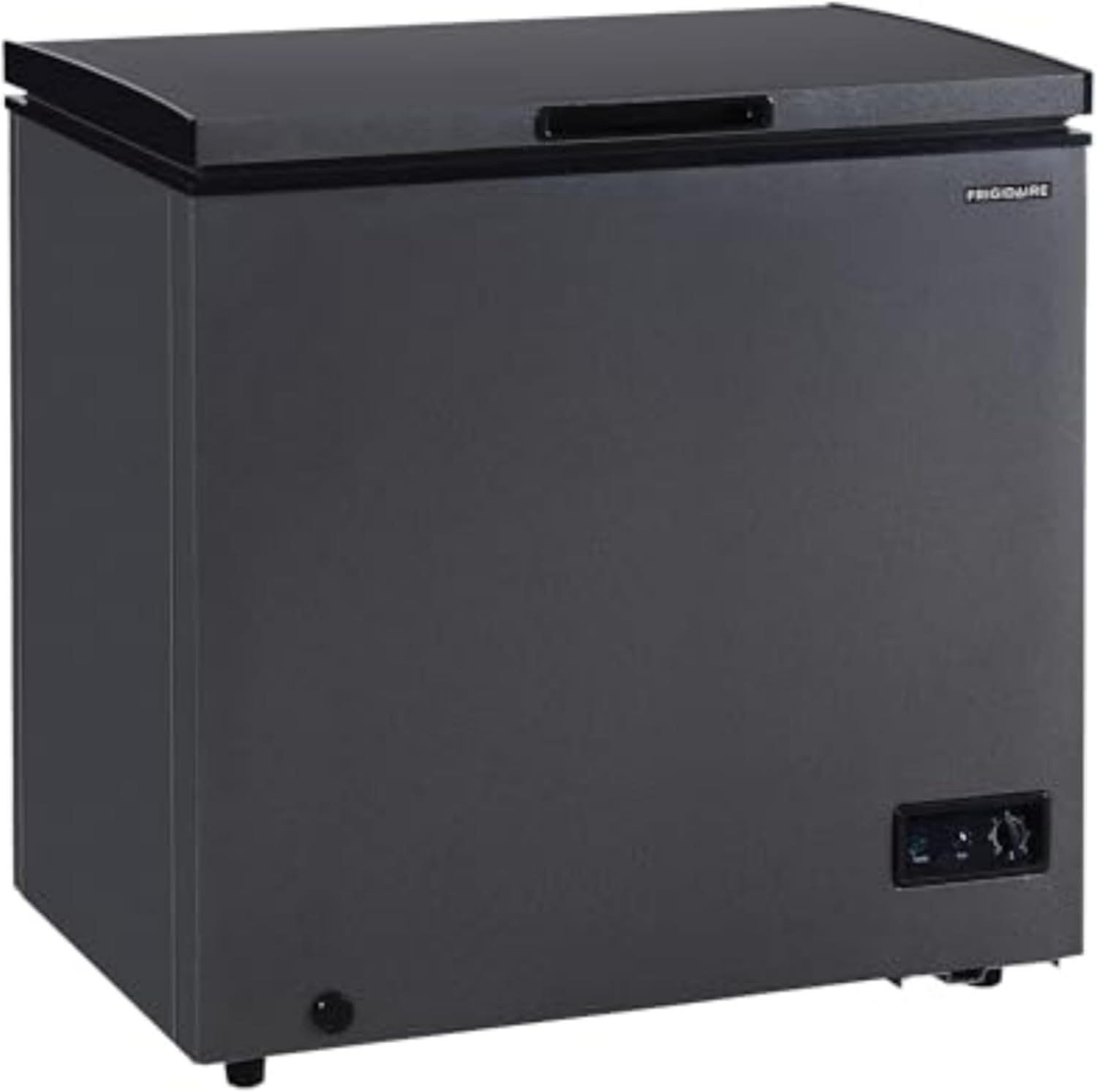
Large 7 cubic foot capacity enables effortless storage of favorite recipes, home groceries, and delicious foods in quantities that would overwhelm standard refrigerator-freezer combinations. This substantial volume accommodates bulk shopping from warehouse stores, seasonal harvests from gardens, or large meat purchases from farms and butchers. The capacity transforms food storage from constant space management struggle into simple abundance where everything fits comfortably without creative tetris-style packing.
Distinctive design features bespoke “Granita” textured finish that stands out aesthetically from standard appliances. This unique surface treatment creates visual interest while potentially offering practical benefits through texture that may resist fingerprints or minor impacts better than smooth finishes. The appearance consideration matters for freezers placed in visible locations rather than hidden in utility spaces where aesthetics prove irrelevant.
Well-designed practical features include interior drain plug and defrost drain mode simplifying the cleaning process that otherwise requires tipping or siphoning water from freezer interiors. This drainage system transforms defrosting from messy, frustrating chore into manageable maintenance task requiring minimal effort. The compressor indicator light provides visual confirmation of operational status, while adjustable exterior thermostat enables perfectly freezing any food types including seasonal harvests, meats, and prepared meals without opening the freezer and releasing cold air.
Compact footprint despite large internal capacity creates surprisingly efficient space utilization ideal for small spaces where floor area comes at premium. The low profile footprint maximizes storage density, providing substantial capacity without dominating rooms or interfering with other space uses. This efficiency makes the freezer practical even in constrained garages, basements, or utility rooms where space limitations might otherwise preclude adequate frozen storage.
1. Midea Chest Freezer
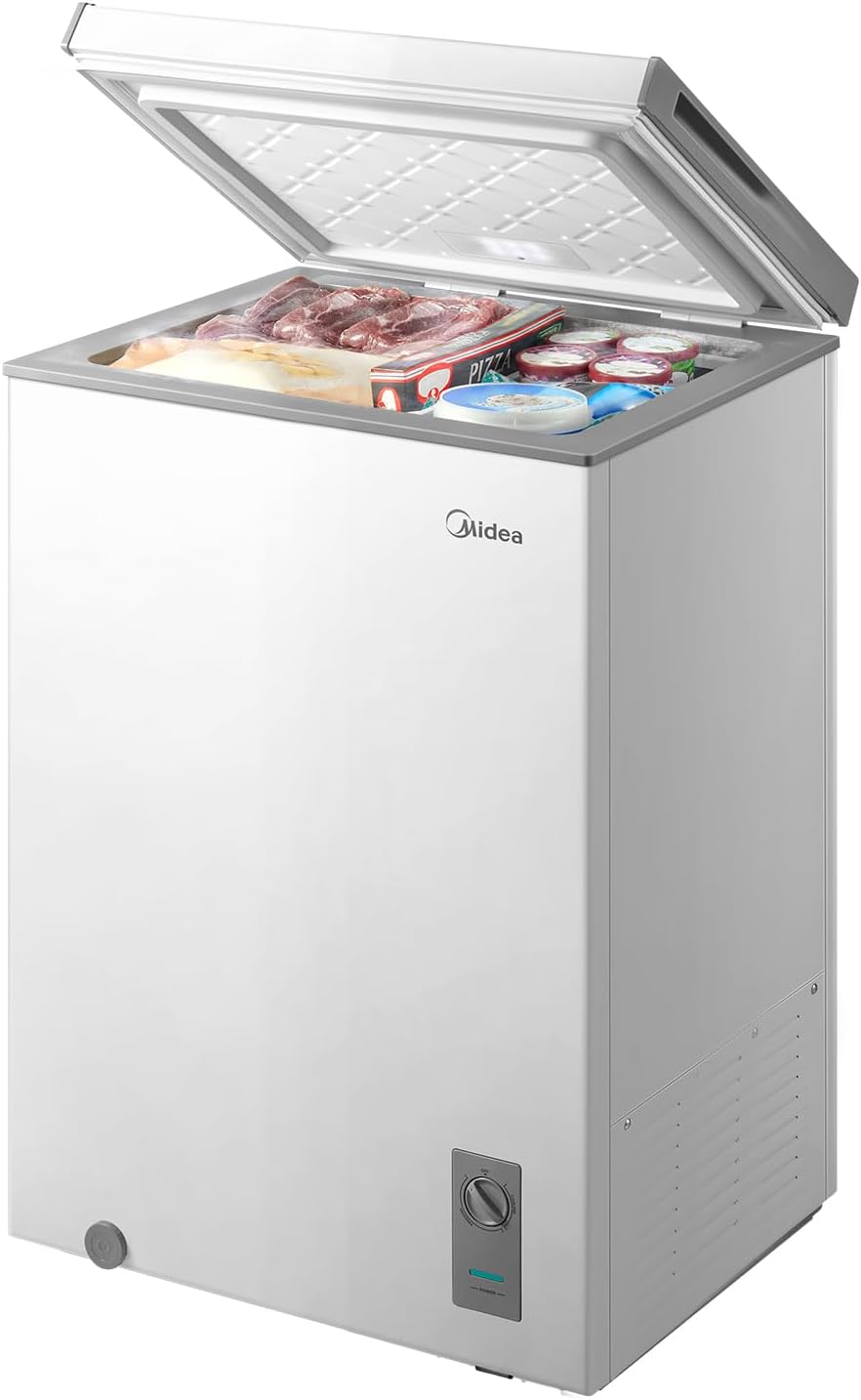
Large storage capacity offers ample space for frozen or fresh foods, working perfectly as secondary freezer for garages or basements supplementing main kitchen appliances. The 3.5 cubic foot volume provides meaningful expansion of household frozen storage without overwhelming available space—ideal sizing for most families’ supplemental storage needs. This capacity level suits typical bulk shopping, harvest preservation, or meal prep batch cooking that generates frozen inventory exceeding primary freezer capacity.
Convertible functionality represents significant advantage through easy mode switching between freezer and refrigerator operation matching ever-changing food storage needs. This flexibility enables using the appliance as freezer during hunting seasons or harvest periods requiring maximum frozen capacity, then converting to refrigerator mode when hosting events demanding beverage cooling or when seasonal needs shift. The dual-mode capability essentially provides two appliances’ functionality from single purchase and floor space allocation.
Garage-ready design emerges through engineering and testing ensuring efficient operation in non-climate-controlled environments. The unit functions reliably across temperature ranges from 38°F to 110°F in refrigerator mode and 0°F to 110°F in freezer mode, accommodating the temperature extremes common in uninsulated garages, sheds, or outdoor storage areas. This environmental tolerance eliminates concerns about freezer failures during summer heat or winter cold that disable appliances designed only for climate-controlled indoor spaces.
Power outage protection maintains items frozen up to 48 hours after losing electricity—critical capability preventing food loss during storm-related outages or planned maintenance events requiring temporary power disconnection. The exceptional insulation preserving cold temperatures transforms potentially catastrophic food loss into manageable inconvenience giving users two-day windows for power restoration or alternative cold storage arrangements. Considerable design features include adjustable legs enabling height customization for any placement scenario, removable plastic basket simplifying food storage organization, and exterior control panel allowing temperature monitoring and adjustment without opening the lid and releasing precious cold air that increases energy consumption and warm-up times.
The Ultimate Guide to Chest Freezers: Capacity, Efficiency, and Selecting Your Ideal Food Preservation Solution
Chest freezers have become essential appliances for households pursuing food cost savings through bulk purchases, preserving garden harvests, or simply needing additional frozen storage beyond cramped refrigerator-freezer compartments. These dedicated freezing appliances maintain colder, more consistent temperatures than combination units while offering superior energy efficiency and capacity-to-footprint ratios. Understanding capacity requirements, efficiency specifications, and practical features that impact daily use enables selection of chest freezers that optimize food preservation while fitting available space and operating budgets. This comprehensive guide explores everything necessary for choosing chest freezers delivering reliable, cost-effective frozen storage through decades of operation.
Understanding Chest Freezer Capacity
Size Classification Standards
Chest freezers typically range from compact 3.5 cubic foot models to large 20+ cubic foot commercial-scale units. Small freezers under 5 cubic feet suit individuals, couples, or supplemental storage for small families, holding approximately 125-175 pounds of food. Medium 5-9 cubic foot freezers accommodate average family needs, storing 175-315 pounds. Large 10+ cubic foot models serve big families, bulk shoppers, or hunters/gardeners preserving substantial harvests, with capacities exceeding 350 pounds.
The appropriate size depends on household size, shopping patterns, and storage purposes. Families buying weekly from conventional grocery stores need less capacity than bulk shoppers visiting warehouse stores monthly or gardeners freezing summer produce for winter consumption. Undersizing frustrates through inadequate capacity that defeats the purpose, while oversizing wastes floor space and energy maintaining partially empty freezers. Honest assessment of actual storage needs prevents both extremes.
Capacity vs. Footprint Efficiency
Chest freezers offer superior storage efficiency compared to upright freezers—their top-opening design eliminates door shelving and maximizes usable internal volume. A 7 cubic foot chest freezer occupies roughly 2×3 feet of floor space while providing capacity matching 10-12 cubic foot upright models requiring similar floor area but utilizing vertical space less efficiently. This efficiency matters tremendously in space-constrained basements, garages, or utility rooms where floor area limits capacity more than ceiling height.
The downside involves accessibility—items at chest freezer bottoms require removing upper layers, creating potential for food being forgotten and wasted. Organizational systems including hanging baskets and dividers partially mitigate this challenge by keeping frequently accessed items within easy reach. The capacity efficiency generally outweighs accessibility inconvenience for users prioritizing maximum storage from limited floor space.
Temperature Management and Control
Manual vs. Automatic Defrosting
Manual defrost freezers require periodic user intervention to remove frost buildup that gradually reduces capacity and efficiency. This maintenance occurs perhaps 1-2 times annually depending on usage patterns and humidity levels, involving unplugging the freezer, removing contents to temporary cold storage, and allowing ice to melt before wiping dry and restarting. The process proves inconvenient but enables maintaining perfectly consistent temperatures without defrost cycle warm-ups.
Automatic defrost systems periodically warm slightly to melt accumulated frost before resuming normal operation. This convenience eliminates manual defrosting but causes temperature fluctuations potentially affecting food quality during extended storage. The warming cycles can promote freezer burn or quality degradation in sensitive items stored long-term. Most chest freezers employ manual defrost since capacity and temperature consistency matter more than convenience for their typical applications.
Temperature Range and Adjustability
Quality chest freezers maintain temperatures from 0°F to negative 10°F or lower, with adjustable thermostats enabling customization to specific storage needs. Deep freeze settings preserve food quality longest but consume more energy, while moderate settings around 0°F provide adequate preservation with better efficiency. Some advanced models offer dual-zone capability with separate temperature controls for different freezer sections, though this sophistication remains rare in chest freezers.
The thermostat accessibility impacts convenience significantly—exterior controls enable adjustment without opening freezers and releasing cold air, while interior controls require opening lids to access. This seemingly minor detail affects energy efficiency since each lid opening releases cold air requiring replacement, increasing operating costs over time. The inconvenience also makes users less likely to optimize settings for different seasons or storage contents.
Energy Efficiency Considerations
Energy Star Certification
Energy Star certified chest freezers meet strict efficiency guidelines, typically consuming 10-15 percent less electricity than standard models while maintaining equivalent cooling performance. The certification indicates careful engineering optimizing insulation thickness, compressor efficiency, and seal quality to minimize energy waste. The initial price premium for Energy Star models typically recovers within 2-3 years through reduced operating costs, with continued savings accumulating throughout the appliance’s 10-20 year lifespan.
Electricity costs compound dramatically over decades of 24/7 operation—a freezer consuming 50 watts extra draws an additional 438 kilowatt-hours annually, costing roughly $50-75 per year depending on local electricity rates. Over 15 years, this difference totals $750-1125, potentially exceeding the appliance’s initial purchase price. Energy efficiency deserves heavy consideration during selection, though capacity, features, and reliability matter equally for overall value.
Climate and Placement Impact
Ambient temperature dramatically affects freezer efficiency—units in 90°F garages work substantially harder than those in 60°F basements, potentially increasing energy consumption 30-50 percent. This efficiency penalty makes climate-controlled indoor placement attractive when possible, though garage or basement installation often proves necessary when indoor space cannot accommodate additional appliances. “Garage ready” models engineered for temperature extremes maintain efficiency better in harsh environments than standard models designed assuming climate-controlled operation.
Placement near heat sources like furnaces, water heaters, or direct sunlight further increases cooling loads and energy consumption. Providing adequate ventilation around freezers—several inches clearance on all sides—improves efficiency by enabling proper heat dissipation from compressor and condenser coils. These placement considerations cost nothing but deliver meaningful efficiency improvements through reduced operating costs and extended compressor life from reduced workload.
Essential Practical Features
Organization Systems
Removable storage baskets create separate zones for frequently accessed items, preventing them from sinking to freezer bottoms beneath seldom-used contents. These baskets typically hang from freezer lips or rails, remaining accessible without excavating through entire freezer contents. The organizational benefit proves substantial for households with diverse frozen inventory requiring different access frequencies. However, baskets consume vertical space that could otherwise hold stacked items—the trade-off between organization and raw capacity affects different users variably.
Dividers or additional baskets enable creating multiple zones segregating meats, vegetables, prepared meals, and other categories. This categorization speeds item location while preventing cross-contamination concerns from raw meats contacting other foods. Some freezers include lighting illuminating interiors for better visibility, though this feature remains uncommon in chest freezers where top-opening designs naturally admit room lighting.
Defrost Drain Systems
Drain plugs or built-in drainage systems dramatically simplify defrosting and cleaning by channeling melt water to designated outlets rather than requiring sponging or bailing water from freezer bottoms. The drain location and hose compatibility determine whether water can discharge directly to floor drains or requires collection containers. This seemingly mundane feature transforms messy, time-consuming maintenance into straightforward procedures requiring minimal effort.
Freezers lacking drainage systems require tipping to pour water out or sponging water with towels—approaches proving difficult with heavy appliances or in spaces where floor moisture causes concerns. The drainage feature justifies modest price premiums for users maintaining freezers themselves rather than hiring service professionals for periodic maintenance.
Durability and Construction Quality
Insulation Thickness
Insulation quality determines both energy efficiency and cold retention during power outages. Thick foam insulation—2 inches or more—maintains internal temperatures substantially longer during electrical failures, potentially preserving food through brief outages that would thaw contents in poorly insulated units. The same insulation reduces compressor runtime during normal operation by slowing heat infiltration, lowering energy costs while extending compressor life through reduced cycling.
Cabinet construction quality affects long-term durability—heavy-gauge steel resists denting and rust better than thin sheet metal that dents easily and may corrode in humid environments. Powder-coated or vinyl-coated wire baskets resist rust more effectively than bare metal that oxidizes in freezer’s humid environment. These quality indicators suggest overall build quality predicting reliable long-term operation versus premature failures requiring replacement.
Compressor Quality and Warranty
Compressor represents the most critical and expensive freezer component—failure typically means appliance replacement rather than economical repair. Quality manufacturers use proven compressor designs from established suppliers with track records of reliable operation through millions of units. Extended warranties specifically covering compressors indicate manufacturer confidence in component reliability, while short warranties suggest potential quality concerns.
Noise levels vary considerably between compressor designs and installation quality—well-engineered freezers operate nearly silently while budget models generate noticeable humming or vibration. The noise consideration matters primarily for freezers in living spaces where sound intrudes, proving largely irrelevant for garage or basement installations away from occupied areas. Testing freezers in stores rarely reveals operational noise since display floor ambient noise masks appliance sounds—user reviews provide better noise assessment from home installation experiences.
Specialized Features and Considerations
Convertible Freezer/Refrigerator Modes
Some advanced chest freezers convert between freezer and refrigerator operation, providing flexibility for changing storage needs. This capability enables using the appliance as seasonal refrigerator during entertaining when beverage cooling needs spike or converting to freezer mode during hunting seasons or harvest times requiring maximum frozen capacity. The dual-mode functionality essentially provides two appliances from single purchase, though users rarely switch modes frequently enough to fully exploit the capability.
The convertible feature typically adds significant cost compared to dedicated freezers, making economic sense only for users who will genuinely utilize both modes rather than setting once and leaving indefinitely. Temperature range in refrigerator mode usually spans typical refrigeration temperatures of 32-50°F, adequate for most cold storage needs beyond deep freezing.
Power Outage Protection
Insulation quality determines how long freezers maintain safe food storage temperatures during power outages—quality chest freezers may preserve frozen conditions 24-48 hours depending on ambient temperature and how frequently lids open. This thermal retention provides valuable buffer time for power restoration or relocating contents to alternate cold storage. Some models include alarm systems alerting users to temperature rises indicating power loss or mechanical failures, enabling intervention before complete food loss occurs.
The power outage resilience proves particularly valuable in storm-prone regions or areas with unreliable electrical infrastructure where extended outages occur periodically. This capability can save hundreds of dollars in food by preventing total loss during weather events, potentially justifying premium pricing for superior insulation even beyond ongoing energy savings.
Making Your Optimal Selection
Realistic Capacity Assessment
Determining appropriate freezer size requires honest evaluation of actual storage needs rather than wishful thinking about ideal situations. Tracking current freezer usage—how full it typically remains and whether items get frozen in refrigerator compartments or discarded from lack of space—reveals whether supplemental capacity would get utilized. Buying substantially more capacity than needed wastes floor space and energy maintaining empty freezer volume, while undersizing defeats the purpose through continued space constraints.
Consider future needs alongside current requirements—growing families need more capacity over time, while empty nesters may need less. Buying slightly larger than immediate needs accommodates gradual expansion in frozen inventory without requiring premature replacement. However, buying dramatically oversized freezers anticipating possible future needs often results in perpetually underutilized capacity wasting resources.
Budget Balancing Initial Cost and Operating Expenses
Chest freezer pricing ranges from $150 for basic small models to $600+ for premium large units with advanced features. The temptation to minimize initial cost often proves false economy when budget models consume substantially more electricity or fail prematurely. Calculating total cost of ownership including purchase price plus estimated energy costs over 10-15 year typical lifespans reveals true economic value beyond misleading focus on initial price alone.
Energy-efficient models costing $50-100 more initially typically recover that premium within 2-4 years through reduced operating costs, then continue delivering savings throughout remaining lifespan. Similarly, quality construction costing modestly more likely operates reliably for 15-20 years while budget models may fail after 5-8 years, requiring replacement purchases negating any initial savings. Focusing on lifetime value rather than just purchase price leads to better long-term satisfaction and economy.
The ideal chest freezer balances adequate capacity against available space while optimizing energy efficiency and incorporating practical features that simplify operation and maintenance without unnecessary complexity. Whether seeking supplemental storage for bulk shopping, preserving garden harvests, or expanding frozen inventory for large families, understanding how specifications and features impact real-world food preservation enables confident decisions. This investment in dedicated frozen storage delivers returns through reduced food costs, decreased waste, and increased meal planning flexibility that transforms household food management for years or decades of reliable service.