Finding the Best Home Theater Projector that delivers cinema-quality visuals without requiring darkroom conditions or professional installation shouldn’t mean sacrificing smart features or settling for complicated setup procedures. Washed-out images, frustrating manual adjustments, and limited streaming options plague budget projectors—yet navigating brightness specifications, resolution claims, and smart platform differences creates overwhelming technical confusion. This comprehensive guide explores five exceptional home theater projectors engineered to transform living spaces into immersive entertainment centers, featuring intelligent auto-adjustment and integrated streaming that work reliably without requiring videophile expertise or extensive calibration knowledge.
Contents
5. Voplls G3

Smart entertainment ecosystem powered by Google TV AI transforms content discovery through intelligent home screen organization of movies, shows, and live programming based on viewing habits. The system pushes tailored recommendations directly to the 4K projector, learning preferences over time for increasingly accurate suggestions. Personalized profile creation enables separate watch history and recommendations per user—perfect for bedroom projectors and camping use during family trips where different family members have distinct preferences. Essential kid-safe mode provides content rating filters, viewing time limits, and bedtime lock screen activation protecting children from inappropriate content while managing screen time without constant parental monitoring.
Hands-free voice command functionality enables natural speech control through simple microphone button presses on the home theater projector remote. Users command content naturally—”Play Stranger Things on Netflix,” “Lower volume,” or “What’s the weather?”—with built-in Google Assistant understanding context perfectly. The voice capabilities extend beyond basic play/pause to searching movies across apps, launching Netflix directly, and controlling smart features completely hands-free. This convenience proves perfect for bedroom viewing, outdoor movie nights, and camping trips where fumbling with remotes in darkness becomes frustrating.
Powerful 2000 ANSI brightness delivers vividly brighter viewing experiences even in partially lit environments where lesser projectors fade into unwatchability. Movie theater-quality visuals emerge through stunning HDR10 clarity producing deep blacks retaining texture while bright scenes maintain vibrance without blown-out highlights. The projector supports 4K input displaying native 1080p resolution—ideal for backyard movie nights and indoor viewing. Wide 98 percent color coverage delivers Hollywood-grade color reproduction rivaling premium televisions. The sleek portable body rotates 360 degrees projecting onto ceilings or angled patio screenings, perfect for camping trips and outdoor portable movies requiring flexible positioning.
Gaming and indoor professional picture quality benefit from self-adjusting perfection eliminating manual adjustments entirely. Simply point the room projector anywhere for instant magic through auto focus producing crisp images within seconds even after bumps, auto keystone correcting tilted frames automatically, smart avoidance dodging wall outlets and photo frames, screen fit snapping perfectly to projection screens, and digital zoom providing 50-100 percent size flexibility. PS5 and Switch connections via HDMI port enable lag-free gaming experiences. Installation flexibility includes desktop, wall-mount, tripod, or ceiling mounting options. Moving mid-movie triggers self-realignment completing before popcorn refills finish. Dolby Atmos and Bluetooth 5.2 bidirectional technology ensures lossless audio/video synchronization. Movie mode delivers Dolby Atmos via dual speakers—thunder rumbles from floor to ceiling with crystal-clear dialogue for home theater immersion. Party mode instantly switches to Bluetooth speaker functionality without screen requirements for playlist enjoyment. Late-night viewing accommodates zero-lag wireless headphone pairing compatible with iPhone and Android devices, eliminating noise complaints in apartments.
4. BenQ HT2060

LED vibrant colors with high contrast stem from LED technology’s long lamp life producing rich DCI-P3 and 98 percent Rec.709 color coverage performance. The projector’s HDR10 and HLG compatibility produces deeper blacks revealing fine details in dark scenes that lower-contrast projectors completely obscure. This color accuracy and contrast performance create cinematic experiences rivaling premium televisions at substantially larger screen sizes. The LED light source eliminates the lamp replacement costs and gradual dimming plaguing traditional bulb-based projectors, maintaining consistent brightness through thousands of hours.
Versatile entertainment capabilities enable using the projector as TV replacement or dedicated gaming display, creating best-in-class immersive experiences regardless of content source. Whether watching movies, streaming shows, or gaming on large screens, the projector delivers engaging visuals that make smaller televisions feel inadequate by comparison. The 2200-lumen brightness ensures usability in partially lit rooms rather than requiring complete darkness that limits viewing flexibility.
Universal connectivity through dual HDMI 2.0 ports and S/PDIF supporting 5.1 channel audio output accommodates multiple source devices simultaneously without constant cable swapping. The comprehensive connectivity eliminates the single-input limitations forcing choosing between game consoles, streaming devices, or media players during setup. Low latency specifications of 16.7ms at 1080p 60Hz and 33.4ms at 4K 60Hz (downscaling to 1080p 60Hz) provide smooth gameplay without the input lag making fast-paced gaming frustrating on high-latency displays. This gaming performance makes the projector legitimate option for competitive gaming rather than just casual play.
Superior audio emerges from built-in 5Wx2 chambered speakers featuring projector-optimized design in placement, direction, angle, and sound output. The integrated audio eliminates external speaker requirements for casual viewing, though audiophiles may prefer connecting dedicated sound systems through S/PDIF outputs. The vertical lens shift, keystone correction, and 1.3x zoom provide installation flexibility accommodating various room configurations without perfect projector positioning.
3. WiMiUS G1

Content discovery simplifies through Google Ecosystem utilizing AI and viewing habits to recommend content across all subscriptions, eliminating the stress of finding entertainment among overwhelming options. Users discover next favorite shows effortlessly through intelligent algorithms learning preferences over time. Sports fans benefit from “For You” sports tabs helping quickly find live and upcoming games with personalized recommendations staying current with favorite teams and events. This curated approach transforms aimless browsing into directed discovery.
Hands-free voice assistant with virtual control and casting enables using voice alone to search content, control playback, check weather, or adjust volume without touching remotes. Phone keyboards or Google Home app facilitate navigating and typing show names easily, eliminating tedious remote-based text entry. Displaying favorite Google Photos memories on screen or casting content directly from phones or tablets provides ultimate WiFi 6 wireless experiences connecting personal devices to big-screen viewing seamlessly.
Multi-user profiles with child mode accommodate families sharing single projectors through separate user accounts maintaining individual watchlists and viewing histories. Kids Mode creates safe spaces by selecting approved apps, setting screen time limits, and establishing bedtime cutoffs giving parents control without constant supervision. Whether backyard movie nights, camping, or cartoon viewing, everyone receives personalized lists matching individual preferences rather than shared watch histories creating conflicts.
Three-level brightness with 4K support and HDR10 delivers clear, vibrant visuals through native 1080p and 4K support offering deeper blacks, brighter whites, and enhanced detail. Google TV provides three brightness modes including High Brightness mode plus five picture presets. ECO mode reduces noise and power consumption for quiet evening viewing. Perfect for indoor and outdoor use without exaggerated brightness claims—specifications match real-world performance. Note that 4K-labeled videos display at native 1080p resolution, commonly termed “4K supported,” with best viewing in dim or dark environments rather than daylight conditions.
Intelligent AI auto screen adjustment delivers truly seamless experiences through auto focus, auto keystone correction, smart obstacle avoidance, smart screen alignment, and 50-100 percent zoom. Unlike competitors claiming “smart” features while relying on manual or motorized focusing, this projector genuinely automates adjustments. Additional features include sleep timers and customizable settings easily switchable for parties, presentations, or gaming scenes without manual reconfiguration.
2. WiMiUS P62

Market-tested reliability distinguishes this projector as WiMiUS’s first video projector with auto-focus and auto-keystone correction, focusing on core functionality upgrades rather than gimmicky features. Return rates lower than industry averages plus highest satisfaction ratings within the brand ensure reliability and quality. Auto-focus and 6D auto-keystone technology eliminate troublesome manual adjustments—enjoy clear rectangular pictures within 5 seconds of startup. Built-in displacement sensors continuously detect projector movement, maintaining seamless image clarity even when bumped or repositioned during viewing.
Native 1080p with 700 ANSI and 20,000:1 contrast ratio delivers upgraded brightness and wider color gamut through enhanced lumens and contrast specifications. This results in massive increases in color volume producing vivid, detailed visuals. Native 1080p resolution with 4K video support restores full video quality providing excellent shadow details. The projector offers true home theater experiences ideal for outdoor movie nights, sports viewing, or binge-watching final seasons. Note that 4K-labeled videos display at native 1080p resolution, commonly termed “4K supported” in marketing.
WiFi 6 technology represents industry-first implementation in projector category, offering compatibility with both 2.4GHz and 5GHz networks at maximum rates up to 9.6Gbps. Seamless screen casting from iOS via AirPlay and Android/Windows through Miracast enables reliving family moments by sharing photos and videos on big screens effortlessly. The projector strives minimizing latency during gaming on Nintendo Switch or PS5, addressing the input lag concerns making some projectors unsuitable for responsive gaming.
Upgraded Bluetooth 5.2 and Hi-Fi built-in speakers feature latest Bluetooth chips supporting stable connections to various external speakers. Built-in 12-watt stereo speakers deliver immersive, powerful sound adequate for casual viewing. Latest firmware updates enable HDMI ARC support on HDMI 2 ports, simplifying soundbar connections without additional audio cables—addressing the complicated audio routing making some home theater installations frustrating.
1. Happrun H1
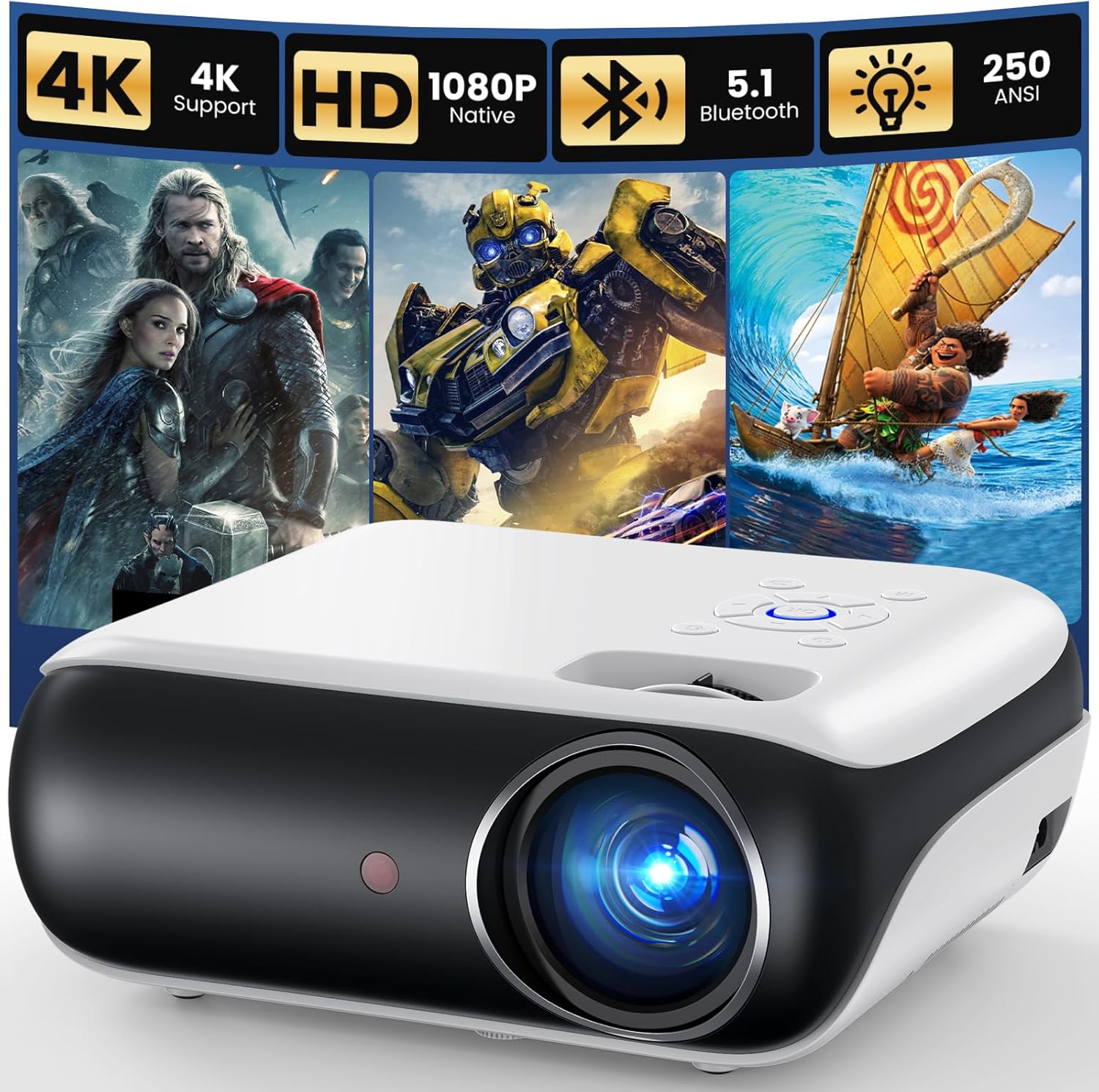
Native 1080p full HD resolution delivers crystal-clear visuals through genuine 1920×1080 native resolution producing sharper, brighter, and more vibrant images for immersive viewing experiences. This true 1080p projector proves perfect for creating stunning home theater or bedroom projector setups without the resolution compromises afflicting “1080p supported” models that actually display lower native resolutions. The genuine full HD capability ensures text remains readable and fine details stay visible rather than blurring into pixel mush.
Bluetooth 5.1 technology enables connecting to Bluetooth speakers for richer, more powerful sound experiences, or pairing with headphones for private, immersive viewing without disturbing others. Perfect for both shared movie nights and personal entertainment, this smart projector proves great Bluetooth projector option for iPhone users seeking wireless audio flexibility. The Bluetooth connectivity eliminates the wired audio limitations forcing positioning speakers near projectors regardless of optimal placement for sound quality.
Built-in Hi-Fi stereo speakers deliver rich, crystal-clear sound adequate for small bedrooms or cozy movie nights, providing powerful audio bringing movies, shows, and games to life without external speaker requirements. This small projector proves ideal as bedroom projector or outdoor projector where full audio systems would prove impractical or excessive. The integrated audio quality exceeds typical projector speakers that produce tinny, inadequate sound requiring immediate external speaker purchases.
Seamless compatibility with TV sticks enables effortless integration with popular streaming devices like Fire TV Stick, Chromecast, and similar platforms, offering access to vast libraries of streaming content. Users enjoy premium viewing experiences rivaling high-end televisions at fraction of costs. This streaming stick compatibility transforms basic projectors into smart entertainment hubs without requiring built-in smart platforms that may become outdated as streaming services evolve.
The Ultimate Guide to Home Theater Projectors: Image Quality, Smart Features, and Selecting Your Perfect Entertainment Display
Home theater projectors have evolved from expensive luxury items into accessible entertainment solutions delivering cinematic experiences at television-comparable pricing. Modern projectors balance impressive brightness, smart features, and automatic setup assistance that earlier generations couldn’t match, making large-screen home cinema practical for average households rather than just dedicated enthusiasts. Understanding brightness specifications, resolution realities, and smart platform differences enables selection of projectors that genuinely enhance entertainment rather than disappointing through overhyped specifications. This comprehensive guide explores everything necessary for choosing home theater projectors delivering theater-quality experiences without requiring professional installation or extensive technical knowledge.
Understanding Brightness and Image Quality
ANSI Lumens vs. Marketing Claims
ANSI lumen ratings represent standardized brightness measurements more reliable than generic “lumen” claims that may inflate actual output substantially. Quality projectors specify ANSI lumens ranging from 500-3000 for home theater use, with higher ratings enabling viewing in brighter ambient lighting. However, brightness alone doesn’t guarantee quality images—proper contrast ratios and color accuracy matter equally for cinematic experiences. Excessively bright projectors without adequate contrast produce washed-out images lacking the depth and punch making movies engaging.
The viewing environment dramatically affects required brightness. Dedicated dark home theaters function excellently with 500-1000 ANSI lumens, while living rooms with windows require 1500-2500 ANSI lumens maintaining image visibility during daytime viewing. Outdoor projectors need maximum brightness combating ambient light from street lights, moon, or surrounding buildings. Understanding actual usage environments prevents over-buying excessive brightness wasted in dark rooms or under-buying inadequate brightness creating disappointment in typical viewing conditions.
Native Resolution vs. “Supported” Resolution
Native resolution indicates actual pixel count projectors physically display, while “supported” resolution merely means projectors accept that input before downscaling to native resolution. A projector claiming “4K supported” while displaying native 1080p actually shows 1080p images regardless of 4K source material—the “supported” language misleads uninformed buyers expecting true 4K quality. Genuine native 1080p (1920×1080) projectors deliver sharp, detailed images adequate for most home theater applications at screen sizes up to 120 inches.
True 4K projectors displaying native 3840×2160 resolution cost substantially more but provide noticeably sharper images on very large screens or when sitting close to projection surfaces. The question becomes whether the sharpness improvement justifies potentially doubled or tripled pricing compared to quality 1080p alternatives. For typical 10-12 foot viewing distances with 100-120 inch screens, native 1080p proves perfectly adequate while 4K becomes more compelling at closer distances or larger screen sizes.
Smart Platform Integration
Google TV vs. External Streaming Devices
Built-in Google TV platforms integrate streaming services directly into projectors, eliminating external device requirements while providing AI-powered content recommendations across services. The unified interface simplifies finding content without switching between devices or inputs, while voice control enables hands-free operation through Google Assistant integration. However, built-in smart platforms may become outdated as streaming services evolve, potentially requiring external streaming sticks anyway after several years.
External streaming devices like Fire TV Stick or Chromecast provide regularly updated platforms easily replaced when better options emerge without replacing entire projectors. This approach separates display hardware from smart platform software, preventing smart platform obsolescence from rendering otherwise functional projectors outdated. The trade-off involves additional device complexity and potential HDMI port consumption, though many users prefer this flexibility over integrated platforms with uncertain longevity.
App Availability and Licensing
Official app licensing matters tremendously for streaming services—particularly Netflix, which restricts unauthorized implementations. Projectors with official Netflix licensing provide native apps with full feature support, while unlicensed projectors require external streaming devices or casting from phones. The licensing ensures reliable, high-quality streaming rather than workarounds that may break with service updates. Verifying official licensing for essential streaming services prevents discovering favorite platforms require complicated workarounds or remain completely inaccessible.
Voice control quality varies between implementations—some respond accurately to natural speech while others require specific phrasing or struggle with accents and background noise. Testing voice features during return periods reveals whether marketing claims match real-world functionality or whether traditional remote control proves more reliable than frustrating voice recognition.
Automatic Setup and Adjustment Features
Auto Focus and Keystone Correction
Auto focus eliminates the manual focus adjustment typically requiring trial-and-error turning focus rings while evaluating image sharpness. Quality autofocus systems achieve crisp images within seconds, even after projector movement or bumps during viewing. This automation proves particularly valuable for portable projectors frequently repositioned between uses, where manual focusing would become tedious chore discouraging regular use. However, autofocus reliability varies—some systems hunt endlessly without locking while others nail focus consistently on first attempt.
Auto keystone correction automatically adjusts for projector tilt or angle relative to projection surfaces, preventing the trapezoidal distortion requiring manual correction on simpler projectors. Advanced systems correct both vertical and horizontal keystone simultaneously (6D correction), plus compensate for complex angles that single-axis correction cannot address. This automation enables placing projectors wherever convenient rather than requiring precise alignment perpendicular to screens, dramatically simplifying setup and enabling flexible positioning matching room layouts.
Screen Fitting and Obstacle Avoidance
Smart screen fitting automatically detects projection screen edges and adjusts image size matching perfectly without overshooting boundaries—particularly valuable for permanently mounted screens where precise alignment proves tedious manually. Obstacle avoidance detects objects like wall outlets, light switches, or pictures that would partially obstruct projections, automatically shifting images avoiding these obstacles without manual repositioning. These intelligent features distinguish truly smart projectors from basic models claiming smart capabilities while still requiring extensive manual adjustment.
Digital zoom enables resizing images from 50-100 percent without moving projectors—useful for matching various screen sizes or adjusting when precise projector positioning proves difficult. However, digital zoom reduces effective resolution since pixels simply enlarge rather than adding detail, so native sizing without zoom produces sharpest images. The zoom proves most valuable for minor size adjustments rather than dramatic changes that significantly degrade image quality.
Audio Considerations
Built-in Speaker Quality
Integrated speakers range from barely adequate emergency options to surprisingly capable audio systems eliminating external speaker needs for casual viewing. Typical projector speakers produce 5-15 watts total output—adequate for small bedrooms or apartments but insufficient for large rooms or immersive movie experiences. Quality implementations position speakers optimally considering projector placement, angling sound toward viewing areas rather than blasting at walls behind projection surfaces. The speaker quality should set realistic expectations—integrated audio suffices for convenience but dedicated speakers dramatically improve experiences for serious home theater enthusiasts.
Bluetooth audio enables connecting wireless speakers or headphones, providing flexibility external wired connections cannot match. Quality Bluetooth implementations using version 5.0+ specifications provide stable connections with minimal latency avoiding the lip-sync problems plaguing older Bluetooth versions. The wireless headphone capability proves particularly valuable for late-night viewing in apartments or shared living situations where external speaker volume would disturb others. However, Bluetooth introduces slight delays potentially noticeable during gaming where instant audio feedback proves essential.
HDMI ARC and External Audio Systems
HDMI ARC (Audio Return Channel) support simplifies connecting soundbars or AV receivers, sending audio through same HDMI cables carrying video rather than requiring separate audio connections. This single-cable solution reduces setup complexity while ensuring audio and video synchronization. Not all projectors support ARC despite including HDMI ports—verifying this feature prevents discovering complicated audio routing becomes necessary after purchase.
S/PDIF optical audio outputs enable connecting to home theater receivers or soundbars, providing digital audio quality surpassing analog connections. The optical connection supports multi-channel audio formats including Dolby Digital and DTS, creating immersive surround sound experiences impossible through stereo connections. Serious home theater builders should prioritize projectors with comprehensive audio output options supporting their preferred external audio systems.
Installation and Portability
Mounting Options and Flexibility
Mounting versatility enables ceiling mounting for permanent installations, wall mounting for space-saving setups, desktop placement for temporary use, or tripod mounting for outdoor events. Quality projectors include standard mounting threads and clear installation guidance supporting these varied approaches. Ceiling mounting creates cleanest installations with projectors out of sight and cables hidden, though requiring permanent mounting hardware and potentially professional installation. Desktop or shelf placement provides easiest setup but occupies furniture space and potentially blocks walking paths.
Portable projectors prioritizing compact size and light weight enable carrying between rooms or outdoor locations, transforming single projector into multi-location entertainment solution. However, portability often compromises brightness, feature sets, or image quality compared to larger dedicated home theater models. The portability-performance trade-off forces choosing between versatile lightweight units or powerful stationary installations—rarely do projectors excel at both simultaneously.
Cable Management and Connectivity
HDMI port quantity determines how many devices connect simultaneously without swapping cables—dual HDMI enables connecting both streaming device and game console permanently. However, most users eventually exceed available ports regardless of quantity, making HDMI switches practical additions supporting three or more source devices. USB ports enable powering streaming sticks directly from projectors, eliminating separate power adapters reducing cable clutter. WiFi and Bluetooth connectivity minimize physical cables for streaming and audio, creating cleaner installations without networking or audio cable runs.
Cable routing through ceiling mounts or wall installations requires planning during installation—running cables after mounting completion proves substantially more difficult than pre-planning cable paths. Wireless connectivity partially addresses this challenge though cannot completely eliminate cables since power connections remain necessary regardless of wireless capabilities.
Making Your Optimal Selection
Room Size and Viewing Distance
Screen size and viewing distance determine optimal projector specifications. Small rooms with 6-8 foot viewing distances work well with native 1080p projectors on 80-100 inch screens, while large dedicated home theaters with 12-15 foot distances benefit from 4K resolution on 120-150 inch screens. Calculating appropriate screen sizes based on viewing distances prevents buying projectors unable to fill desired screen sizes or over-buying excessive brightness for small spaces.
Ambient light control affects achievable image quality regardless of projector quality. Rooms with blackout curtains or shades enable using less expensive projectors with moderate brightness, while rooms with uncontrolled windows require high-brightness projectors compensating for ambient light washing out images. Honestly assessing light control capabilities prevents disappointment when bright rooms overwhelm moderately bright projectors or darkness enables using less expensive models producing excellent results.
Budget and Feature Priorities
Home theater projector pricing ranges from $200 budget models to $3000+ premium units, with quality generally correlating to price though not perfectly. Ultra-cheap projectors typically deliver disappointing brightness, resolution, or reliability, while expensive models may provide marginal improvements over good mid-range options. The $400-800 range offers excellent value providing quality images and useful features without excessive premium pricing for minor enhancements.
Feature prioritization should reflect actual usage—smart platforms matter tremendously for users without external streaming devices but prove irrelevant for those already owning Fire TV Sticks or Apple TVs. Auto-adjustment features justify premium pricing for portable projectors frequently repositioned but waste money on permanently ceiling-mounted installations where one-time manual adjustment suffices. Focusing budgets on features matching specific usage rather than pursuing maximum feature counts regardless of utility delivers better satisfaction per dollar spent.
The ideal home theater projector balances image quality, smart features, setup convenience, and price into solutions matching specific viewing environments and usage patterns rather than attempting universal excellence across conflicting priorities. Whether seeking portable entertainment for outdoor movie nights, bedroom ceiling projection, or dedicated home theater installations, understanding how specifications translate into real-world viewing experiences enables confident decisions. This investment in large-screen entertainment delivers returns through enhanced movie enjoyment, gaming immersion, and sports viewing excitement that smaller televisions simply cannot match at comparable prices.